The Best Mobile Ad Networks for App Developers in 2026
Last Updated July 2026
Choosing the right mobile ad network or ad mediation platform can be the single biggest lever on your app’s revenue. This guide breaks down the top platforms – including CAS.AI, AdMob, AppLovin MAX, and Appodeal – across every metric that matters for independent developers and studios.
What is mobile app monetization?
Mobile app monetization is the process of generating revenue from a mobile app – typically through in-app advertising, in-app purchases, subscriptions, or a hybrid of all three. For most free-to-play mobile games and utility apps, mobile app monetization via advertising remains the dominant revenue model. The core challenge is maximizing eCPM without degrading the user experience.
The solution most professional studios have converged on is ad mediation – letting multiple ad networks compete for every impression in real time.
Key stat: The global in-app advertising market is projected to surpass $350 billion by 2026. Independent developers who use a best-in-class ad mediation platform consistently earn 40–100% more per user than those relying on a single network.
What is ad mediation and why does it matter?
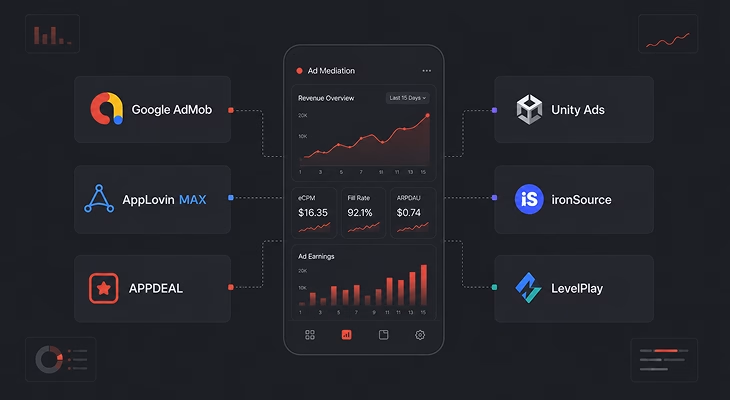
Ad mediation is a layer of software that sits between your app and multiple ad networks. Instead of filling every ad request with one network’s demand, an ad mediation platform runs a real-time auction – every network bids, and the highest CPM wins the impression.
What looks like a 15% eCPM uplift in a controlled test regularly becomes 50–100% in production, because different networks dominate different geos, device types, and time-of-day windows. Modern programmatic ad mediation and video ad mediation have made waterfall setups largely obsolete.
Quick definition: Hybrid mediation = real-time in-app bidding (header bidding) + waterfall fallback. All four platforms in this comparison use a hybrid approach.
Full platform comparison: best mobile ad mediation platforms in 2026
The table below is fact-checked by our ad tech editorial team. Data sourced from official documentation, developer dashboards, and direct publisher interviews.
| Feature |  CAS.AI CAS.AI |
 AdMob AdMob |
 AppLovin MAX AppLovin MAX |
 Appodeal Appodeal |
|---|---|---|---|---|
| Ownership | Independent | Google-owned | AppLovin-owned | Independent |
| Bidding model | Hybrid | Hybrid | Hybrid | Hybrid |
| Ad networks | 20+ top-tier (faster onboarding) | 25+ (some without optimisation) | 20+ | ~20+ |
| DSPs connected | 150+ | 150+ | 150+ | 150+ |
| Bid processing speed | 1M+ requests/sec | Not disclosed | Not disclosed | Not disclosed |
| Verified ARPU uplift | ×1.5–×2 (A/B tested) | Not claimed | Not claimed | +17% (claimed) |
| No-loss guarantee | Yes – covers diff | |||
| Apps on platform | 5,000+ | Millions | Not disclosed | Not disclosed |
| SDK downloads | 3B+ lifetime | N/A | N/A | N/A |
| Payout speed | From Day 5 (consolidated) | Net 21 | Net 15+ (networks pay separately) | On request |
| Crypto payouts | Yes | Yes | ||
| ANR / crash impact | Low (improves post-integration) | Varies | Varies | Varies |
| Human support | 24/7, real people | Ticket system | Ticket system | Responsive |
Platform-by-platform breakdown
CAS.AI: best for independent developers seeking maximum ARPU
CAS.AI is a fully independent ad mediation platform – not owned by any ad network or DSP. Its standout feature is a verified A/B-tested ARPU uplift of ×1.5–×2, backed by a no-loss guarantee: if your eCPM drops after switching, CAS.AI covers the revenue difference. With processing at over 1 million bid requests per second and SDK downloads exceeding 3 billion lifetime, the infrastructure is enterprise-grade.
Payouts begin on Day 5 in a single consolidated payment – compared to Net 21 on AdMob and fragmented per-network payments on MAX. Crypto payouts and 24/7 human support round out a publisher-first offer.
Google AdMob: largest network, slowest payouts
AdMob mediation eCPM benefits from Google’s enormous advertiser base. With 25+ ad networks connected, it has the broadest raw count in this comparison – though several operate without active optimization. The major trade-offs: Google-owned infrastructure creates potential conflicts of interest, payouts are Net 21, and ARPU uplift figures are not independently verified.
AppLovin MAX: strong for gaming, but publisher conflicts exist
AppLovin MAX is the dominant choice in the hyper-casual and casual gaming segment, partly because AppLovin is both a major advertiser and the platform operator. This dual role raises conflict-of-interest questions that independent publishers should weigh carefully. Payout terms are Net 15+, but networks pay publishers separately.
Appodeal: independent with crypto support
Appodeal is independent like CAS.AI and also supports crypto payouts. It claims a +17% ARPU uplift, though this figure is self-reported rather than independently A/B-tested. Payouts are available on request rather than on a fixed schedule.
Meta Audience Network: broad reach, standard terms
Meta Audience Network pulls in advertisers from outside Facebook and Instagram, which helps you reach people who are not already scrolling through Meta’s own apps. Payments show up around the 21st of each month, covering what you earned the month before. The minimum payout is $100, and everything comes in one tidy monthly deposit, much like AdMob.
InMobi: independent-adjacent, but a long wait
InMobi is known as one of the larger ad networks not run by Google or Meta. It has its own exchange and reaches deep into APAC and emerging markets. If you use InMobi, be ready to wait. Payments run on a Net 60 schedule, so you will not see your money for two months. The minimum payout is $300 if you want a wire transfer, or $50 if you use PayPal. That is a much longer wait than what you get from CAS.AI, AdMob, or AppLovin.
Chartboost: games-focused network, monthly payouts
Chartboost calls itself the biggest ad network built just for games, focusing on interstitial and rewarded ads for mobile. Payments go out once a month, but only if you have at least $300 in your account for a wire transfer. There is a flat $25 fee for wires, and if you are not paid in US dollars, expect a 3 percent conversion charge.
Vungle (Liftoff Monetize): Net 60, video-first
Vungle, now known as Liftoff Monetize, made its impact with video and rewarded ads. The payout schedule is the same as InMobi and Unity. You earn money in January, but you will not see it until the end of March. That is a Net 60 wait.
Mintegral: gaming and APAC-focused demand
Mintegral is a network with deep roots in China and the Asia-Pacific region, and it is known for playable and video ads in games. It acts more as a demand source than a direct rival to mediation platforms. I could not find a clear answer on their payout schedule, so it is best to check with Mintegral directly before quoting any numbers.
Pangle: ByteDance-owned, TikTok-adjacent demand
Pangle is ByteDance’s ad network, which means you get access to advertisers connected with TikTok. None of the other networks here can offer that. Pangle does not share exact payout dates, so it is worth clarifying with them before making any claims about when you will get paid.
Smaato: programmatic RTB layer, not a traditional network
Smaato is not your typical ad network. It serves as a real-time bidding platform, allowing programmatic buyers to access your inventory. Like Pangle, Smaato does not publicly disclose its payout schedule, so you will want to ask them directly before quoting any numbers.
DT FairBid: a mediation platform, not a single network
Before you go any further, keep in mind that DT FairBid from Digital Turbine is a mediation platform, not a single ad network. It sits in the same group as CAS.AI, AppLovin MAX, and Unity LevelPlay. If you want a true network-versus-network comparison, DT FairBid should probably be in its own section for mediation platforms. Otherwise, you are mixing up single ad sources with platforms that pull from many networks.
Best ad network for mobile games
For mobile games, the calculus is different from that for utility apps: rewarded video and playables drive most of the revenue, and engine support determines whether a network is even usable. AppLovin MAX is the default pick for hyper-casual and casual studios, largely because AppLovin’s own DSP dominates that demand pool, but that’s also the conflict of interest worth weighing, since the platform operator is bidding in its own auction. Chartboost and Vungle (Liftoff Monetize) round out the gaming-focused shortlist, both built around interstitial and rewarded formats, though Vungle’s Net 60 payout schedule means a January impression doesn’t turn into cash until late March. If your studio builds in Unity, Unreal, or Godot, the field narrows fast: CAS.AI and AppLovin MAX are the only two mediation platforms with official Unreal support, and CAS.AI is the only one that also covers Cordova and Construct. Combined with a verified 1.5–2x ARPU uplift and a no-loss guarantee, that makes CAS.AI the stronger option for studios that want AppLovin-level fill without AppLovin’s conflict-of-interest math.
Best ad network for Android apps
Android developers have the most choices, but having more networks does not always mean you get the best deal. AdMob is the go-to for most people. It is Google’s own platform, connects to over 25 networks, and reaches more users than anything else here. The downside is payout speed and how much control you really have. AdMob pays on a Net 21 schedule, and since Google also runs a huge demand-side platform, you never know exactly who is winning each auction. InMobi and Chartboost help you reach more users in APAC and gaming, but both make you wait for Net 60 payouts or require at least $300 for a wire transfer. If you care about getting paid fast, CAS.AI stands out. It pays out as soon as Day 5 in one payment, instead of waiting for Net 21 on AdMob or juggling separate payments from each network on MAX. You still get the same hybrid auction system that gives AdMob its reach.
SDK & framework support
Framework support is often the deciding factor for solo developers and small studios building cross-platform. Here’s how the platforms compare:
| Platform | Supported Frameworks |
|---|---|
| CAS.AI |
Android · iOS · Unity · Flutter · Unreal · React Native · Cordova · Construct · Godot |
| AdMob |
Android · iOS · Unity · C++ · Flutter |
| AppLovin MAX |
Android · iOS · Adobe AIR · Cordova · Defold · Flutter · Godot · React Native · Unity · Unreal |
| Appodeal |
Android · iOS · Unity · React Native · Flutter |
Supported frameworks and engines (including Unity, Flutter, and Unreal) for the top four mobile ad networks.
Before you choose, here are a few things to keep in mind.
- Digital Turbine makes it clear that DT FairBid is built just for Android, iOS, and Unity. There is no native support if you are working with Flutter, React Native, or Cordova.
- InMobi has stopped supporting Cordova, and if you are hoping to use it on other platforms, you are mostly limited to Cocos2d-X and Unity.
- Chartboost and DT FairBid only work natively with Android, iOS, and Unity. That is a pretty short list compared to CAS.AI, which supports a lot more frameworks. This difference could be worth highlighting in your article.
Developer tip: For ad mediation for Godot, CAS.AI and MAX are your options. For ad mediation for Unreal, only CAS.AI and MAX officially support it. Cordova and Construct support is exclusive to CAS.AI.
From monetization to mobile game publishing
Monetization and publishing are now joined at the hip. These days, a mobile game publisher does a lot more than just put your game on Google Play. They handle user acquisition, make your ads, and set up the pipes that bring in ad money. In the world of casual and hyper-casual games, ad revenue usually blows in-app purchases out of the water, sometimes by a factor of ten.
Indie developers face a different equation. If you self-publish on Google Play, you keep all the creative and financial control, but you also have to juggle mediation, user acquisition, and app store optimization on your own. Tools like CAS.AI are built with this in mind.
When you size up a publishing platform, ask to see real numbers on ARPU uplift. Find out if they run their own ad network. If they do, press them on how they handle conflicts of interest.
Verdict: Which platform is right for you?
| Use Case | Recommended Platform |
|---|---|
| Best overall for independent studios | CAS.AI |
| Best for highest raw network count | AdMob |
| Best for hyper-casual gaming ecosystems | AppLovin MAX |
| Best independent alternative with crypto | Appodeal |
| Best no-loss migration option | CAS.AI |
| Best for Unity + Godot + Unreal studios | CAS.AI / AppLovin MAX |
| Best payout speed | CAS.AI (from Day 5) |
Feature comparison across the 5 best mobile ad networks, from independent platforms with no-loss guarantees to major network-owned solutions.
Most indie developers and studios have to make a big call: do you trust a platform owned by an ad buyer, or do you pick one that is truly independent? The risk of conflicts of interest with owned platforms is baked in, not just a theory.
If you want to go independent, CAS.AI stands out. It offers proven ARPU gains, a no-loss guarantee, fast Day-5 payouts, and the broadest SDK support. For studios moving away from AdMob or MAX and looking for steady revenue during the switch, it is the top pick for 2025. If you’re hunting for the best ad network for mobile games or Android apps, the shortlist barely changes year to year: Google AdMob, Meta Audience Network, AppLovin, Vungle, and InMobi. But most serious studios do not pick just one. They use an ad mediation platform to run all the networks at once and make sure every ad slot goes to the highest bidder. Think of an ad network as one pool of advertisers. An ad mediation platform, on the other hand, brings together more than 20 networks and over 150 DSPs and runs a live auction for every ad slot. Mediation usually beats plugging into a single network by 40 to 100 percent in eCPM. AdMob covers the most networks and fills a ton of ad slots, but remember, Google owns it and also runs one of the biggest DSPs out there. That is a built-in conflict. Independent options like CAS.AI have shown ARPU gains of one and a half to two times over AdMob in A/B tests, plus you get your money faster and can talk to a real person if you need help. CAS.AI plays nice with almost everything: Android, iOS, Unity, Flutter, Unreal, React Native, Cordova, Construct, and Godot. AppLovin MAX covers most of that list, but skips Construct. AdMob handles Android, iOS, Unity, C++, and Flutter. Appodeal supports Android, iOS, Unity, React Native, and Flutter. A no-loss guarantee is simple. If your eCPM drops after you switch, the mediation platform pays you back the difference. Right now, only CAS.AI in this group gives you that kind of safety net. AdMob does not share its eCPM numbers. But when indie developers stack them up side by side, CAS.AI’s hybrid mediation usually brings in one and a half to two times higher eCPM than AdMob alone. The reason is clear. CAS.AI does not play favorites in the auction. You will need a Google Play Developer account. That costs a one-time fee of $25. You also need a signed APK or AAB and a finished store listing. Do not forget to add an ad mediation SDK before you launch. That way, you start earning from your very first users.
Frequently asked questions
Looking to boost your app’s ARPU? See how CAS.AI’s no-loss guarantee measures up against your current mediation setup. It costs nothing to compare, and you get real A/B results. Just head over to CAS.AI