
CAS.AI mobile publishing: KPIs, UA testing, monetization, in-app purchase

CAS.AI Method in Action: Reliable, Scalable Mobile Publishing

October 17, 2025 6 min read

At CAS.AI we do mobile publishing the pragmatic way—clear KPI gates, Tenjin-powered analytics, and ILD monetization—so we’re scaling apps efficiently, not blindly. Start small, validate, then grow what works.

Who We Are

PSV games started in Ukraine and moved its headquarters to Cyprus in 2014. Today we operate two offices in Cyprus and one in Ukraine, with a 150-person distributed team. Our portfolio includes roughly 500 apps: about 300 kids’ games (including our own Hippo brand and licensed IP like Masha and the Bear, LOL, etc.) and around 100 non-kids titles. Actively, we run UA for ~100 apps, with 40–45 of them receiving major acquisition scale at any time.

From Mediation to Mobile Publishing

We initially built our own monetization stack and mediation (“CAS.AI”), then partners asked for help with UA because monetization performance was strong. This is how our publishing arm was born about 18 months ago. We now publish and scale UA for roughly 20 external studios, supporting marketing, UA, and monetization end-to-end.

How We Evaluate New Games

Before committing to scale, we review in-game metrics and run a small paid UA test. We primarily focus on hyper-casual and casual genres. Our baseline acceptance thresholds:

  • Retention. D0 (Day 0): ≥ 20% • D7: ~5–7% • D30: ~2–3% (higher is better).
  • Playtime / session length. Casual & hyper-casual: 7–10 minutes per session is a solid starting point.
  • Ad load & formats. Ad-only games: ~5–7 ad impressions per user/day. If mostly interstitials: target ~7/day. If interstitial + rewarded mix: ~5–7/day total (e.g., ~5 interstitials + 2 rewarded, adjusted via tests). Banners can lift LTV ~10%, but watch UX: they often bother users unless placed carefully.

Recommendation for studios: Set genre-specific guardrails, not absolutes. Use these benchmarks to decide “go/no-go” after a small test, then tune per cohort (geo/device/channel).

UA Testing for Mobile Publishing Scale

We start with small budgets—typically $150–$200 per channel—to validate economics before scaling. Historically we began with Google Ads + Firebase, but today we diversify channels. Example: a recent Mintegral test passed our KPI, so we scaled spend and added sources.

A typical early KPI might be D0 ROAS ≥ 67% (illustrative; varies by genre/country). If ad-mediation revenue on D0 exceeds the KPI threshold, we greenlight scaling and broaden channels.

Recommendation for studios: Define a per-genre D0/D1/D7 ROAS template (and margin of error). If a channel beats your target with stable retention and CPMs, promote it to your “always-on” set.

Monetization Stack and Impression-Level Data (ILD)

We operate our monetization via CAS.AI mediation and collect impression-level revenue data (ILD). For every ad impression, we know the network, placement, format, and revenue. This feeds our dashboards and lets us see which combinations of network × geo × format × placement drive profitable scale.

  • Ad-first games: start with interstitial + rewarded; add banners only with no UI overlap and good viewability.
  • Hybrid games: lead with rewarded, add native/immersive where you can provide 2+ seconds of safe on-screen time, and place interstitials only at clean milestones.

Recommendation for studios: Treat ILD as a must-have. It’s the fastest way to spot dying placements, underperforming networks, or geos with inefficient CPMs.

Analytics: Tenjin as the MMP and Data Backbone

  • Attribution + MMP basics (our single source of truth for UA).
  • Raw Data + DataVault access for analytics engineering.
  • Custom dashboards by game/platform/geo/channel/campaign.
  • Cohort breakdowns for ROAS, retention, LTV, CPM/eCPM, CTR/CR by country, device, source, and creative.

We import historical data (last 30/90/120 days) to analyze behavior and forecast LTV. Then we align creative and channel strategy with the best-performing cohorts.

Learn more about our analytics approach in thisTenjin × CAS.AI interview with our CMO , where we discuss DataVault usage, ILD workflows, and ROAS tracking in practice.

Recommendation for studios: Start with an MMP that gives you raw data. Let your analytics team own a single self-serve dashboard with the exact cuts UA managers need (channel × geo × D0/D7 ROAS, retention, CPI, eCPM).

Reporting, Access, and Collaboration

Internally, different teams (UA, analytics, monetization) receive role-based access (e.g., admin for analytics to build dashboards, read raw data). For publishing partners, we grant scoped access—they can see only their own apps and create reports. This transparency speeds up joint decision-making without exposing unrelated portfolios.

Recommendation for studios: Implement RBAC and per-app scoping for partners. Transparency builds trust; isolation protects data.

Example Outcome (What “Pass” Looks Like)

  • Early test on a new network meets/exceeds D0 KPI (e.g., ≥67% ROAS).
  • Ad mediation shows higher-than-target D0 revenue per user.
  • Retention and session length hold under added ad load.

Decision: scale spend, add more channels, iterate creatives, and retest geos with best early CPMs.

What Other Studios Can Apply (Actionable Takeaways)

  • Define acceptance KPIs per genre — use D0/D7/D30 retention and D0 ROAS guardrails to decide “test → scale” quickly.
  • Start small; prove unit economics — $150–$200/channel is enough to validate before you ramp.
  • Ad mix by design. Hyper-casual: 5–7 impressions/day total; interstitials at clean breaks; rewarded for boosts; banners only if they don’t harm UX. Hybrid: lead with rewarded + native/immersive; interstitials only at milestones.
  • Collect impression-level data (ILD) — prune weak placements, negotiate floors, and tune waterfall/bidding strategy.
  • Use an MMP with raw data — Tenjin (or similar) + a central dashboard by geo × channel × campaign accelerates decisions.
  • Segment by geo from day one — your D0 KPI in Tier-1 vs Tier-3 will differ. Don’t average them.
  • Respect UX — banners can add ~10% LTV only if they avoid UI overlap and accidental clicks.
  • Scale only what passes — if a channel beats your KPI and retention holds, move it to “always-on.” If it slips, pause and triage.

Closing: CAS.AI’s Way of Mobile Publishing and Scaling Apps

CAS.AI evolved from a kids-games studio to a global publishing and mediation platform by standardizing acceptance KPIs, testing UA in small, data-driven steps, running ad monetization on ILD, and building analytics on reliable MMP data. If you’re a studio looking to publish or to scale UA/monetization, adopt these practices—then iterate relentlessly.

Interested in publishing or mediation support?

Get in touch with CAS.AI. And if you need an MMP that scales with you, Tenjin remains a simple, powerful choice for attribution and raw data workflows.


Helpful resources

Oleg Shlyamovich
Oleg Shlyamovich CEO & Co-Founder, CAS.AI

9+ years in mobile monetization. 500+ apps, 5B+ downloads.

View all articles →

Explore More

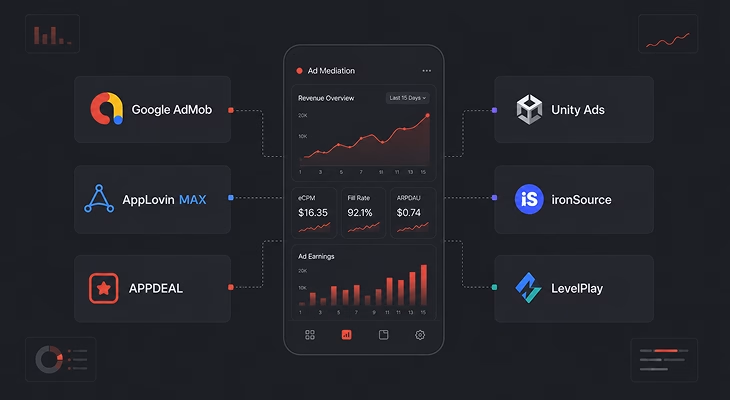
Technical isometric diagram for Unity mobile ad mediation, illustrating the network infrastructure to maximize mobile game ad revenue.
AdTech & Monetization

What Is Ad Mediation for Unity Developers

For Unity developers, ad mediation is the essential technology layer that sits between your mobile game and dozens of global ad networks. Instead of relying on a single provider, mediation connects you to a vast marketplace, triggering real-time auctions for every impression. By polling multiple networks simultaneously, the system ensures the highest-paying ad is always served, significantly increasing your eCPM and fill rates. Modern platforms utilize programmatic bidding (or header bidding) alongside traditional waterfalls to create a competitive environment where 20 to 70+ networks bid for your inventory. For Unity creators, this eliminates single-network dependency and centralizes reporting into one dashboard. Whether you choose native solutions like Unity LevelPlay or high-performance independent options like CAS.AI, implementing a robust mediation strategy is the most effective way to automate growth and ensure you aren't leaving money on the table.

March 8, 2025 5 min read
Network node diagram illustrating mobile header bidding mechanics with a central publisher app connecting to multiple programmatic demand sources.
AdTech & Monetization Guide

The Complete Header Bidding Guide

Traditional waterfall mediation is failing modern publishers. By ranking ad networks in a fixed, predetermined order based on historical data, the waterfall model creates a structural revenue leak where higher-paying bidders are often ignored simply because of their rank. Header bidding solves this by flipping the auction model entirely, allowing all demand partners to bid simultaneously before the ad server is even called. Whether you are a hyper-casual game developer or a cross-platform creator using Flutter or Unity, understanding the technical nuances between client-side and server-side auctions is critical. While client-side offers transparency, server-side bidding is often preferred for mobile apps to reduce latency. By integrating header bidding into your ad mediation platform, you move away from managed queues toward a live, competitive market, ensuring you capture the true market value of every single impression.

May 1, 2025 12 min read
Technical isometric diagram for Flutter mobile ad mediation, illustrating efficient ad monetization infrastructure for cross-platform app developers.
AdTech & Monetization

Ad Mediation for Flutter

Maximizing revenue in the competitive mobile landscape requires more than just standard ad placements; it demands a strategic approach to monetization. For Flutter developers, ad mediation serves as the ultimate engine for growth. By implementing a robust mediation platform, you can force top-tier ad networks to compete for your inventory in real-time, significantly driving up your average eCPM. This guide explores the technical and strategic advantages of moving beyond single-network setups. You will learn the nuances of integrating industry-leading networks and the transformative power of programmatic bidding. Unlike traditional waterfalls, programmatic bidding ensures that every impression is sold to the highest bidder at the exact moment of the request, eliminating manual overhead and maximizing fill rates. Whether you are launching a new utility app or scaling a global gaming title, mastering these mediation techniques is the key to unlocking sustainable, scalable earnings and ensuring your Flutter project achieves its full financial potential.

July 8, 2025 5 min read
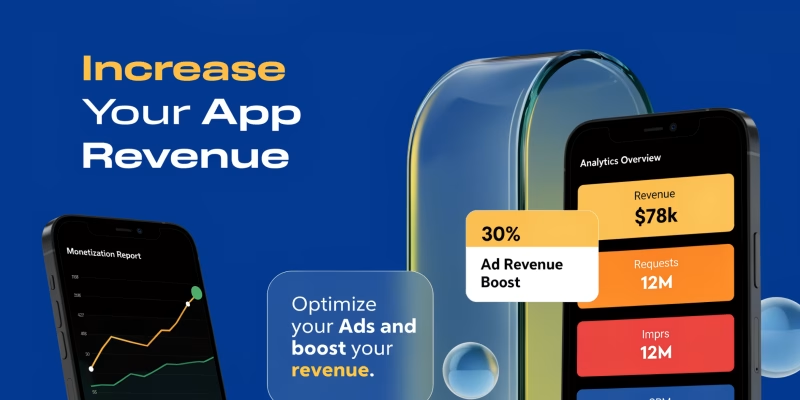
Promotional banner showcasing mobile ad optimization features on a smartphone screen to achieve a 30 percent ad revenue boost for application publishers.
AdTech & Monetization Guide

Ad Mediation: The Guide to Mobile App Monetization

Managing monetization network by network is a grind - multiple SDKs, scattered dashboards, constant eCPM tweaks, and missed revenue. Ad mediation, which manages ads across networks, solves this. With mediation, you get a single SDK and dashboard. Each ad request is sent to multiple networks, bids are compared in real time, and the highest-paying ad wins - no manual prioritization or stale data, just maximum value per impression. The result? Higher eCPMs, better fill rates, and far less operational overhead. Modern platforms combine real-time bidding and waterfall fallback, so every impression is monetized efficiently. Centralized analytics and automated optimization mean you’re scaling performance, not just reacting. Manual setups leave revenue on the table. Mediation isn’t just a tool - it’s the backbone of smart app monetization.

January 4, 2025 15 min read
Two mobile phones displaying revenue growth charts and data analytics with promotional text Grow Together, Earn Together for CAS.AI mobile game ad mediation program.
AdTech & Monetization

CAS.AI Launches Referral Program

Grow Together: Introducing the CAS.AI Referral Program Scale your revenue beyond your own games with the new CAS.AI Referral Program. We’re turning community trust into a powerful third growth engine for mobile developers. How it works: • Earn Passive Income: Receive 1% of your referred partner’s ad revenue every month for a full year. • Performance Boost: Refer five or more active partners in a single month to jump your rate to 1.5%. • Guaranteed Start: Your first month’s bonus is guaranteed, with no revenue thresholds applied. • Simple Setup: Partners just enter your account name when signing up at cas.ai/company. Whether you are a studio founder, a mediation partner, or a publishing expert, you can now turn your professional network into recurring yield. [Read the Full Article] Ready to start earning? Log in to your dashboard to find your account name and start referring today.

April 16, 2026 6 min read
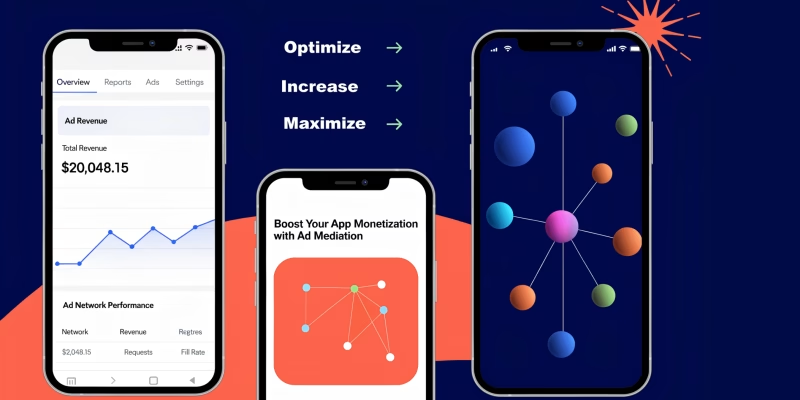
obile app ad mediation flow chart illustrating how to optimize and boost app monetization
AdTech & Monetization

Mobile Game Monetization: The Complete Guide

For any mobile game publisher, success isn't just about the build; it’s about the infrastructure behind it. Whether you are an indie developer or an established indie game publisher, treating monetization as an afterthought is a costly mistake. Mobile game publishing has evolved, and manual setups are now a revenue leak that a casual game publisher simply cannot afford. To become the best casual game publisher in your niche, you must leverage automation. This is especially true for a hyper casual game publisher, where thin retention curves mean every impression counts. By choosing a robust game publishing platform like CAS.AI, you streamline your workflow from day one. Don't wait until launch to fix your strategy. Master indie game publishing by integrating a mediation layer before you publish your game on Google Play, ensuring you squeeze maximum value from your global audience while focusing on the gameplay players love.

May 13, 2025 16 min read

Maximize your ad revenue with CAS.ai

Smart mediation platform for mobile publishers and game developers.


Telegram
WhatsApp
Slack
Phone