
Laptop displaying data charts for user acquisition efficiency and mobile app monetization performance analytics.

January, as strong as Black Friday: record UA efficiency at CAS.ai

January 20, 2026 4 min read
In mobile games, January has long had a reputation as a “dead” month. Once the holidays are over, marketing budgets tighten, eCPMs soften, algorithms need to recalibrate, and marketing profit can look grim. Most teams accept the dip as inevitable and respond reactively—only once the numbers have already slid.

At CAS.ai, we’ve found the opposite is true. January stops being a problem when you treat it as a predictable seasonal phase and manage it proactively, rather than scrambling to fix things after the fact.

This January, CAS.ai’s publishing team delivered results comparable to our peak Black Friday weeks—still widely regarded as the most profitable stretch of the year.

Facts & figures: January at Black Friday level

A look at weekly Total Profit (marketing profit) makes the point clear:

  • In past years, our best Black Friday and pre-New Year weeks typically delivered $130–140K profit per week.
  • The final “holiday” week reached $154K, one of the strongest weekly results across the year.
  • After the New Year break—when the market usually softens—CAS.ai held performance at around $135K per week, fully in line with strong November and December levels.

    Weekly UA performance table for December 2025 and early January 2026 showing Spend, Total Profit, Marketing Profit, Ad Revenue and IAP Revenue by group date — CAS.ai
    Weekly UA performance across December 2025 and early January 2026, highlighting how CAS.ai sustained profit through the post-holiday market shift.
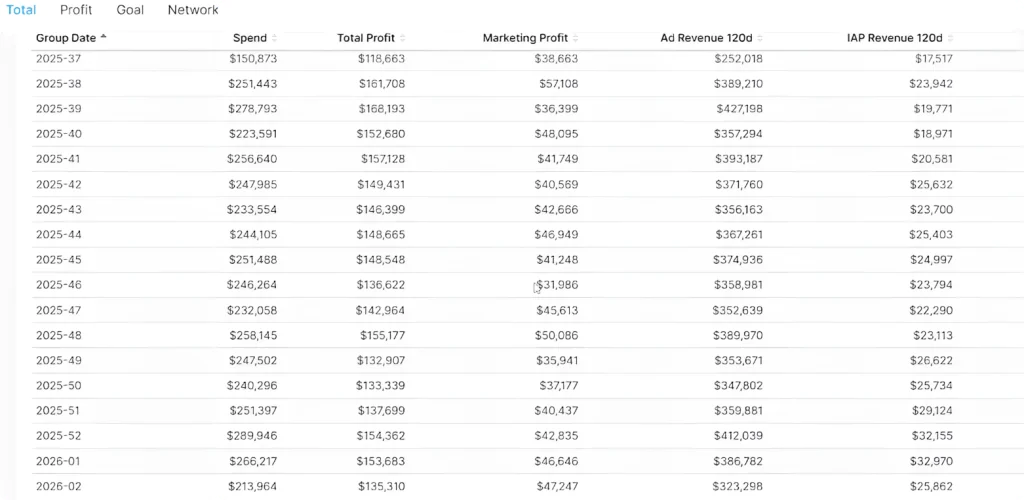
In practical terms, January landed at roughly 10–12% below the absolute Black Friday peak. For the market overall, a 30–50% drop in the same period is far more common.

That’s why this wasn’t just “steady” January performance—it was a structurally strong month.

What we did differently: the publishing team’s role

The biggest lever was our publishing-led approach and the way we use predictive models in User Acquisition.

As CAS.ai CMO Zoryana Omelchuk points out, the market’s most expensive mistake is cutting bids too late—after teams can already see eCPM falling and performance slipping.

Zoryana Omelchuk, CMO at CAS.ai
took a different approach:

  • We began lowering bids early, 28–30 December, through controlled, step-by-step adjustments.
  • We made a meaningful cut on 31 December, before the market entered its sharp CPM decline.
  • CPI and ROAS moves weren’t driven by “yesterday’s numbers”, but by calendar- and seasonality-based predictions.

The outcome:

  • Spend didn’t balloon 1.5–2x, which is a common pattern between 1–5 January.
  • Algorithms kept their learning intact.
  • Predicted profit stayed on target.

Why the market loses money in January

The mechanics behind the January dip are well understood:

  • Large advertisers hit budget limits.
  • CPM falls quickly.
  • UA systems don’t adapt fast enough.
  • Yesterday’s bids become overpriced in the new market reality.

Most teams respond reactively, cutting bids 3–5 business days later. By that point, some of the budget has already been burned and learning models have deteriorated.

CAS.ai chose a different route—and moved ahead of the market.

January is decided in advance, not in the first working week

One of the key messages from our publishing team is simple:

You can’t analyse January in isolation from the calendar.

Seasonality is remarkably predictable:

  • End of quarter
  • Black Friday
  • Christmas
  • New Year
  • The first half of January

All of these points are known in advance. And if you plan for them—by:

  • lowering CPM targets,
  • adjusting ROAS,
  • managing bidding in staged steps,

—then January stops being an “unknown risk”.

What really drives January’s financial outcome

Use the calendar. Work with predictions. Make the decisions before the market forces your hand.

Do that, and January stops being a problem—and becomes just another month you can win.

Oleg Shlyamovich
Oleg Shlyamovich CEO & Co-Founder, CAS.AI

9+ years in mobile monetization. 500+ apps, 5B+ downloads.

Last updated: View all articles →

Explore More

Best Mobile Ad Networks for App Developers in 2025 blog banner
AdTech & Monetization

The Best Mobile Ad Networks

hoosing the right mobile ad mediation platform is the single biggest lever for app revenue in 2025. This guide compares top industry leaders—CAS.AI, AdMob, AppLovin MAX, and Appodeal—across performance metrics essential for independent developers. While the global in-app advertising market heads toward $350 billion by 2025, professional studios are moving away from single-network setups toward hybrid mediation. This approach uses real-time bidding to force competition, often resulting in 40–100% ARPU uplifts. The comparison highlights CAS.AI’s independent model and "no-loss guarantee" against the giant ecosystems of Google-owned AdMob and AppLovin MAX. Key factors include payout speeds (ranging from 5 to 21 days), SDK support for frameworks like Unity, Godot, and Unreal, and the critical importance of avoiding conflicts of interest. Whether you are self-publishing on Google Play or managing a gaming studio, selecting an independent partner with verified A/B-tested results is the most reliable way to maximize eCPM without compromising user experience.

March 13, 2025 7 min read
Technical isometric diagram for Godot Engine mobile ad mediation, illustrating the network infrastructure to optimize and boost mobile game income.
AdTech & Monetization

Ad Mediation for Godot

Ad mediation is the essential middleman between your mobile game and multiple ad networks, ensuring you never leave money on the table. Instead of relying on a single provider like AdMob, mediation triggers a real-time auction for every ad slot, allowing the highest bidder to win the impression. For Godot developers, this technology is a game-changer. By implementing a mediation layer, you can navigate the engine's unique SDK landscape while accessing high-paying formats like rewarded videos and interstitials. Platforms like CAS.ai streamline this process by connecting your project to over 20 networks and 150 DSPs through a single integration. This setup eliminates the "empty slot" problem, stabilizes revenue during seasonal shifts, and provides unified analytics. Whether you are building hyper-casual titles or complex midcore games, ad mediation can boost your total revenue by 30% to 60%, making it a non-negotiable tool for any serious mobile developer.

June 8, 2025 6 min read
Technical isometric diagram for Unity mobile ad mediation, illustrating the network infrastructure to maximize mobile game ad revenue.
AdTech & Monetization

What Is Ad Mediation for Unity Developers

For Unity developers, ad mediation is the essential technology layer that sits between your mobile game and dozens of global ad networks. Instead of relying on a single provider, mediation connects you to a vast marketplace, triggering real-time auctions for every impression. By polling multiple networks simultaneously, the system ensures the highest-paying ad is always served, significantly increasing your eCPM and fill rates. Modern platforms utilize programmatic bidding (or header bidding) alongside traditional waterfalls to create a competitive environment where 20 to 70+ networks bid for your inventory. For Unity creators, this eliminates single-network dependency and centralizes reporting into one dashboard. Whether you choose native solutions like Unity LevelPlay or high-performance independent options like CAS.AI, implementing a robust mediation strategy is the most effective way to automate growth and ensure you aren't leaving money on the table.

March 8, 2025 5 min read
Diagram illustrating the In-App Purchases (IAP) mobile app monetization model, featuring a shopping cart icon and a 30-day eCPM performance metric chart.
AdTech & Monetization

App Monetization Guide

Making money from an app is not as simple as flipping a switch. You need a whole toolkit. Ads, in-app purchases, subscriptions, and mixing them together all come with their own twists. What actually works depends on your app and the people using it. This guide walks you through every model that is actually worth your time. I will show you how in-app ads and mediation work in practice, where in-app purchases and subscriptions fit in, and why hybrid monetization is taking over in 2026. You will see how to choose a strategy based on your app, your platform, and your region. I will also break down the five metrics that really matter and the common mistakes that quietly put a lid on revenue for most teams. Let us look at some real numbers. One CAS.AI publisher, Fail Games, saw their revenue jump by about 80 times after it switched to a hybrid setup with both ads and in-app purchases, using mediation to manage the ads. Another publisher went from making just four dollars a day to eighteen thousand euros a month, simply by adding mediation. Here is how they did it.

January 20, 2026 13 min read
ASO 2026 strategies for mobile app discovery, organic growth, and app monetization.
AdTech & Monetization

Mobile App Monetization Under Siege: Maturing Algorithms Kill Organic Growth as User Acquisition Takes the Crown

ASO and paid user acquisition have merged into a single growth system as store algorithms focus on product quality, Apple expands ad placements, and organic-only strategies lose ground inside the competitive app economy of 2025. Mobile marketing entered 2025 at a crossroads. The rules that governed app growth for years - organic optimization here, paid acquisition there - no longer hold. Apple Search Ads rolled out new placements, user behavior shifted in unexpected ways, and competition intensified across every category. The result? ASO stopped being a standalone discipline practiced in isolation and became inseparable from the entire product and marketing funnel.

February 6, 2026 13 min read

Maximize your ad revenue with CAS.AI

Smart mediation platform for mobile publishers and game developers.


Already registered? Your current password may predate these requirements — reset it instead of signing up again. Reset password

 
Telegram
WhatsApp
Slack
Phone