
Mobile game publishing illustration with a rocket launch, player community, growth chart, and trophy symbolizing game scaling.

Mobile Game Publishing Behind the Scenes: How Growth Really Happens

December 3, 2025 4 min read

Mobile game publishing is more than promotion or user acquisition. It’s a full support ecosystem that helps indie developers turn a hobby into a sustainable business.
CAS.AI combines analytics, monetization, A/B testing, creatives, and scaling—creating real growth stories where games multiply revenue many times over.
Today we’ll share four examples—Racing in Car 2021, Siren Horror, Car Crash Royale, and Warzone Commander—and explain how publishing can radically change a game’s trajectory.

1) From $5/day to €72,500: Racing in Car 2021 — a Mobile Game Publishing Success Story

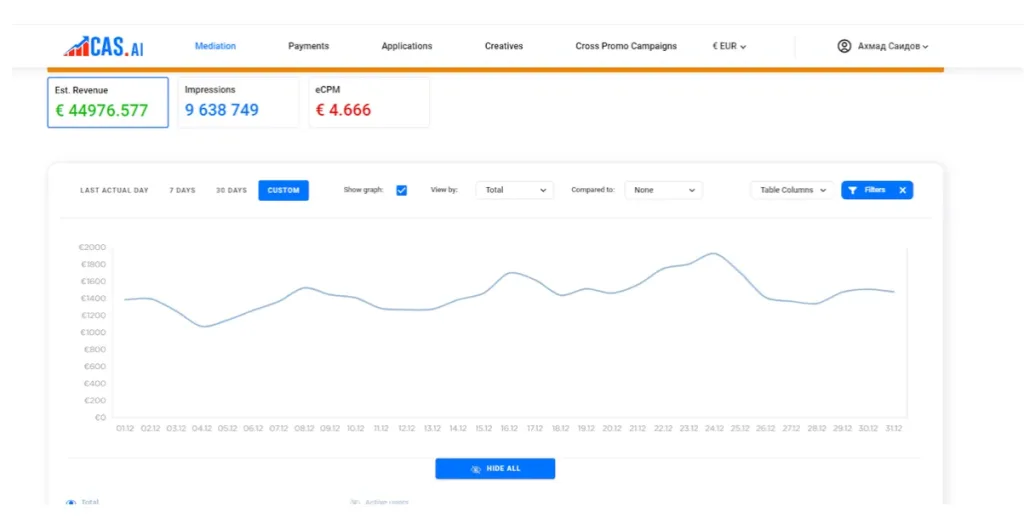
When developer Zafar launched his driving simulator, revenue was just $4–5 per day. After integrating
CAS.AI mediation, results shifted from day one:

    • eCPM grew from $1.44 to €4
    • Fill rate exceeded 90%
    • Revenue reached €75–80/day in the first month Mobile game publishing results for Racing in Car — CAS.AI publisher dashboard with revenue, eCPM and performance growth

The real breakthrough came after switching to a publishing model. CAS.AI ran icon A/B tests, refreshed creatives,
and optimized UA—icon redesign alone lifted installs by +4.5%. Monthly revenue rose to €18,000,
and in a year hit €72,500. CAS.AI continues to grow both App Store and Google Play versions
through consistent mobile game publishing support.

2) Siren Horror: From Hobby to a Stable Business

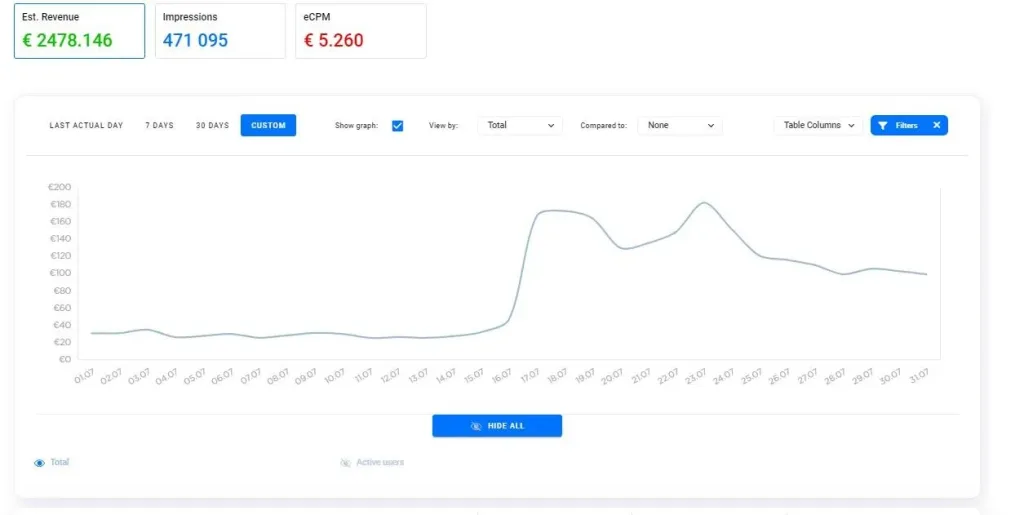
When Rinaz Khadiev released his first horror title Siren Horror: Big Head Game 3D, IronSource revenue was about $3/day. After connecting CAS.AI mediation and fine-tuning waterfalls:

  • Profit reached €30/day within the first days
  • After moving to publishing, revenue 6× increased
  • Ad impressions per year grew from 471,000 to 9.4MSiren Horror analytics after joining CAS.AI publisher program — revenue lift and eCPM growth

CAS.AI took over scaling—UA, ASO, icon/video tests. In a year, gross revenue grew 100×, and net profit 20×.
Today the developer has 12 games live and is building a new multiplayer horror with CAS.AI, continuing his mobile game publishing journey.

3) Car Crash Royale — When Publishing Meets Analytics

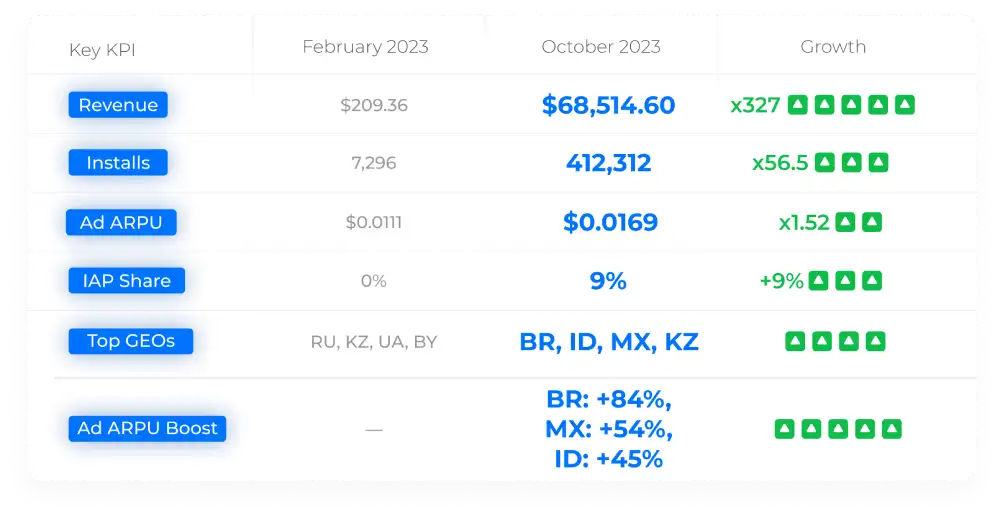
Fail Games already used CAS mediation, but growth stalled. Before the partnership, the numbers looked like this: ARPU = $0.011, fewer than 19K installs, IAP = 0.
CAS.AI built a full growth funnel:

  • UA across Google, Unity, Mintegral, IronSource, YSO
  • Shift from CPI to ROAS campaigns for efficient scaling
  • 50+ creatives (video, banners, playables)
  • Localization for Brazil, Spain, and Arabic markets → +1M installs
  • ASO tests: CVR improved from 30.6% to 44.3%
  • Hybrid monetization: eCPM ×2.5, IAP = 9% of revenueCAS.AI publishing analytics for Car Crash Royale — revenue, installs and eCPM improvement after publisher support

As a result, the game hit Top 3 Free in 16 countries, evolving from a niche project into a profitable, resilient business.

4) Warzone Commander — 55× Revenue Growth with CAS.AI

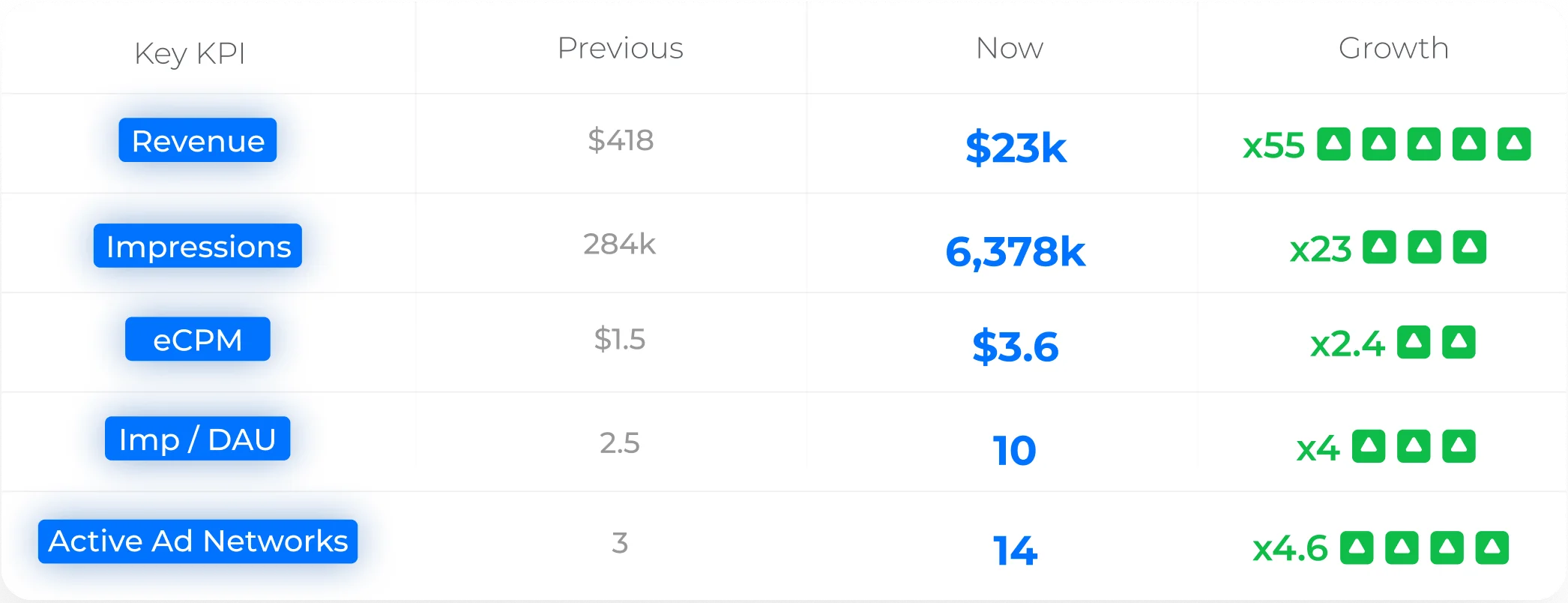
Before CAS.AI, the team behind Warzone Commander faced typical indie hurdles: low eCPM, no UA, limited visibility. Baseline: $418/month, eCPM = $1.5, a couple of ad networks.
After integrating the CAS SDK—14 active networks, full mediation, and ROAS campaigns—the metrics changed dramatically:

  • Installs: 200K+ per month
  • ROAS D1: 65–67%
  • CTR: >7%, CR: up to 35% CAS.AI publishing analytics for Warzone Commander — revenue, impressions and eCPM growth after publisher integration

The team fixed technical issues, introduced new ad formats, and built analytics to scale IAP revenue. Warzone Commander shows how a
mobile game publishing strategy can turn a small title into a sizeable business.

5) What All These Stories Share

Despite different genres—racing, horror, shooter, strategy—successful projects share common traits:

  • Transition from pure mediation to mobile game publishing
  • Hybrid monetization (ads + IAP)
  • Data-driven approach (analytics, ROAS tests, A/B experiments)
  • Strong creative support
  • Multi-geo strategy and localization
  • Fast tech support (Telegram responses within ~20 minutes)

The mix of CAS.AI technology and team expertise creates a multiplier effect—every invested dollar returns more.

6) The CAS.AI Growth Formula

CAS.AI Growth Formula:

Smart UA + Hybrid Monetization + Data-Driven Optimization + Creative Testing = 📈 Sustainable Revenue Growth

Publishing isn’t just marketing. It’s a partnership that helps indie teams think strategically: analyze, test, scale—and grow.

Conclusion

Our partners’ stories prove: even a single passion project can become a reliable income stream with the right team beside you.
CAS.AI publishing supports developers at every stage—from SDK integration to UA launches and climbing the global charts.


Oleg Shlyamovich
Oleg Shlyamovich CEO & Co-Founder, CAS.AI

9+ years in mobile monetization. 500+ apps, 5B+ downloads.

View all articles →

Explore More

Promotional banner showcasing mobile ad optimization features on a smartphone screen to achieve a 30 percent ad revenue boost for application publishers.
AdTech & Monetization Guide

Ad Mediation: The Guide to Mobile App Monetization

Managing monetization network by network is a grind - multiple SDKs, scattered dashboards, constant eCPM tweaks, and missed revenue. Ad mediation, which manages ads across networks, solves this. With mediation, you get a single SDK and dashboard. Each ad request is sent to multiple networks, bids are compared in real time, and the highest-paying ad wins - no manual prioritization or stale data, just maximum value per impression. The result? Higher eCPMs, better fill rates, and far less operational overhead. Modern platforms combine real-time bidding and waterfall fallback, so every impression is monetized efficiently. Centralized analytics and automated optimization mean you’re scaling performance, not just reacting. Manual setups leave revenue on the table. Mediation isn’t just a tool - it’s the backbone of smart app monetization.

January 4, 2025 15 min read
Abstract 3D digital technology platform block representing ILRD Impression Level Revenue Data for mobile game monetization.
AdTech & Monetization

ILRD Is Not a Setting. It’s the Foundation of Your Monetization Stack.

ILRD isn’t just a setting. It’s the base of your monetization stack. If you’re still looking at yesterday’s aggregate revenue and calling it “performance,” you’re flying blind. In modern user acquisition (UA), seeing $27,000 in daily revenue doesn’t tell you whether your campaigns are profitable, whether your ad frequency test is working, or whether your cheapest advertising channel is quietly hurting lifetime value (LTV). Impression-Level Revenue Data (ILRD), which measures revenue earned per individual ad impression, changes that. It connects every ad impression to a real user, specific device, and the original traffic source, turning return on ad spend (ROAS) optimization, analyzing groups of users over time (cohort analysis), and combining ads with in-app purchases (hybrid monetization) into measurable systems instead of relying on educated guesses. But IRLD isn’t just about turning it on. Waterfall floor math, bidding mechanics, alternative stores like RuStore, and Meta's platform restrictions can introduce discrepancies that quietly corrupt your signal and your UA decisions. In the full article, we break down what’s normal, what’s fixable, and what’s catastrophic. We also show you how to verify your IRLD before every build. If you’re using target Return on Ad Spend (tROAS) in 2026, this isn’t optional reading.

March 6, 2026 11 min read
Technical isometric diagram for React Native mobile ad mediation, illustrating smart ad integration infrastructure to optimize cross-platform app revenue.
AdTech & Monetization

Ad Mediation in React Native

Ad mediation is the essential "go-between" for React Native developers looking to maximize app revenue. Rather than relying on a single ad network, mediation creates a real-time auction where multiple networks compete for your ad slots. This ecosystem ensures that every impression—whether it’s a banner, interstitial, or high-value rewarded video—is sold to the highest bidder. The transition from traditional "waterfall" models to programmatic bidding has revolutionized monetization, often increasing earnings by 10% to 30%. By integrating a single mediation SDK, developers can access premium demand from giants like AdMob, AppLovin, and CAS.ai without the engineering overhead of managing dozens of individual plugins. Beyond higher eCPMs, mediation offers unified analytics, improved fill rates in secondary markets, and built-in A/B testing. For any React Native developer aiming for professional-scale growth, a robust mediation strategy is no longer optional. It is the foundation of a profitable mobile business.

May 8, 2025 8 min read
ASO 2026: app discovery revolution banner with an iPhone App Store screen
AdTech & Monetization

Mobile App Monetization Under Siege: Maturing Algorithms Kill Organic Growth as User Acquisition Takes the Crown

ASO and paid user acquisition have merged into a single growth system as store algorithms focus on product quality, Apple expands ad placements, and organic-only strategies lose ground inside the competitive app economy of 2025. Mobile marketing entered 2025 at a crossroads. The rules that governed app growth for years - organic optimization here, paid acquisition there - no longer hold. Apple Search Ads rolled out new placements, user behavior shifted in unexpected ways, and competition intensified across every category. The result? ASO stopped being a standalone discipline practiced in isolation and became inseparable from the entire product and marketing funnel.

February 6, 2026 13 min read
Technical isometric diagram for Godot Engine mobile ad mediation, illustrating the network infrastructure to optimize and boost mobile game income.
AdTech & Monetization

Ad Mediation for Godot

Ad mediation is the essential middleman between your mobile game and multiple ad networks, ensuring you never leave money on the table. Instead of relying on a single provider like AdMob, mediation triggers a real-time auction for every ad slot, allowing the highest bidder to win the impression. For Godot developers, this technology is a game-changer. By implementing a mediation layer, you can navigate the engine's unique SDK landscape while accessing high-paying formats like rewarded videos and interstitials. Platforms like CAS.ai streamline this process by connecting your project to over 20 networks and 150 DSPs through a single integration. This setup eliminates the "empty slot" problem, stabilizes revenue during seasonal shifts, and provides unified analytics. Whether you are building hyper-casual titles or complex midcore games, ad mediation can boost your total revenue by 30% to 60%, making it a non-negotiable tool for any serious mobile developer.

June 8, 2025 6 min read
App Store Optimization 2025 banner showing app indexing in Google Play and conversion optimization in the App Store with visual elements like magnifying glass and upward arrows
AdTech & Monetization Case Study

ASO in 2026: How to Make Sure Users Can Actually Find Your App Page

ASO in 2025 is no longer a checklist but a full growth strategy. This article explains how App Store Optimization really works today, how App Store and Google Play algorithms interpret your metadata and visuals, and why a systematic, data-driven ASO approach has become a competitive advantage. We break down keyword strategy, localization, A/B testing, and the role of tools like ASOMobile in improving app visibility, conversion rates, and organic growth.

December 12, 2025 6 min read

Maximize your ad revenue with CAS.ai

Smart mediation platform for mobile publishers and game developers.


Telegram
WhatsApp
Slack
Phone