AdMob vs Appodeal: Which Monetization Approach Wins?
Last updated in July 2026
Here’s the bottom line: AdMob gives you Google’s massive demand and an easy setup. Appodeal brings independence and 70+ networks fighting for every impression. But if you want to maximize revenue, don’t pick one; let both compete head-to-head in a single mediation layer.
AdMob vs Appodeal: Two Very Different Bets
Every mobile app developer faces the same choice: stick with AdMob, the default and safe option, or go independent with Appodeal and unlock 70+ networks at once.
It’s not about which platform is ‘better’ overall. What matters is which one fits your audience, ad formats, and growth stage, and whether forcing both to compete in a single mediation layer outperforms either one alone.
This comparison breaks down eCPM, auction type, formats, fees, payout speed, and the real trade-offs. By the end, you’ll know exactly which fits your app, and why independent mediation usually comes out on top.
AdMob vs Appodeal: Side-by-Side Comparison
| Criteria |  AdMob AdMob |
 Appodeal Appodeal |
|---|---|---|
| Type | Ad network (with mediation) | Independent aggregator (70+ networks) |
| Auction type | Bidding + waterfall hybrid | In-app bidding via BidMachine |
| Stronger formats | Banner, App Open, Native | Rewarded video, Interstitial |
| eCPM potential | Stable; Google demand anchors floor | Often +17% via competitive auction (claimed) |
| Networks / DSPs | 25+ networks | 70+ networks via aggregation |
| Commission / fees | ~30, 40% rev-share (est.) | Rev-share (exact rate undisclosed) |
| Setup complexity | Simple, single SDK, fast integration | Medium, Appodeal SDK + dashboard config |
| Payout speed | Net 21 days | Net 30, 60 days |
| Best for | Starters, utilities, Google-heavy audiences | Apps wanting independence from big networks |
| *Fee figures based on published third-party reviews (metacto, Teqblaze). | ||
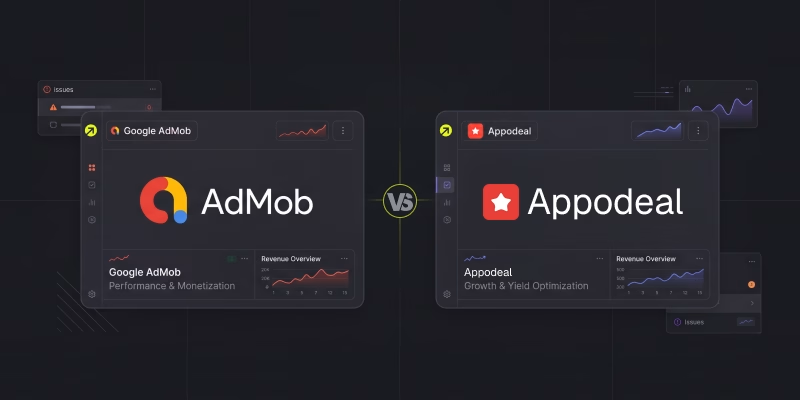
Detailed feature and workflow comparison between Google AdMob and Appodeal.
No single metric tells the whole story. AdMob’s edge is Google’s massive advertiser pool, the same one powering Google Ads, DV360, and YouTube. Appodeal wins on breadth, with 70+ networks fighting for every impression through BidMachine. But both keep you boxed in: neither lets outside demand sources bid freely.
Independent mediation fills that gap. Drop CAS.AI between your app and these networks, and you get the highest bid from Google, Appodeal, and 18+ more, every single time.
If CAS.AI earns less, we pay the difference.
One-on-One Comparisons
Go deeper on any matchup. Each page includes a full data table, honest pros and cons, and a verdict by use case.
Appodeal: Overview
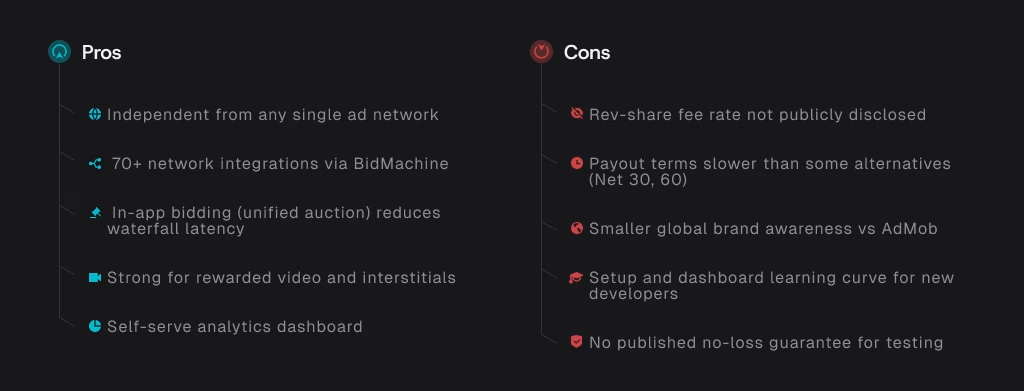
Appodeal is an independent ad monetization platform and aggregator built on top of BidMachine, its own supply-side technology. Unlike AdMob, Appodeal holds no allegiance to any single ad network; it connects to 70+ demand sources and runs an in-app bidding auction to find the highest price on every impression.
Appodeal is a closer conceptual parallel to CAS.AI than AdMob is: both sit above the individual networks and claim to run a neutral auction. The key difference is CAS.AI’s RTB+waterfall hybrid, no-commission model, and no-loss revenue guarantee during testing.
AdMob: Overview
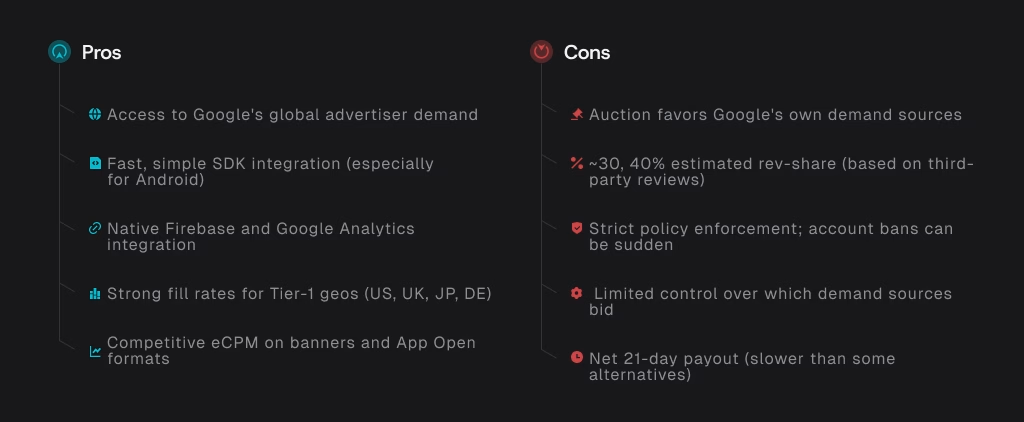
AdMob is Google’s mobile advertising network and mediation platform, used by millions of apps worldwide. It is the default starting point for most Android developers and integrates natively with Firebase, Google Analytics, and the broader Google Ads ecosystem. Its core strength is access to the single largest pool of programmatic advertisers on the planet.
How to Choose a Mobile Ad Network
No single network fits every app. Before you integrate, run these four filters.
- App type and main format matter. Banners and App Open ads usually get the best results from AdMob’s Google demand. Rewarded video and interstitial-heavy games pull higher eCPMs from aggregators like Appodeal, or better yet, from a mediation layer that forces both to compete for every impression.
- Audience geography is key. AdMob dominates Tier-1 Western markets. Appodeal’s network mix is stronger in emerging markets. If your audience spans both, mediation is the only way to capture top eCPM everywhere.
- Mediation or single network? One network is easy to set up, but each missed eCPM dollar from low fill or slow auctions is lost revenue. Independent mediation earns more because it drives competition on every impression, not just when your main network has inventory.
- Payout terms matter. AdMob pays Net 21. Appodeal pays Net 30 or 60. If cash flow drives your UA budget, payment speed is mandatory. CAS.AI pays as early as Day 5 and supports crypto payouts.
Where does CAS.AI fit?
CAS.AI isn’t a network; we are a growth operator – independent from every network above. One SDK connects you to 20+ ad networks and 150+ DSPs. CAS.AI has no ad network, so no demand source is prioritized. Every impression goes to the highest bidder: AdMob, Appodeal, or a DSP you’ve never heard of.
Apps that switch to CAS.AI for independent mediation see ARPU 1.5-2× higher than with a single network or biased mediation. With the no-loss guarantee, if your revenue drops during testing, CAS.AI pays the difference. You risk nothing by finding out your real number.
For the full picture of how mediation works, see CAS.AI Mediation.
Key Takeaways
- AdMob stands out for its huge pool of Google advertisers and how easy it is to get started. Appodeal, on the other hand, casts a much wider net, letting over seventy networks compete for your ad space through BidMachine.
- The type of ad you use makes a difference. AdMob is the go-to for banners, app opens, and native ads, while Appodeal takes the lead when it comes to rewarded video and interstitial formats.
- If you rely on ad revenue to fund user acquisition, payout speed matters. AdMob pays out faster, usually in about three weeks, while Appodeal can take up to two months.
- Neither AdMob nor Appodeal lets outside advertisers bid without restrictions. The top-performing apps do not just pick one—they run both through an independent mediation layer to squeeze out the best results from each.
- CAS.AI, as a growth operator, takes a different approach. It does not have its own ad network, offers a no-loss guarantee while you test it out, and starts paying as early as day five.
Ad Network Comparison FAQ
Neither is universally better. AdMob leads on simplicity, integration speed, and Tier-1 Google demand. Appodeal leads on network breadth (70+) and independence from any single buyer. The highest revenue typically comes from running both through a neutral mediation layer that lets them compete on every impression.
Appodeal claims an average +17% eCPM lift through its unified auction. AdMob typically delivers stronger CPMs in Tier-1 US/UK/JP markets, especially on banners and App Open formats. Results vary by app category, geo mix, and format split. The safest way to find your real number is to run a head-to-head A/B test on an independent mediation platform.
For mobile games, Appodeal’s rewarded video and interstitial CPMs are often competitive because of its 70+ network auction. AdMob is stronger for hyper-casual games targeting US/EU audiences, where Google’s advertiser pool dominates. Game developers running both via mediation typically outperform either platform alone.
Independent ad mediation is a layer that sits above individual ad networks and runs a neutral auction. Unlike platform-owned mediation (AppLovin MAX, LevelPlay), an independent mediator has no financial stake in which network wins each impression, so Google demand and Appodeal demand compete on equal terms. CAS.AI is an independent mediator.
Yes, through a mediation platform, both can bid on each impression, and the highest bid wins automatically. Running them together through an independent mediation SDK is the standard approach for mature mobile monetization teams.
Learn about CAS.AI Mediation
Check out 2026 Alternatives to AdMob
More head-to-head comparisons: