

Mobile Game Monetization, UA & Publishing Blog

An abstract digital illustration showing mobile ad tracking identifiers like IDFA and GAID transitioning into secure, aggregated data privacy frameworks like SKAN and Privacy Sandbox.
Featured Post
AdTech & Monetization

Marketing in the Privacy Era: Measuring UA Performance Without IDFA

July 9, 2026 19 min read
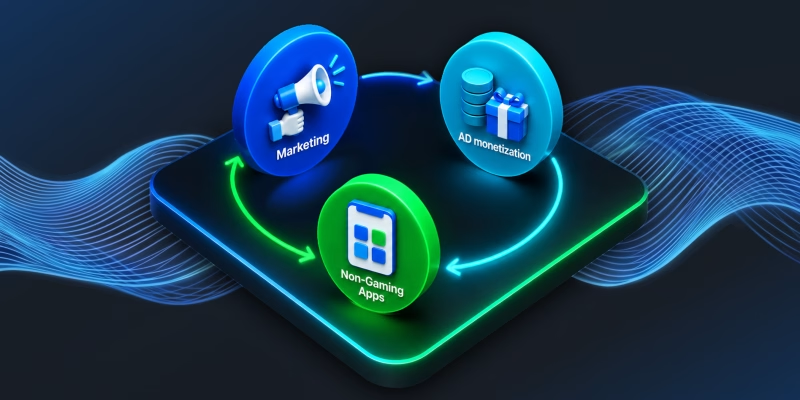
Graphic illustrating a conceptual framework for Beyond Gaming Marketing and Ad Monetization, featuring 3D icons that represent the interplay between user acquisition and revenue generation.
AdTech & Monetization

Beyond Gaming: How Non-Gaming Apps Are Rewriting the Mobile Monetization Playbook

Non-gaming apps are set to out-earn games in 2025: $85.6 billion versus $81.8 billion. But if you’re leaving most users unmonetized, the headline is irrelevant. Most non-gaming apps blow it in three main ways: They obsess over subscriptions, which only convert 2-5% of users; run lazy, single-format ad stacks; and cling to the myth that better monetization ruins the user experience. It doesn’t. Combine ads and subscriptions. Watch lifetime value jump over 50%. Users who hit rewarded video are 4.5 times more likely to pay. Clearly, the formats work. Hybrid models work. The blueprint is already out there. Gaming has already paid the price to figure this out. Skip the mistakes: start adopting hybrid monetization strategies now to close the gap.

June 15, 2026 15 min read
Two mobile phones displaying revenue growth charts and data analytics with promotional text Grow Together, Earn Together for CAS.AI mobile game ad mediation program.
AdTech & Monetization

CAS.AI Launches Referral Program

Grow Together: Introducing the CAS.AI Referral Program Scale your revenue beyond your own games with the new CAS.AI Referral Program. We’re turning community trust into a powerful third growth engine for mobile developers. How it works: • Earn Passive Income: Receive 1% of your referred partner’s ad revenue every month for a full year. • Performance Boost: Refer five or more active partners in a single month to jump your rate to 1.5%. • Guaranteed Start: Your first month’s bonus is guaranteed, with no revenue thresholds applied. • Simple Setup: Partners just enter your account name when signing up at cas.ai/company. Whether you are a studio founder, a mediation partner, or a publishing expert, you can now turn your professional network into recurring yield. [Read the Full Article] Ready to start earning? Log in to your dashboard to find your account name and start referring today.

April 16, 2026 6 min read
Mobile game-publishing reality
Mobile Game Growth

The Mobile Game Publishing Reality

This article breaks down the brutal math: only 1 in 300 indie games reaches $30,000/month, compared to 1 in 10 for publisher-backed titles. The reason comes down to three structural gaps: marketing budgets too small to fuel growth, no predictive analytics to guide user acquisition, and compounding disadvantages in CPI and ARPDAU that make breaking even nearly impossible.

April 8, 2026 10 min read
Abstract 3D digital technology platform block representing ILRD Impression Level Revenue Data for mobile game monetization.
AdTech & Monetization

ILRD Is Not a Setting. It’s the Foundation of Your Monetization Stack.

ILRD isn’t just a setting. It’s the base of your monetization stack. If you’re still looking at yesterday’s aggregate revenue and calling it “performance,” you’re flying blind. In modern user acquisition (UA), seeing $27,000 in daily revenue doesn’t tell you whether your campaigns are profitable, whether your ad frequency test is working, or whether your cheapest advertising channel is quietly hurting lifetime value (LTV). Impression-Level Revenue Data (ILRD), which measures revenue earned per individual ad impression, changes that. It connects every ad impression to a real user, specific device, and the original traffic source, turning return on ad spend (ROAS) optimization, analyzing groups of users over time (cohort analysis), and combining ads with in-app purchases (hybrid monetization) into measurable systems instead of relying on educated guesses. But IRLD isn’t just about turning it on. Waterfall floor math, bidding mechanics, alternative stores like RuStore, and Meta's platform restrictions can introduce discrepancies that quietly corrupt your signal and your UA decisions. In the full article, we break down what’s normal, what’s fixable, and what’s catastrophic. We also show you how to verify your IRLD before every build. If you’re using target Return on Ad Spend (tROAS) in 2026, this isn’t optional reading.

March 6, 2026 11 min read
ASO 2026 strategies for mobile app discovery, organic growth, and app monetization.
AdTech & Monetization

Mobile App Monetization Under Siege: Maturing Algorithms Kill Organic Growth as User Acquisition Takes the Crown

ASO and paid user acquisition have merged into a single growth system as store algorithms focus on product quality, Apple expands ad placements, and organic-only strategies lose ground inside the competitive app economy of 2025. Mobile marketing entered 2025 at a crossroads. The rules that governed app growth for years - organic optimization here, paid acquisition there - no longer hold. Apple Search Ads rolled out new placements, user behavior shifted in unexpected ways, and competition intensified across every category. The result? ASO stopped being a standalone discipline practiced in isolation and became inseparable from the entire product and marketing funnel.

February 6, 2026 13 min read
Diagram illustrating the In-App Purchases (IAP) mobile app monetization model, featuring a shopping cart icon and a 30-day eCPM performance metric chart.
AdTech & Monetization

App Monetization Guide

Making money from an app is not as simple as flipping a switch. You need a whole toolkit. Ads, in-app purchases, subscriptions, and mixing them together all come with their own twists. What actually works depends on your app and the people using it. This guide walks you through every model that is actually worth your time. I will show you how in-app ads and mediation work in practice, where in-app purchases and subscriptions fit in, and why hybrid monetization is taking over in 2026. You will see how to choose a strategy based on your app, your platform, and your region. I will also break down the five metrics that really matter and the common mistakes that quietly put a lid on revenue for most teams. Let us look at some real numbers. One CAS.AI publisher, Fail Games, saw their revenue jump by about 80 times after it switched to a hybrid setup with both ads and in-app purchases, using mediation to manage the ads. Another publisher went from making just four dollars a day to eighteen thousand euros a month, simply by adding mediation. Here is how they did it.

January 20, 2026 13 min read
AdTech & Monetization

AdMob Alternatives

Forget the idea of a universal 'best' AdMob alternative. The right move depends on your app, your audience, and how much control you want over your auctions. In practice, adding a top competitor through independent mediation beats ripping out AdMob. You get more leverage, more competition, and better results. This guide gets straight to why studios outgrow AdMob: hidden revenue share, slow Net 21 payouts, and unreliable global fill. We stack up the real alternatives AppLovin MAX, Unity Ads, InMobi, Appodeal, and DT FairBid head-to-head on eCPM, fees, and payout terms. You get a step-by-step migration path: baseline your numbers, integrate alternatives alongside AdMob, run a live A/B test, and only shift traffic when your own data proves the upside. No guesswork. No marketing spin. Just results.

January 19, 2026 12 min read
Dark infographic displaying mobile ad network eCPM calculations with 1,000 impressions yielding a $2.50 revenue.
AdTech & Monetization

What Is eCPM?

If you're a publisher, eCPM (effective cost per mille) is the revenue you earn for every 1,000 ad impressions. It's calculated with a simple formula: divide total ad revenue by total impressions, then multiply by 1,000. Unlike CPM, a fixed price that advertisers agree to upfront, eCPM reflects what you actually earned after accounting for fill rate, bids, and everything else. But the number alone means little without context. A $1.50 eCPM for a banner in Latin America is not the same as a $1.50 eCPM for rewarded video in the US. Format, geography, platform, and seasonality all move the needle. For publishers, the most reliable way to push eCPM higher? Competition. The more networks bidding on each impression in real time, the better your realized revenue. Publishers who switch to independent mediation typically see revenue per user jump 1.5–2x. That's not theory; that's what the data shows.

January 18, 2026 6 min read
Comparison graphic between Google AdMob and DT FairBid mobile advertising platforms.
AdTech & Monetization

AdMob vs DT FairBid

AdMob and DT FairBid solve monetization from opposite directions. AdMob is Google's closed ecosystem, a private auction backed by DV310 and Google Ads, known for global fill rates, banner strength, and reliable Net 21 payouts. DT FairBid takes the open-auction route, giving game publishers programmatic access to DSPs across the exchange, with standout eCPMs on rewarded video and interstitials at the cost of a steeper setup and Net 30–60 payment terms.The real question isn't which network is "better," it's which format and audience each one is built for. AdMob for banner-heavy, Tier-2/3 apps chasing simplicity. DT FairBid for gaming studios prioritizing fullscreen yield over fast cash flow. Or skip the either/or entirely: run both through a neutral mediation layer and let real competition set your eCPM instead of a single network's bias.

January 17, 2026 7 min read
A side-by-side comparison banner featuring the logos of Google AdMob and InMobi mobile ad networks.
AdTech & Monetization

AdMob vs InMobi

AdMob and InMobi solve different problems. AdMob leans on Google Ads demand to deliver strong eCPMs across the US, UK, Germany, and Australia, with easy Firebase integration and broad format support. InMobi runs independently, connecting to 150+ DSPs through its own RTB exchange, and it wins in India, Indonesia, Vietnam, and Japan — often reversing AdMob's Tier-1 advantage in those markets.Payout timing differs too: AdMob runs net-21, while InMobi ranges from net-30 to net-60 depending on account tier. Neither network discloses exact revenue share, though third-party estimates put both around 30–40%.The takeaway: geography decides the winner, not brand reputation. Apps with mixed APAC and Western traffic get the most value from running both networks through independent mediation, where every impression is auctioned to the highest bidder rather than routed down a fixed waterfall.

January 16, 2026 9 min read