In-App Advertising: The Complete Guide
In-app advertising monetizes a mobile app by showing ads delivered through ad networks and DSPs, usually via a mediation layer that auctions each impression. Advertisers bid on your inventory in real time; the highest bid wins*, and you get paid per impression, click, or completed view, depending on the format.
*Subject to floor prices, the highest bid above the floor price wins.
This guide covers the full stack: how the in-app advertising ecosystem fits together, which ad formats suit which app types, how to calculate and scale revenue, and the mediation setup that actually moves your eCPM.
How Does In-App Advertising Work in Mobile Ecosystems?
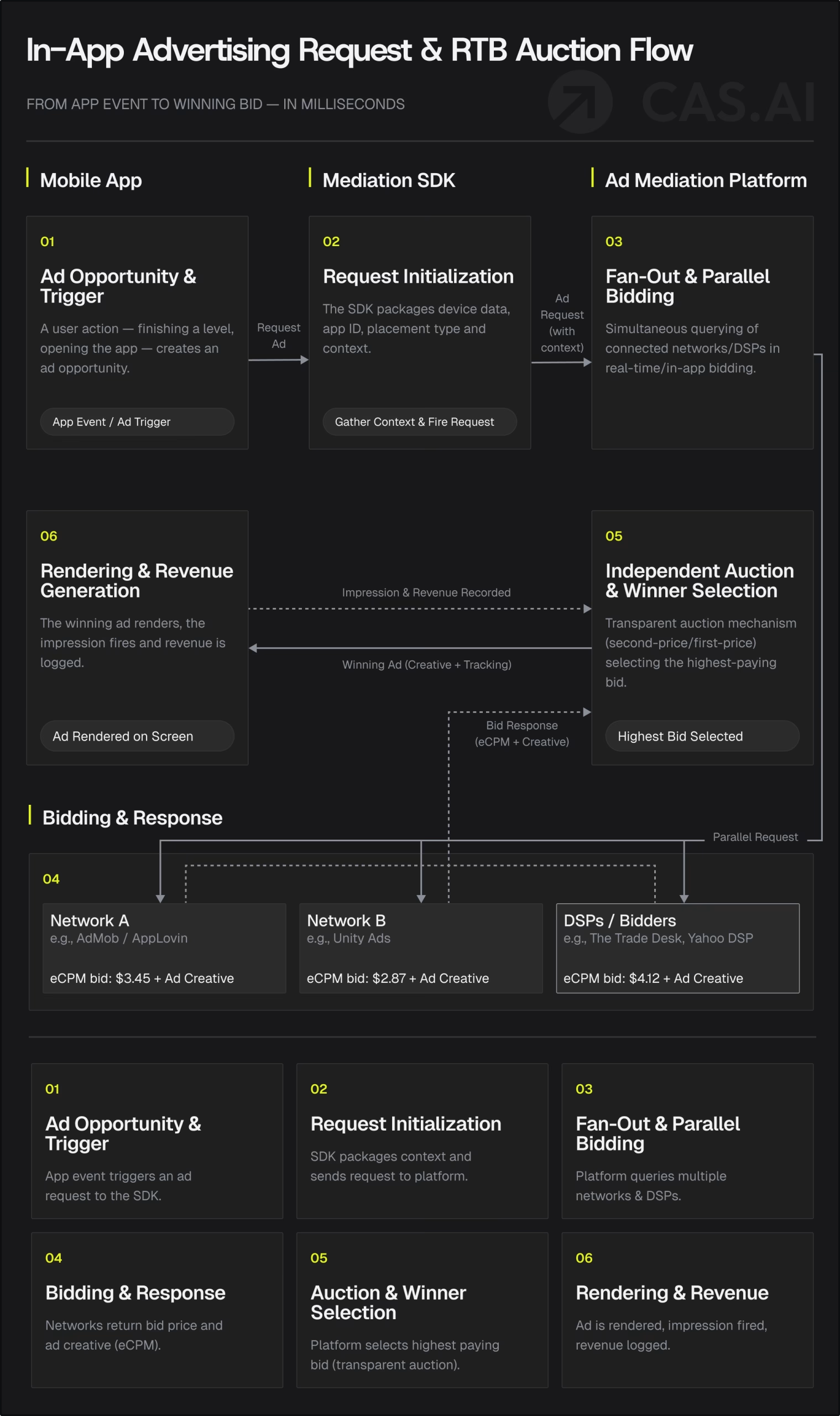
Mobile in-app advertising runs on four roles. The publisher is the app itself , you own the inventory, meaning the ad slots your users see. The ad network aggregates advertiser demand and sells it into that inventory. The demand-side platform, or DSP, buys impressions programmatically on behalf of advertisers, typically bidding in real time for each one. Ad mediation sits above it all, running networks and DSPs against each other for every impression so you don’t have to manually juggle SDKs or a fixed waterfall.
Here’s what happens technically, in the roughly 200 milliseconds between the ad slot opening and the ad rendering:
- The app triggers an ad request , a banner loads, a level ends, a reward is requested.
- The request hits the mediation SDK, which packages it and sends it out to connected demand sources.
- A real-time auction runs across networks and DSPs simultaneously, each bidding what that impression is worth to them.
- The highest bid wins the auction and fills the slot.
- The ad renders, the impression is counted, and revenue is logged against your account.
The mediation layer turns this from a manual waterfall, where you rank networks by average historical yield and hope, into a real auction where every impression is priced on its own merits. For a deeper breakdown of how the layer itself is built, see our ad mediation glossary entry.
Core In-App Ad Formats and UX Impact
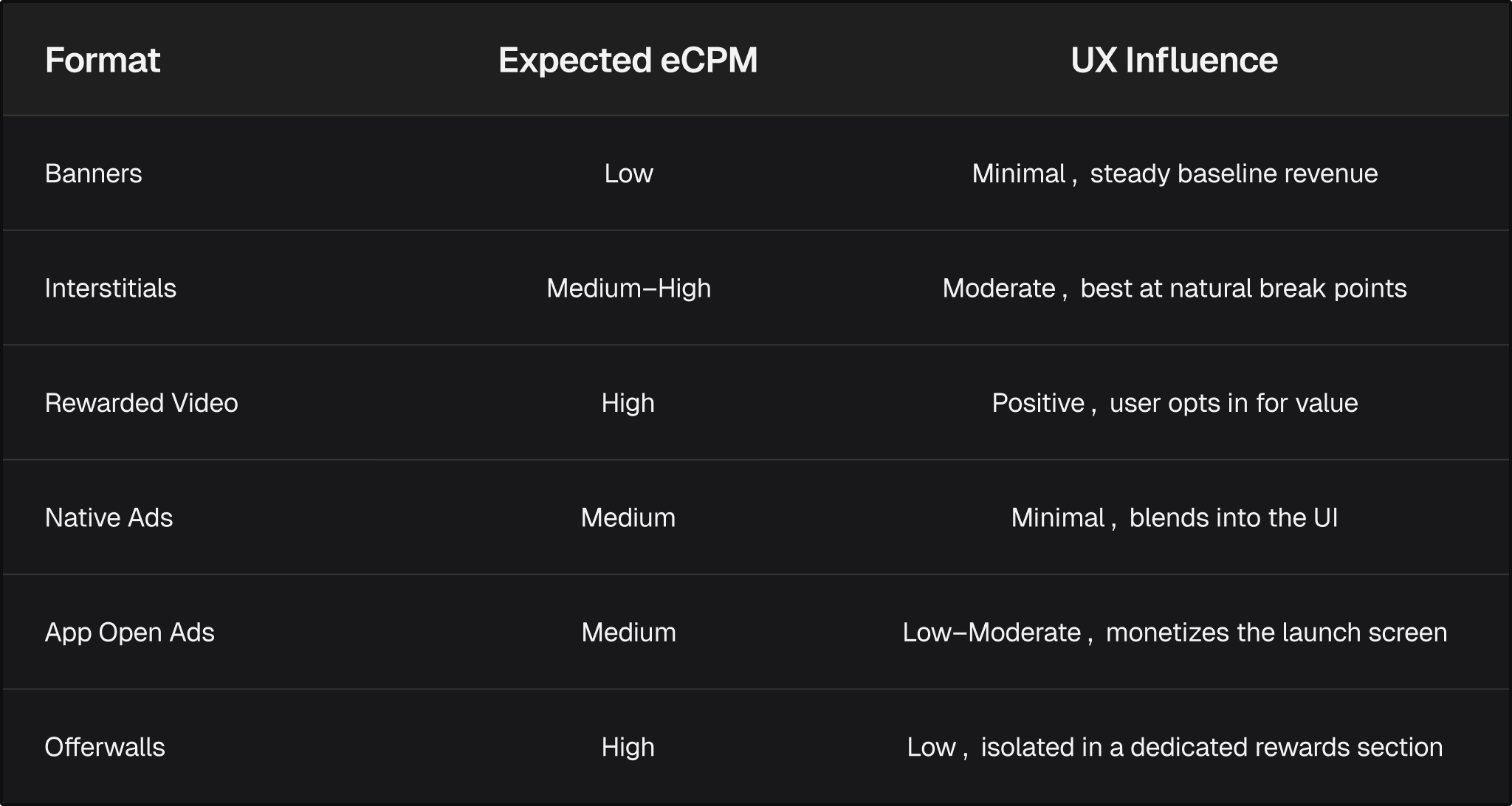
Six formats cover most in-app inventory. Each trades off yield against how much friction it adds for the user.
Banners
Small, persistent ads anchored to a screen edge. Low eCPM per unit, but they run continuously and add almost no UX friction, making them a steady baseline.
Interstitials
Full-screen ads shown at natural breaks , between levels, after a task completes. Higher impact and higher eCPM than banners, but placement timing matters more than any other format on this list.
Rewarded Video
The user opts in, watches a full video, and receives something in exchange , extra lives, in-game currency, unlocked content. Because consent is built in, engagement and eCPM both run high, and retention holds up even at frequent exposure.
Native Ads
Formatted to match the surrounding UI , a feed item, a list entry. Mid-tier eCPM, but the lowest perceived intrusion of any format that isn’t opt-in.
App Open Ads
Shown on cold or warm start, before the user reaches any content. Monetizes a screen that would otherwise be dead time, at the cost of adding a beat to your launch sequence.
Offerwalls
A dedicated screen listing multiple reward actions , install an app, complete a survey, hit a milestone. Common in gaming and utility apps with reward economies; eCPM per completed action is high, and because it lives on its own screen, it doesn’t touch the core UX.
For placement patterns and sizing specs for each format, see our mobile ad formats guide, or look up any term above in the glossary.
How to Calculate and Scale In-App Advertising Revenue
In-app advertising revenue comes down to one formula: impressions × eCPM, divided by 1,000, since eCPM is priced per thousand impressions. Grow either side of that equation and revenue moves , more impressions through more active users or more ad-eligible sessions, or a higher eCPM through better demand and format mix.
Four factors move eCPM more than anything else:
- Geo-location tier , Tier-1 markets (US, UK, Western Europe, Australia) typically clear several times the eCPM of Tier-2/3 markets for the same format.
- Fill rate , an unfilled request earns nothing, so a mediation stack with more connected demand sources fills a higher share of requests, even before eCPM is factored in.
- Ad format mix , rewarded and offerwall formats generally out-earn banners per impression, but only where the app’s engagement loop supports opt-in formats.
- Depth of demand sources , more networks and DSPs bidding on the same impression means more competitive pressure and a higher clearing price.
Exact benchmarks vary widely by vertical , a casual game and a utility app with the same DAU can see very different eCPM ranges , so treat published averages as a starting point, not a target.
For real revenue outcomes across different app categories, see our results and case studies.
In-App Ads vs. In-App Purchases: Why Hybrid Wins
Ad-supported monetization earns from every user, including the roughly 95%+ of mobile users who never make a purchase. In-app purchases (IAP) earn more per paying user but nothing from anyone else. Subscriptions sit between the two , recurring revenue, but only from users willing to commit upfront.
Top-grossing apps rarely rely on just one. A hybrid model runs ads for non-paying users while offering paying users premium features, an ad-free tier, or both , capturing revenue from the full user base instead of leaving the non-paying majority monetized at zero. The trade-off is coordination: ad frequency and IAP offers both compete for the same attention, so they need to be tuned together, not run as separate workstreams.
For a full breakdown of hybrid monetization setups, see our app monetization guide.
Proven In-App Advertising Strategy and Best Practices
The formats and the math only pay off if the strategy around them protects the user experience. Three practices matter most.
Frequency capping
Cap interstitials to roughly one every 3–5 minutes of active session time. Beyond that, incremental revenue per extra impression drops off while churn risk climbs , the cap protects long-term ARPU, not just the current session.
Rewarded ads as a value exchange
Rewarded video only works if the reward is worth the 15–30 seconds it costs. Tie it to something the user already wants , an extra life, a currency boost , rather than bolting it on as a generic option, and engagement holds up even at high frequency.
Floor prices and continuous testing
Set smart floor prices per placement rather than one blanket floor across the app , a floor that’s right for a rewarded slot will suppress fill on a banner slot. Run continuous A/B tests on layout, placement, and floor changes rather than one-off adjustments; eCPM environments shift by geo and season, so a static setup decays.
Quick checklist
- Cap interstitial frequency to protect session length and retention
- Reserve rewarded formats for genuine, opt-in value exchanges
- Set floor prices per placement, not globally
- A/B test layout and floors on a continuous cycle, not a one-time launch
- Review fill rate and eCPM by geo monthly, not just in aggregate
Maximizing eCPM Through Advanced Ad Mediation
A robust in-app advertising platform earns its keep through the mediation layer: aggregating demand from many networks and DSPs at once forces them to compete for every impression, driving fill rate and eCPM up together instead of trading one off against the other.
CAS.AI runs this as independent, real-time auctions across 20+ ad networks and 150+ DSPs , every impression priced on its own, not slotted into a fixed waterfall , backed by a no-loss guarantee so switching mediation providers doesn’t put existing revenue at risk while you test the difference.
See the full mediation setup at CAS.AI
Frequently Asked Questions About In-App Advertising
What is in-app advertising?
Showing ads inside a mobile app to earn revenue from users, alongside or instead of charging them directly.
How does in-app advertising work?
A mediation SDK auctions each ad request in real time across connected ad networks and DSPs, and the highest bid fills the slot.
How much in-app advertising revenue can I make?
Revenue is impressions × eCPM, and it varies significantly by ad format and geo , see our eCPM guide for typical ranges.
In-app ads vs. in-app purchases , which is better?
Most top-grossing apps run both. A hybrid model captures ad revenue from non-paying users while still selling IAP or subscriptions to users willing to pay.
How do I increase in-app ad revenue?
Add mediation to widen demand, diversify your ad format mix toward higher-eCPM formats where UX allows, and optimize floor prices continuously rather than setting them once.
In-app advertising isn’t one lever; it’s the ecosystem, the format mix, the math, and the mediation setup working together. Get the mediation layer right and the rest compounds.