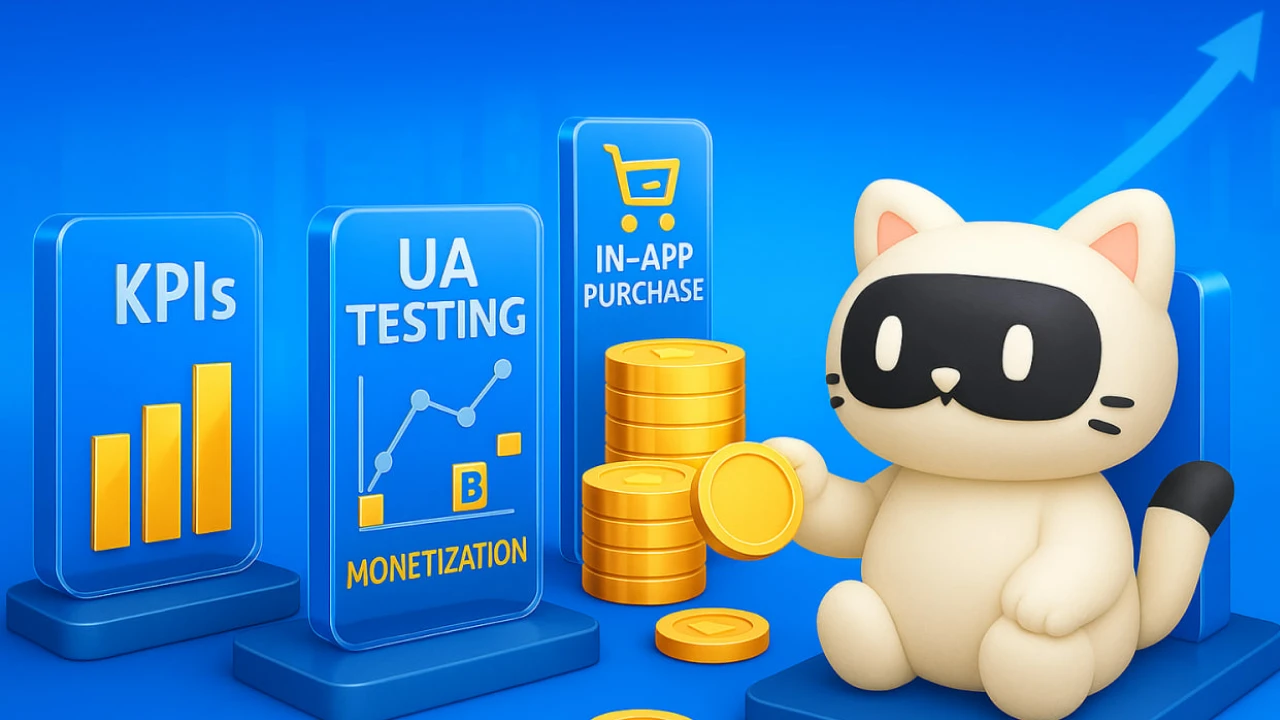
CAS.AI mobile publishing: KPIs, UA testing, monetization, in-app purchase

CAS.AI Method in Action: Reliable, Scalable Mobile Publishing

October 17, 2025 6 min read

At CAS.AI we do mobile publishing the pragmatic way—clear KPI gates, Tenjin-powered analytics, and ILD monetization—so we’re scaling apps efficiently, not blindly. Start small, validate, then grow what works.

Who We Are

PSV games started in Ukraine and moved its headquarters to Cyprus in 2014. Today we operate two offices in Cyprus and one in Ukraine, with a 150-person distributed team. Our portfolio includes roughly 500 apps: about 300 kids’ games (including our own Hippo brand and licensed IP like Masha and the Bear, LOL, etc.) and around 100 non-kids titles. Actively, we run UA for ~100 apps, with 40–45 of them receiving major acquisition scale at any time.

From Mediation to Mobile Publishing

We initially built our own monetization stack and mediation (“CAS.AI”), then partners asked for help with UA because monetization performance was strong. This is how our publishing arm was born about 18 months ago. We now publish and scale UA for roughly 20 external studios, supporting marketing, UA, and monetization end-to-end.

How We Evaluate New Games

Before committing to scale, we review in-game metrics and run a small paid UA test. We primarily focus on hyper-casual and casual genres. Our baseline acceptance thresholds:

  • Retention. D0 (Day 0): ≥ 20% • D7: ~5–7% • D30: ~2–3% (higher is better).
  • Playtime / session length. Casual & hyper-casual: 7–10 minutes per session is a solid starting point.
  • Ad load & formats. Ad-only games: ~5–7 ad impressions per user/day. If mostly interstitials: target ~7/day. If interstitial + rewarded mix: ~5–7/day total (e.g., ~5 interstitials + 2 rewarded, adjusted via tests). Banners can lift LTV ~10%, but watch UX: they often bother users unless placed carefully.

Recommendation for studios: Set genre-specific guardrails, not absolutes. Use these benchmarks to decide “go/no-go” after a small test, then tune per cohort (geo/device/channel).

UA Testing for Mobile Publishing Scale

We start with small budgets—typically $150–$200 per channel—to validate economics before scaling. Historically we began with Google Ads + Firebase, but today we diversify channels. Example: a recent Mintegral test passed our KPI, so we scaled spend and added sources.

A typical early KPI might be D0 ROAS ≥ 67% (illustrative; varies by genre/country). If ad-mediation revenue on D0 exceeds the KPI threshold, we greenlight scaling and broaden channels.

Recommendation for studios: Define a per-genre D0/D1/D7 ROAS template (and margin of error). If a channel beats your target with stable retention and CPMs, promote it to your “always-on” set.

Monetization Stack and Impression-Level Data (ILD)

We operate our monetization via CAS.AI mediation and collect impression-level revenue data (ILD). For every ad impression, we know the network, placement, format, and revenue. This feeds our dashboards and lets us see which combinations of network × geo × format × placement drive profitable scale.

  • Ad-first games: start with interstitial + rewarded; add banners only with no UI overlap and good viewability.
  • Hybrid games: lead with rewarded, add native/immersive where you can provide 2+ seconds of safe on-screen time, and place interstitials only at clean milestones.

Recommendation for studios: Treat ILD as a must-have. It’s the fastest way to spot dying placements, underperforming networks, or geos with inefficient CPMs.

Analytics: Tenjin as the MMP and Data Backbone

  • Attribution + MMP basics (our single source of truth for UA).
  • Raw Data + DataVault access for analytics engineering.
  • Custom dashboards by game/platform/geo/channel/campaign.
  • Cohort breakdowns for ROAS, retention, LTV, CPM/eCPM, CTR/CR by country, device, source, and creative.

We import historical data (last 30/90/120 days) to analyze behavior and forecast LTV. Then we align creative and channel strategy with the best-performing cohorts.

Learn more about our analytics approach in thisTenjin × CAS.AI interview with our CMO , where we discuss DataVault usage, ILD workflows, and ROAS tracking in practice.

Recommendation for studios: Start with an MMP that gives you raw data. Let your analytics team own a single self-serve dashboard with the exact cuts UA managers need (channel × geo × D0/D7 ROAS, retention, CPI, eCPM).

Reporting, Access, and Collaboration

Internally, different teams (UA, analytics, monetization) receive role-based access (e.g., admin for analytics to build dashboards, read raw data). For publishing partners, we grant scoped access—they can see only their own apps and create reports. This transparency speeds up joint decision-making without exposing unrelated portfolios.

Recommendation for studios: Implement RBAC and per-app scoping for partners. Transparency builds trust; isolation protects data.

Example Outcome (What “Pass” Looks Like)

  • Early test on a new network meets/exceeds D0 KPI (e.g., ≥67% ROAS).
  • Ad mediation shows higher-than-target D0 revenue per user.
  • Retention and session length hold under added ad load.

Decision: scale spend, add more channels, iterate creatives, and retest geos with best early CPMs.

What Other Studios Can Apply (Actionable Takeaways)

  • Define acceptance KPIs per genre — use D0/D7/D30 retention and D0 ROAS guardrails to decide “test → scale” quickly.
  • Start small; prove unit economics — $150–$200/channel is enough to validate before you ramp.
  • Ad mix by design. Hyper-casual: 5–7 impressions/day total; interstitials at clean breaks; rewarded for boosts; banners only if they don’t harm UX. Hybrid: lead with rewarded + native/immersive; interstitials only at milestones.
  • Collect impression-level data (ILD) — prune weak placements, negotiate floors, and tune waterfall/bidding strategy.
  • Use an MMP with raw data — Tenjin (or similar) + a central dashboard by geo × channel × campaign accelerates decisions.
  • Segment by geo from day one — your D0 KPI in Tier-1 vs Tier-3 will differ. Don’t average them.
  • Respect UX — banners can add ~10% LTV only if they avoid UI overlap and accidental clicks.
  • Scale only what passes — if a channel beats your KPI and retention holds, move it to “always-on.” If it slips, pause and triage.

Closing: CAS.AI’s Way of Mobile Publishing and Scaling Apps

CAS.AI evolved from a kids-games studio to a global publishing and mediation platform by standardizing acceptance KPIs, testing UA in small, data-driven steps, running ad monetization on ILD, and building analytics on reliable MMP data. If you’re a studio looking to publish or to scale UA/monetization, adopt these practices—then iterate relentlessly.

Interested in publishing or mediation support?

Get in touch with CAS.AI. And if you need an MMP that scales with you, Tenjin remains a simple, powerful choice for attribution and raw data workflows.


Helpful resources

Oleg Shlyamovych
Oleg Shlyamovych CEO & Co-Founder, CAS.AI

12+ years in mobile monetization. 500+ apps, 5B+ downloads.

Last updated: View all articles →

Explore More

Abstract 3D digital technology platform block representing ILRD Impression Level Revenue Data for mobile game monetization.
AdTech & Monetization

ILRD Is Not a Setting. It’s the Foundation of Your Monetization Stack.

ILRD isn’t just a setting. It’s the base of your monetization stack. If you’re still looking at yesterday’s aggregate revenue and calling it “performance,” you’re flying blind. In modern user acquisition (UA), seeing $27,000 in daily revenue doesn’t tell you whether your campaigns are profitable, whether your ad frequency test is working, or whether your cheapest advertising channel is quietly hurting lifetime value (LTV). Impression-Level Revenue Data (ILRD), which measures revenue earned per individual ad impression, changes that. It connects every ad impression to a real user, specific device, and the original traffic source, turning return on ad spend (ROAS) optimization, analyzing groups of users over time (cohort analysis), and combining ads with in-app purchases (hybrid monetization) into measurable systems instead of relying on educated guesses. But IRLD isn’t just about turning it on. Waterfall floor math, bidding mechanics, alternative stores like RuStore, and Meta's platform restrictions can introduce discrepancies that quietly corrupt your signal and your UA decisions. In the full article, we break down what’s normal, what’s fixable, and what’s catastrophic. We also show you how to verify your IRLD before every build. If you’re using target Return on Ad Spend (tROAS) in 2026, this isn’t optional reading.

March 6, 2026 11 min read
CAS.AI mobile ad mediation dashboard displaying real-time analytics and revenue metrics on a dark background.
AdTech & Monetization

How to advertise your app

Programmatic advertising is an automated, real-time auction that determines which ad wins each impression in a mobile app. Inside the mediation SDK, the ad request goes out to every connected network and DSP simultaneously, not one at a time. Each bidder returns a price in milliseconds, and the highest bid wins before the ad ever renders. This is what separates in-app bidding from the older waterfall model, where networks are called in a fixed sequence, and lower-priority demand never sees the best impressions. With programmatic, every impression goes to whoever values it most, which typically results in higher eCPM and less manual reordering. Mobile adds its own constraints SKAdNetwork, Privacy Sandbox, and device ID limits that make in-app bidding a distinct engineering problem, not a straight port of web header bidding. Publishers access it through mediation platforms like CAS.AI, which connect networks and DSPs into a single real-time auction.

October 8, 2024 14 min read
Technical isometric diagram for Godot Engine mobile ad mediation, illustrating the network infrastructure to optimize and boost mobile game income.
AdTech & Monetization

Ad Mediation for Godot

Ad mediation is the essential middleman between your mobile game and multiple ad networks, ensuring you never leave money on the table. Instead of relying on a single provider, mediation triggers a real-time auction for every ad slot, allowing the highest bidder to win the impression. For Godot developers, this technology is a game-changer. By implementing a mediation layer, you can navigate the engine's unique SDK landscape while accessing high-paying formats like rewarded videos and interstitials. Platforms like CAS.ai streamline this process by connecting your project to over 20 networks and 150 DSPs through a single integration. This setup eliminates the "empty slot" problem, stabilizes revenue during seasonal shifts, and provides unified analytics. Whether you are building hyper-casual titles or complex midcore games, ad mediation can boost your total revenue by 30% to 60%, making it a non-negotiable tool for any serious mobile developer.

June 8, 2025 6 min read
Abstract 3D graphic with dark panels, glowing yellow grid lines, and data metrics representing CAS.AI technology.
AdTech & Monetization

High Season Playbook

Q4 ad monetization usually turns into a mad dash at the last minute, but the teams that actually win break the quarter into four sleek phases instead of treating it like one endless holiday sprint. The secret is to sync your strategy with the market’s mood swings: September and October are your time to fix tracking, rebuild those audience pools, and run scrappy, low-cost creative tests. Come November, it’s all about scaling up fast and tweaking price floors to catch those sky-high Black Friday eCPMs. By late December, the smart move is to double down on App Store Optimization and scoop up zero-CPI organic installs from all those shiny new devices getting unboxed. And when January rolls in, you get a golden window for cost-effective retention campaigns while CPMs take a nosedive. If you stick to this phased game plan instead of scrambling mid-season, you’ll keep your fill rates healthy, squeeze every drop from peak ad revenue, and set yourself up for user value that actually lasts past the holidays.

September 28, 2026 13 min read
Illustration of a magnet attracting currency icons, symbolizing user acquisition and app monetization alignment.
AdTech & Monetization

Bridging UA and Monetization

If you are running user acquisition and only checking IAP numbers, you are leaving a pile of money on the table. For games that mix ads and in-app purchases, watching just IAP RoAS is like trying to drive with one eye shut. The campaigns that seem like flops at first glance? Those are often the ones quietly pulling in ad revenue once you look at the full picture. The real problem is when UA and monetization teams are each stuck in their own corner, not sharing what they know. Once you start tracking ad revenue down to each user, everyone finally gets on the same page. Every rewarded video and interstitial can be traced back to its source, so both teams see the whole story: ARPU, LTV, RoAS, all together. Get everyone looking at the same numbers and watch your campaigns start to shine. Stop cutting off your best performers by mistake. Feed impression-level ad revenue into your bidding, dig up those hidden winners, and finally see the real results you have been after.

September 20, 2026 19 min read
CAS.AI mobile ad mediation dashboard glowing analytics graphic on dark background
AdTech & Monetization

ASO in 2025: How to Make Sure Your App Page Actually Gets Found

In 2025, App Store Optimization (ASO) is no longer a one-time checklist item, but a continuous, data-driven growth strategy essential for organic success. Publishing an app is only the beginning; intense competition on both iOS and Android means high-quality products can easily go unnoticed without robust optimization. Modern ASO demands a nuanced approach tailored to distinct platform algorithms. While the App Store indexes specific metadata fields like titles and subtitles, Google Play analyzes entire descriptions, penalizing keyword stuffing. Beyond text, visual assets—such as icons, screenshots, and preview videos—heavily influence conversion rates and user trust. Furthermore, effective localization goes far beyond simple translation to respect cultural contexts and local indexing rules. By pairing comprehensive semantic research with continuous A/B testing via tools like ASOMobile, publishers can systematically track competitor performance, refine hypotheses, and drive predictable organic traffic growth over time.

September 15, 2025 6 min read
Three smartphone mockups showcasing a mobile ad mediation dashboard with analytics tracking, revenue metrics, and user growth charts for publishers.
AdTech & Monetization

Ad Mediation: What is it & How does it affect Mobile App Monetization

Stop bleeding ad revenue (and ditch the manual mess) Managing multiple ad networks shouldn’t feel like a full-time job. If you’re still juggling fragmented dashboards or manually updating endless SDKs, you’re likely leaving money on the table. Ad mediation is the solution. By consolidating your networks into a single platform, you can automate the competition for your ad slots. Whether you use Waterfall, Real-Time Bidding, or a Hybrid model, mediation ensures that the highest-paying network wins every impression in milliseconds. Our latest guide breaks down: Maximum eCPMs: How bidding drives higher value for your inventory. Seamless Integration: One SDK for Unity, Flutter, React Native, and more. Smart Analytics: Using real-time data to optimize fill rates and ARPDAU. Don’t treat monetization as an afterthought. Build a system that works intelligently on your behalf so you can focus on building great apps.

February 5, 2021 7 min read
eCPM mobile app monetization
AdTech & Monetization

What Is eCPM? Formula, Benchmarks & How to Increase It │CAS.AI

If you're a publisher, eCPM (effective cost per mille) is the revenue you earn for every 1,000 ad impressions. It's calculated with a simple formula: divide total ad revenue by total impressions, then multiply by 1,000. Unlike CPM, a fixed price that advertisers agree to upfront, eCPM reflects what you actually earned after accounting for fill rate, bids, and everything else. But the number alone means little without context. A $1.50 eCPM for a banner in Latin America is not the same as a $1.50 eCPM for rewarded video in the US. Format, geography, platform, and seasonality all move the needle. For publishers, the most reliable way to push eCPM higher? Competition. The more networks bidding on each impression in real time, the better your realized revenue. Publishers who switch to independent mediation typically see revenue per user jump 1.5–2x. That's not theory; that's what the data shows.

January 18, 2026 18 min read

Maximize your ad revenue with CAS.AI

Smart mediation platform for mobile publishers and game developers.


6–16 chars · A–Z, digit & special (#!?$%&*()<>.,) · no spaces

Already registered? Your current password may predate these requirements — reset it instead of signing up again. Reset password

 
Telegram
WhatsApp
Slack
Phone