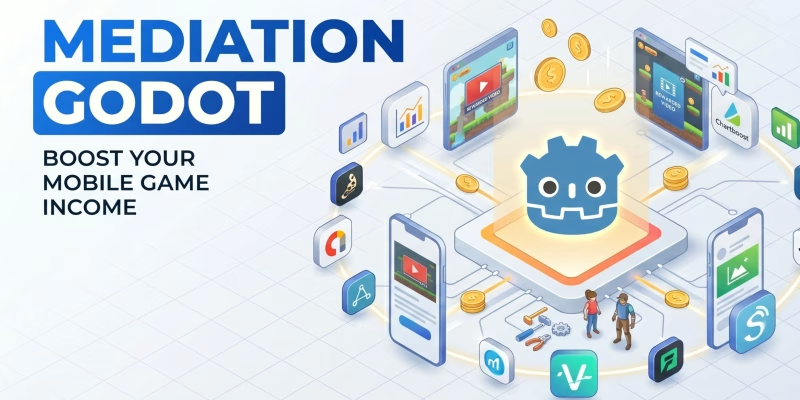
Ad Mediation for Godot: Guide to Maximizing Your Mobile Game Revenue
If you’ve ever tried to make money from ads in your Godot game, you know the drill. One ad network dries up, your eCPMs bounce all over the place, and half the time you’re staring at empty ad slots that could have been cash. That’s where ad mediation comes in. In this guide, I’ll break down what ad mediation actually does, how it fits into your Godot project, and why picking the right platform can make a real difference to your revenue.
Let’s start by answering the basic question: what is ad mediation?
Ad mediation is basically a middleman between your game and a bunch of ad networks. Instead of plugging in a single network and crossing your fingers, mediation lets you run a live auction every time you need to show an ad. Whoever pays the most gets the spot, and you get the best deal for every impression.
It’s a bit like running your own stock exchange, but for ads. Each time a player hits an ad spot in your Godot game, the mediation layer calls up all the networks, lines up the bids, and picks the winner in a blink.
If you’re working solo or in a small team with Godot, this stuff matters a lot. Godot doesn’t have the same buffet of ad SDKs as Unity or Unreal, so picking the right mediation setup is even more important if you want your game to actually pay the bills.
How Ad Mediation Works
Here is the lifecycle of a mediated ad request in a Godot mobile game:
- Your game calls an ad placement (e.g., an interstitial after a level).
- The ad mediation platform receives the request and queries all connected ad networks.
- Networks respond with bids – either via programmatic ad mediation (real-time bidding) or via historical eCPM waterfalls.
- The highest bid wins. The winning network serves the ad.
- Revenue data is aggregated in a single dashboard across all networks.
Most mediation platforms these days handle video ads too—rewarded videos, interstitials, even offerwalls. These formats usually pay way better than boring old banners. If your Godot game has natural breaks, like finishing a level or getting a new life, dropping in a rewarded video ad through mediation is one of the best ways to boost your earnings.
AdMob Mediation and eCPM: What Developers Need to Know
Most Godot devs start with AdMob. Google’s docs are solid, and the fill rate is hard to beat. But if you only use one network, you’re leaving a lot of money on the table.
eCPM from any single network jumps all over the place depending on where your players are, what kind of ads you show, and even the time of year. Q4 is a gold rush thanks to holiday ads, but Q1 is a ghost town. With mediation, you don’t have to sweat these ups and downs. If one network pays less, another can step in and keep your revenue steady.
When configuring AdMob mediation, pay close attention to:
- Floor price settings: setting the floor too high kills fill rate; setting it too low leaves money on the table.
- Waterfall ordering – networks with historically higher eCPMs should sit higher in the waterfall.
- Bidding adapters – newer networks support open bidding (programmatic), which can outperform static waterfall positions.
Choosing the Best Ad Mediation Platform for Godot
Not every top ad mediation platform has a native Godot plugin, which is the first filter to apply. Your choices broadly fall into two categories:
SDK-based platforms with Godot GDNative / GDExtension wrappers. You or someone in the community has to keep the bridge between the ad platform’s native SDK and Godot’s GDExtension working. The good news is you get all the features. The bad news is you’ll need to do some maintenance every time Godot updates.
Web-based / REST API mediation solutions. Some mediation platforms let you do the auction on their servers before the ad even hits your player’s device. These are easier to hook up with Godot’s HTTPRequest node, but you might have to trade off some speed or ad variety.
One platform worth highlighting for Godot developers is CAS.ai — an independent mobile ad mediation platform with RTB, DSP access, and connections to 20 top ad networks plus 150+ DSPs including AdMob, ironSource, Unity Ads, AppLovin, and Mintegral. With a single SDK integration and one unified dashboard, it removes the burden of managing each network separately. CAS processes 1M+ requests per second to maximize eCPM on every impression and is already running across 1.8B+ devices in 5,000+ apps. For developers evaluating options, CAS offers a no-loss guarantee — if your current platform outperforms CAS in an A/B test, they pay the difference.
When evaluating the best mobile ad mediation option for your Godot project, weigh these criteria:
- Number of connected demand sources: more networks mean stronger competition and higher eCPMs. CAS connects to 150+ DSPs and 20 top networks out of the box.
- Programmatic ad mediation support — open bidding and header bidding outperform static waterfalls over time. CAS uses full RTB auctions with no network prioritization, keeping competition fair and revenue maximized.
- Video ad mediation formats — rewarded video support is non-negotiable for midcore and casual games. CAS supports rewarded video, interstitial, banner, MREC, and native ads.
- Reporting granularity — can you break down AdMob mediation eCPM by placement, country, and OS version? CAS provides a unified dashboard with transparent auction reporting.
- Godot SDK availability — native GDExtension support vs. manual bridging effort. CAS uses a single SDK integration model, reducing overhead regardless of engine setup.
- Minimum payout thresholds and payment terms — critical. CAS offers custom contracts and invoices with 24/7 support to handle commercial arrangements directly.
A Note on Unreal Engine
If you’re coming from Unreal or just comparing, you’ll notice Unreal has way more official mediation plugins. That’s because it’s a bigger commercial target for ad networks. But Godot’s open-source setup and lightweight engine make it a great fit for hyper-casual and casual games—the exact types where ad money matters most. The same mediation rules apply to Unreal, you just get more plugin choices there.
Why You Should Implement Ad Mediation in Your Godot Game
The business case is straightforward:
- Higher eCPMs – competition between networks raises the price per impression.
- Better fill rates – if one network has no inventory in a geography, another fills the gap.
- Reduced SDK maintenance – one mediation SDK replaces five individual network integrations.
- Unified analytics – a single dashboard tracks revenue across your entire ad mediation network stack.
- Format diversification – easily test banner, interstitial, and rewarded video performance. If you’re launching your Godot game on Android or iOS and you care about making real money, you need ad mediation. Sticking with just one network will always leave you behind. A good mediation setup can boost your ad revenue by 30 to 60 percent, sometimes even more.