

Getting Ad Monetization Ready Before the Q4 Rush
Q4 is never a surprise. Everyone in charge of monetization or product knows it is coming. Still, every year, teams end up in a last-minute rush in late September, scrambling to get their setup ready for the flood of demand. The issue is not that people forget. It is that they do things in the wrong order.
The teams that win in Q4 are the ones who break it into four clear phases, not just one big holiday sprint. The tricks that work in September can backfire in November. The moves that pay off during Black Friday can drain your budget in January. Here is how we actually tackle Q4, step by step, with the eCPM and fill-rate numbers that guide us at each stage.
This playbook is for the people who actually have to deliver results. If you are the one watching eCPM dashboards, deciding where your engineers spend their time, or trying to hit a yearly target that Q4 can make or break, this is for you. Everything here is what we do ourselves, tweaked each year based on what went wrong last time.
Why does Q4 break so many monetization setups
Here’s the thing: eCPMs, fill rates, and buyer behavior don’t politely ease into Q4 – they leap. Big brands and retailers flood in around mid-November, keep the party going until mid-December, and then disappear almost overnight. If you’re still running your setup like it’s October, you’ll either miss the gold rush or get stuck with bargain-bin prices when the buyers ghost you in January.
Publishers who plan Q4 as a single “turn everything up” event tend to see one of two failure patterns:
- Under-preparation looks like this: your tracking is messy, and your audience segments are out of date. When the November rush hits, your mediation cannot keep up. Your eCPM does not rise as much as it should during the most valuable weeks.
- Over-correction is the opposite problem. You raise your floors too soon or too high, and all of a sudden you lose impression volume in October before the demand is even there, right when you need it for testing..
The fix is a phased plan. Here’s ours.
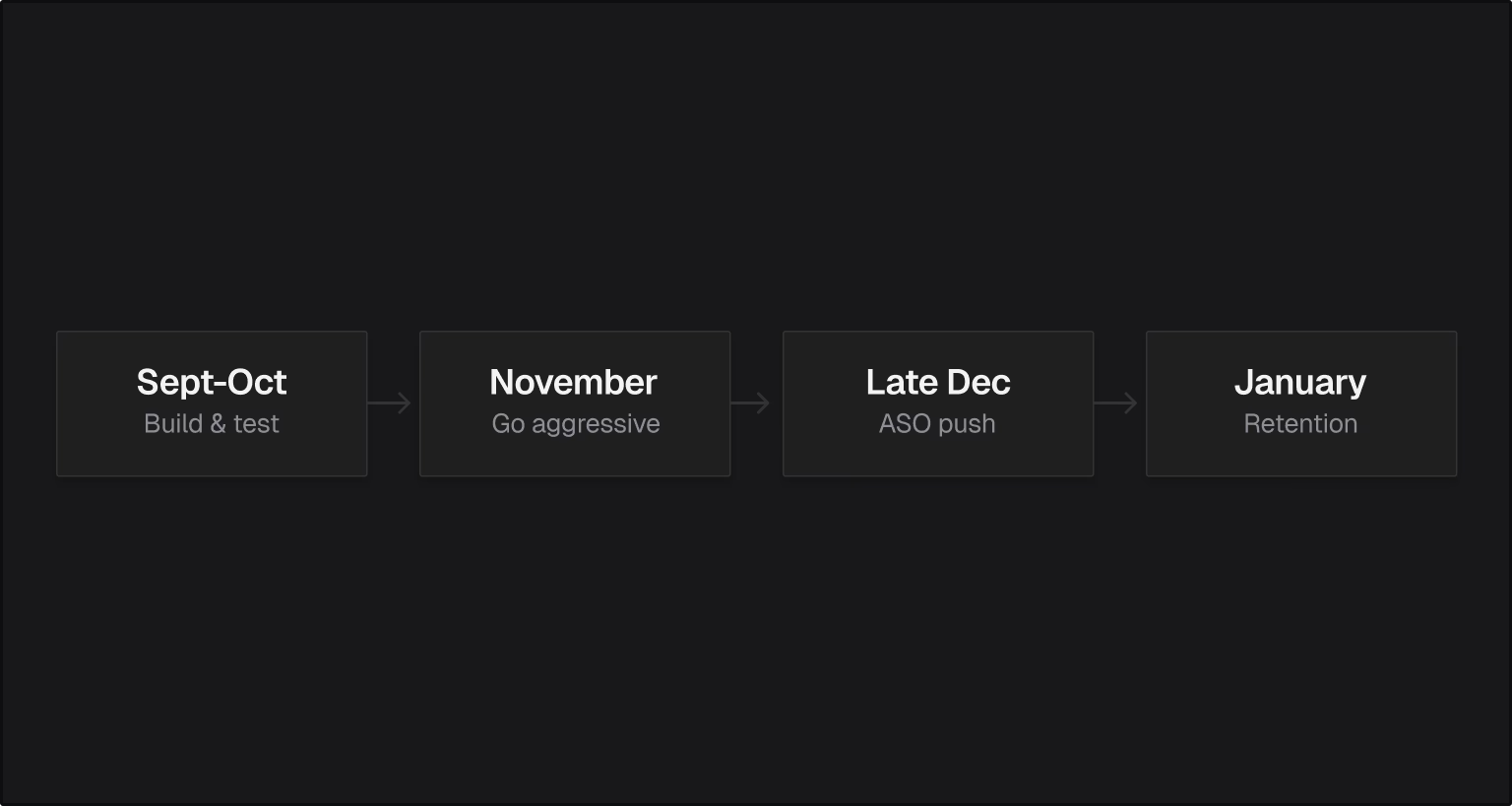
September–October: Build the audience pool, fix your tracking, test creative.
This is the least exciting part of Q4, but it is the one that will decide whether November actually delivers. First, you fix your tracking. Then, you test your creatives.
Get your tracking airtight before you need it.
If you’ve ever watched a Q4 unravel in slow motion, you know the usual suspects: a postback that quietly breaks, a SKAdNetwork setup stuck in last year, or an attribution window that never got the memo. In the sleepy days of September, these glitches barely make a stir. But come November, they’re draining your revenue and making DSPs ghost your inventory, all because your eCPM is putting on a bad show.
Before October ends, confirm:
- Server-to-server postbacks are firing correctly across every ad network and DSP in your waterfall, not just your top three by volume.
- SKAdNetwork conversion value mapping reflects your current monetization events, not a schema from two quarters ago.
- Your MMP dashboards and your internal BI numbers agree within a small margin of error; if they don’t, find out why now, not during Black Friday week.
Rebuild and segment your audience pools.
Audience quality builds over time. A user you bring in and keep around in September is worth more in November than someone who shows up cold during Black Friday. You have more data on them, so bidders know what they are getting. Use September and October to:
- Re-engage lapsed users who are likely to respond to holiday-season creative, rather than starting from a cold start in November.
- Build out lookalike and value-based segments now, while CPMs are still cheap, so they’re mature and reliable by the time demand peaks.
- Clear out any segments that have not converted or engaged in the last two or three months. Carrying dead weight into Q4 just drags down your average bid.
Test creative before CPMs make testing expensive.
Now is the time to try new things: new ad formats, new video placements, new timing for interstitials. CPMs are at their lowest, so testing is cheap. If a test flops in September, you lose a little. If you wait until November, a bad test can cost you real money during the most valuable weeks.
Think of September and early October as the warm-up act: eCPMs are typically 15 to 25 percent below the Q4 headliner. That gap? Consider it your playground for testing. Spend it with purpose. By Halloween, you should have a crystal-clear sense of which creatives and placements are stealing the show. Come November, it’s time to go all-in on your winners – no more rolling the dice.
November: Black Friday and the demand spike, go aggressive, on purpose
When Black Friday week hits, everything changes. Fill rates and eCPMs jump as advertiser demand floods in, especially from retail and finance. If your setup is ready, you get rewarded. If not, you miss out.
Scale spend and floors together, not floors alone
It is tempting to jack up your price floors as soon as demand jumps. That is not wrong, but you also need to ramp up user acquisition at the same time. If you only raise floors, you end up with fewer, more expensive impressions and your total revenue does not move. Raising floors lacking additional supply just shrinks your funnel.
Consider this your heads-up: eCPMs tend to soar a cool 30 to 60 percent above your October baseline during Black Friday week. Retail and shopping apps are the real winners here, raking in the biggest gains. If your mediation setup is dialed in, you should see more DSPs jump into the bidding frenzy and eCPM climb accordingly. If DSP participation drops off this week, the culprit is your configuration, not the market.
Run promos and target buyers who are ready to convert.
November is not the time to test new creative on cold audiences. This is when you go after users who have already shown they are ready to buy or engage. Run your promos, limited-time bundles, and Black Friday creative at the warm segments you built up in September and October.
Practically, this means:
- Prioritize UA spend toward lookalike audiences built from your highest-LTV Q3 cohorts.
- Push promotional and bundle offers through your highest-eCPM placements first, since that’s where the demand is concentrated.
- Monitor eCPM by network daily during Black Friday week specifically; this is the one week where a stale waterfall configuration costs you the most, the fastest.
Late December: Shift to app store optimization and device unboxing traffic
By mid-to-late December, the November eCPM party is winding down. But just as the confetti settles, a new crowd rolls in: people unboxing shiny new phones and tablets. Between December 24 and early January, millions of fresh devices light up for the first time, every single a blank canvas in the App Store. This is your moment to excel with updated creative, screenshots, preview videos, and icons that actually speak to someone seeing your app for the very first time. No brand baggage, just pure curiosity.
- Update keyword targeting and metadata to capture “new phone” and holiday-adjacent search behavior, which spikes predictably between December 24th and January 2nd.
- Focus on making the first steps easy for people who have never used your app before. Around the holidays, many installs come from folks unwrapping a new device and setting it up for the first time, not from someone clicking an ad.
eCPMs are dropping from their November highs, but new device installs are way up. That means your total ad revenue can still hold steady, even if each impression is worth less. The teams that win here are not chasing eCPM. They are scooping up cheap installs through organic and ASO while ads settle down.
January: Everyone else slows down.
January is when the calendar finally works for you, if you are watching closely. Most advertisers are resetting their budgets, so demand and CPMs drop fast. Many publishers see this as a slow season and pull back. That is a mistake, in proportion. That’s a mistake.
Low CPMs in January mean you can run re-engagement and retention campaigns for less. The users you picked up in November and December are now in your app, and this is the key window to keep them. Now is the time to bring them back, because it is cheaper than any other point in the quarter.
Concretely, that means:
- Now’s the time to roll out those retention and win-back campaigns for your Q4 crowd, while CPMs are lounging a cool 20 to 40 percent below their holiday highs. No need to wait around for prices to snap back to their so-called normal in February or March.
- Analyzing Q4 cohort retention curves closely- day 7, day 14, and day 30 retention from your November and December installs will tell you which acquisition channels and creative actually delivered durable users versus one-time holiday spenders.
- Lock in the learnings from your Q4 A/B tests (which started back in September) into your always-on strategy before the next planning cycle begins.
Teams that go hard on retention in January end up with better full-year LTV, not just a good Q4. They keep users that competitors lose by pulling back too soon.
Forecasting benchmarks: what “normal” looks like across the quarter
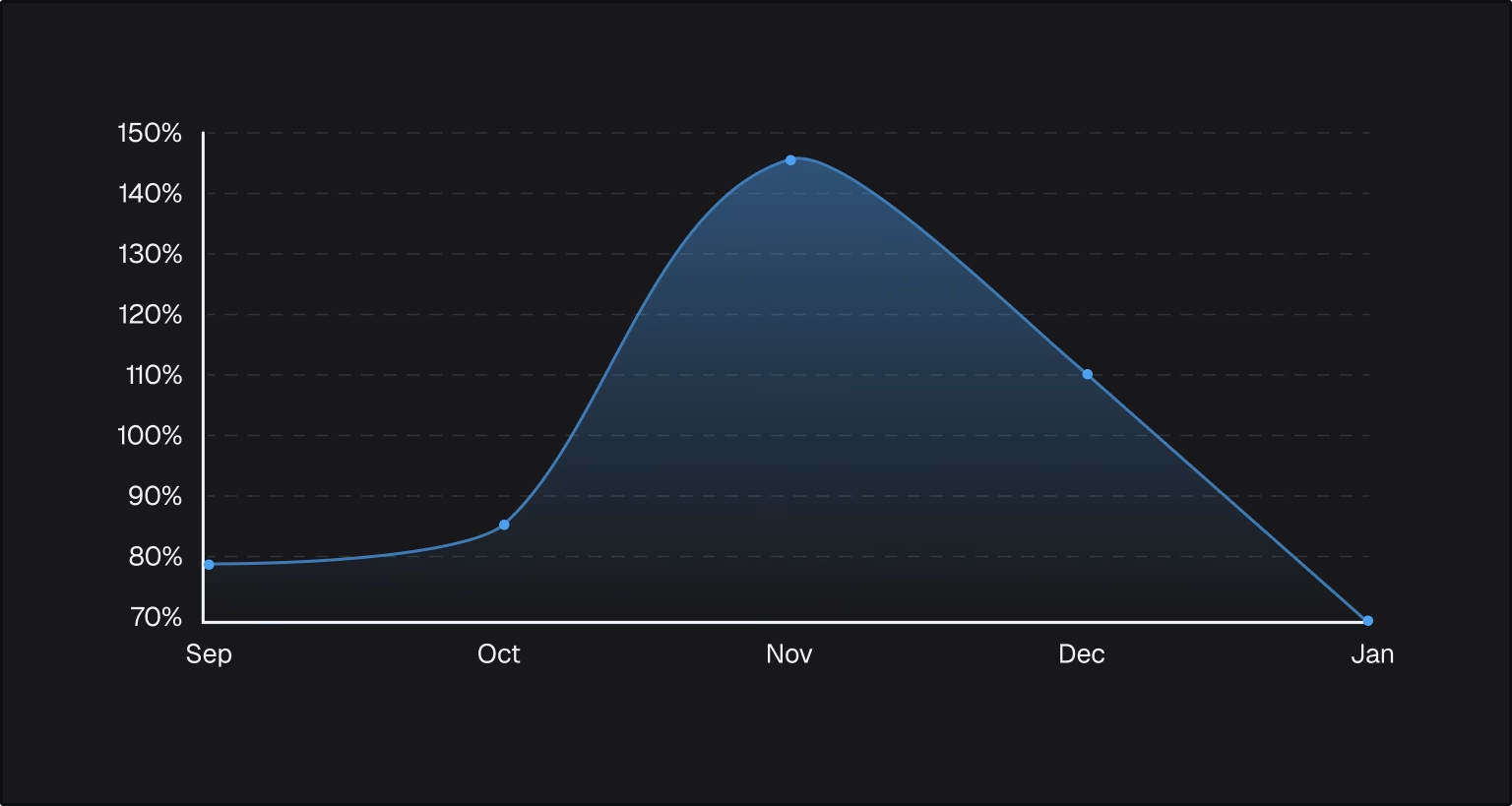
Every publisher’s numbers will differ by vertical, geo, and ad-format mix, but having a directional benchmark going into planning season helps you recheck your projections and spot problems early. As a general shape for Q4, relative to a September baseline:
- September and October are the warm-up act: eCPM hovers at 75–85 percent of the Q4 high.
- November is when things get flashy… If your waterfall is dialed in, that demand should show up directly in eCPM.
- By mid to late December, eCPM starts to mellow out, settling at a still-solid 100 to 120 percent of baseline. Meanwhile, install volume surges as all those freshly unboxed devices come online.
- January is the cooldown: Fewer DSPs stay active; this is your cue to pivot.
Treat these numbers as a starting point, not the final word. The real trick is to track your own week-over-week changes against last year’s Q4. That way, if your eCPM starts lagging against last year’s curve, you spot it early and can do something about it.
Where mediation actually earns its keep
All of this only works if your mediation layer can handle the ups and downs. It needs to scale demand response during the November spike, stay steady in December and not force you to babysit the setup when you are busiest. This is the part people miss until it breaks. A mediation setup that works fine most of the year can fall apart right when demand surges, which is the worst time to find a problem.
A mediation layer that can handle demand bursts on its own, without you tweaking floors and waterfalls every day, is what turns your Q4 plan into real revenue. Otherwise, you end up leaving money on the table during the two weeks that matter most.
The mistakes we see most often
We see the same mistakes over and over across publishers and studios. Each one can be avoided by raising floors too soon. Teams get excited in early October, see a good day, and hike up floor prices across the board. If demand is not there yet, so impressions go unfilled, and eCPM does not increase. This is the worst trade you can make when you need impressions for testing. For creative testing.
Thinking of Black Friday and Cyber Monday as a quick two-day sprint? Not quite. The real story is that demand stays sky-high from Thanksgiving week all the way through mid-December, with those two days simply stealing the spotlight. If you only gear up for the main event and then kick back, you’re leaving weeks of premium eCPM on the table.
Skipping the tracking audit because it worked last quarter. Attribution setups change all the time. Maybe you added a new SDK, a new ad format, or a DSP changed how it sends data. What worked in Q3 might not work in Q4. Finding out during Black Friday is way more expensive than spending half an hour on an audit in October.
Pulling back in January. This is the costliest mistake because you do not see the damage right away. A slow January just looks quiet. But the publishers who keep spending on retention while CPMs are low get more value from every user they acquired in November and December. The ones who stop spending let that value slip away.
Not segmenting device-unboxing traffic from ad-driven traffic in latNot separating device-unboxing traffic from ad-driven installs in late December. These two groups act very differently. One comes in cold from the app store; your ads warm up the other. Mixing them makes it hard to see what actually drove your December install spike. Realistically, by early September. The tracking audit and audience-pool rebuild described in the September–October phase need to be substantially complete before demand starts climbing in November, and both take longer than teams expect, especially tracking fixes that require coordination with ad network or DSP partners.
Should floor prices be adjusted manually through Q4, or left to automated rules? Manual floor management can work if you have the team bandwidth to monitor and adjust daily through November, but most teams don’t have that bandwidth during the periods that matter most. This is one of the strongest arguments for a mediation layer that automatically adjusts to demand; the alternative is a monetization manager trying to hand-tune waterfall floors during the highest-stakes week of the year.
How much should UA spend, specifically during Black Friday week? This depends heavily on category and historical ROAS data. Still, the general principle holds across verticals: scale spend toward audiences with proven high intent (warm lookalikes, retargeting pools built earlier in the quarter) rather than broad, undifferentiated scaling. Aggressive spend against cold, untested audiences during the highest-CPM week of the year is the fastest way to erode Q4 margins.
Is the late-December ASO push worth prioritizing over continued ad spend? Both matter, but they’re solving different problems. Ad spend in late December is competing against a shrinking pool of active holiday-season demand, while ASO captures a large, predictable wave of organic, zero-CPI installs from new device activations. Underinvesting in ASO during this window means paying to acquire users you could have gotten for free with a stronger app store presence.
What’s the single highest-leverage action for January? Cohort analysis on your Q4 acquisition, specifically day 7 and day 14 retention broken out by acquisition channel and creative. That data tells you which parts of your Q4 spend actually built durable users versus which parts bought one-time engagement, and it should directly inform how you allocate budget for the next full year, not just the next quarter.
The bottom line
Q4 is not just one big push. It is four phases, each having its own goal. Build and test in September and October. Go big and target warm buyers in November. Shift to ASO and new device installs in late December. Then focus on cheap retention in January while everyone else is resetting. The publishers who plan for the whole sequence, not just the spike, end up with a strong Q4 and an even better year ahead.