The Complete Header Bidding Guide: Everything Publishers & Developers Need to Know
Who This Guide Is For
If you’re a publisher, developer, or anyone involved in mobile app monetization – this guide is for you. Whether you’re just getting started with app monetization or you’re evaluating top ad mediation platforms to scale an existing operation, this guide walks you through everything: the what, the why, the how, and the what-next of header bidding.
We’ll also explore how header bidding connects to broader ecosystems, such as mobile game publishing, ad mediation solutions, and cross-platform development tools like ad mediation for Unity or Flutter.
Part 1: The Problem Header Bidding Solves
The Old Way Was Broken
To appreciate header bidding, you first need to understand what came before it – and why it failed publishers.
Waterfall mediation ranked ad networks in a fixed, predetermined order based on historical CPM data. The top-ranked network got first dibs on all available inventory. If it couldn’t fill everything, the remainder passed down to the next network. And so on. This is sometimes called daisy-chaining.
The result? A deeply inefficient market. A lower-ranked network might have been willing to pay more for a specific impression – but it never got the chance. Publishers left money on the table every single day.
This was especially painful for mobile app monetization, where impression volume is enormous and even small CPM improvements compound into significant revenue gains. For a casual game publisher or hyper casual game publisher dealing with millions of daily active users, waterfall inefficiencies were not a minor inconvenience – they were a structural revenue leak.
Open RTB Wasn’t Enough Either
Open RTB (Real-Time Bidding) improved things somewhat by introducing real-time auctions. But publishers still daisy-chained SSP and ad-exchange auctions sequentially, meaning true simultaneous competition never occurred. The informational asymmetry remained – publishers couldn’t see what all buyers were actually willing to pay at any given moment.
Header bidding was built specifically to fix this.
Part 2: Header Bidding Explained From First Principles
The Core Idea
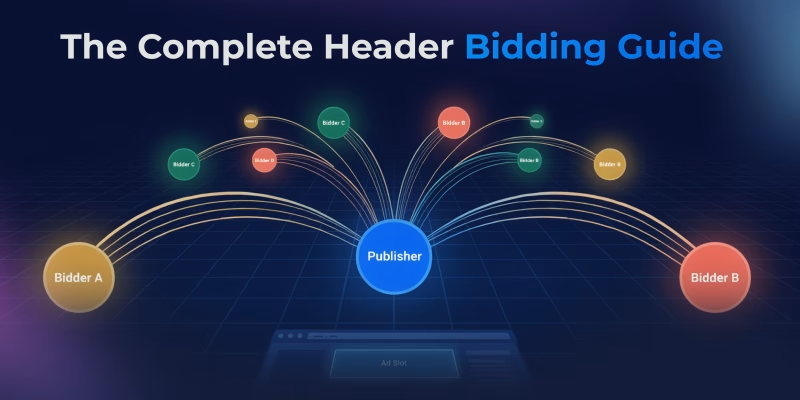
Header bidding flips the auction model entirely. Instead of asking buyers one at a time, it asks all of them at once – before the ad server ever gets involved. Every eligible buyer sees the same impression at the same moment and submits their best bid. The highest bid wins.
This is the foundation of truly competitive programmatic ad mediation: not a managed queue, but a live, simultaneous open market.
Where the Name Comes From
The name “header bidding” refers to the JavaScript code – called a wrapper – that sits in the <head> HTML element of a publisher’s webpage. This wrapper is invisible to readers but does the heavy lifting of coordinating the auction behind the scenes.
The wrapper:
- Connects to all demand partners simultaneously
- Manages bidding rules and timeouts
- Collects bids and passes the winner to the ad server
- Can add or remove demand partners without structural changes to the page
Think of the wrapper as the auctioneer – neutral, fast, and in control of the rules.
Part 3: The Two Types of Header Bidding Wrappers
Not all wrappers are created equal. There are two fundamental categories, and choosing between them has real consequences for your mobile app monetization platform strategy.
Proprietary Wrappers
A proprietary wrapper is built and managed by a third-party vendor. Setup is simpler, support is readily available, and most vendors bundle in data analysis tools to help you improve performance. Many also automate line-item creation in their ad servers.
Best for: Publishers and developers who want fast implementation without deep technical overhead – including those just beginning to explore best mobile ad mediation options or building their first game publishing platform integration.
Trade-off: You’re dependent on the vendor for updates, partner relationships, and rule-setting.
Open-Source Wrappers
Open-source wrappers – most commonly Prebid.js – give you complete control. You define the rules, the partner list, the timeout logic, and any custom functionality you need. This is the preferred path for publishers with strong engineering teams who want full clarity and flexibility.
Best for: Advanced operations operating complex ad mediation solutions, or platforms supporting ad mediation for React Native and Flutter, or other cross-platform environments in which custom behavior is vital.
Trade-off: Requires ongoing technical investment for setup, maintenance, and updates.
Part 4: Step-by-Step – How Header Bidding Actually Works
Here is the full sequence, from page load to ad display:
Step 1 – User arrives.
A visitor lands on a webpage or opens an app. The header bidding wrapper initializes instantly.
Step 2 – Simultaneous bid requests.
The wrapper sends bid requests to every connected demand partner – DSPs, SSPs, ad exchanges – all at exactly the same time. This simultaneity is the key differentiator from the waterfall.
Step 3 – Partners evaluate and bid.
Each demand partner assesses the impression based on their data: who the user is, what the context is, and what they’re willing to pay. They return their bids to the wrapper.
Step 4 – Header auction resolves.
The wrapper collects all returned bids and conducts an auction in the browser (or on the server, depending on implementation). The highest bid is identified.
Step 5 – The winner goes to the ad server.
The winning bid is passed to the publisher’s ad server, which verifies it and serves the corresponding creative.
Step 6 – User sees the ad.
The highest bidder’s ad appears. The entire process takes milliseconds.
Part 5: Client-Side vs. Server-Side Header Bidding
This is one of the most important architectural decisions in header bidding – and it has immediate implications for mobile ad mediation performance.
Client-Side Header Bidding
The auction runs in the user’s browser. Every bid request travels from the browser to a demand partner and back.
Advantages:
- Full transparency – all bids are visible.
- Cookie syncing between SSPs and DSPs is preserved, enabling better audience targeting and retargeting.
- Easier to audit and debug
Disadvantages:
- Page latency increases with each additional demand partner.
- Mobile users on slower connections feel the impact most acutely.
- The slowest bidder can bottleneck the entire auction.
This latency issue is particularly significant for video ad mediation, where slow load timings can trigger buffering and degrade the user experience.
Server-Side Header Bidding
The auction moves off the browser and onto a dedicated external server. Bid requests are processed server-to-server, dramatically reducing the load on the client device.
Advantages:
- Significantly speedier load times
- Scales easily to large numbers of demand partners
- Ideal for mobile app monetization, where mobile performance varies widely
Disadvantages:
- Cookie visibility is reduced, which limits user identification for advertisers.
- Less transparency into auction mechanics
- Publishers may find it harder to audit results independently.
For most mobile game publisher operations – especially those supporting indie game publishing at scale – server-side header bidding is the preferred infrastructure choice.
Part 6: Header Bidding vs. Ad Mediation – Understanding the Relationship
This distinction causes significant confusion in the industry, so let’s be precise.
What Is Ad Mediation?
Ad mediation is a management layer that sits between a publisher and multiple ad networks. An ad mediation platform aggregates demand from across an ad mediation network, making decisions about which network to call for each impression – often based on historical eCPM data, fill rates, and other signals.
Mobile ad mediation is specifically designed for app environments, where developers must manage relationships with networks like AdMob, Unity Ads, Meta Audience Network, and many others simultaneously.
Common implementations include:
- Ad mediation for Unity – built into Unity’s LevelPlay (formerly ironSource) ecosystem
- Ad mediation for Flutter – via SDKs that bridge Flutter apps to mediation layers
- Ad mediation for React Native – through community and commercial SDKs
- Ad mediation for Godot – an emerging area as Godot gains commercial traction
- Ad mediation for Unreal – typically used in mid-core and hardcore mobile titles.
How Header Bidding and Ad Mediation Work Together
Rather than competing, these two technologies are increasingly integrated. The best ad mediation solutions now incorporate header bidding as a core component – forming a hybrid model where:
- Header bidding surfaces real-time programmatic demand bids.
- The mediation layer manages network relationships and fills logic.
- Together, they maximize both CPM and fill rate simultaneously.
This is why best ad mediation platform evaluations now almost always include header bidding capability as a selection criterion. Top ad mediation platforms differentiate themselves precisely on how well they combine these two auction models.
A key metric to watch is AdMob mediation eCPM – a reliable benchmark to understand whether your mediation and bidding configuration is performing optimally relative to market rates.
Part 7: Header Bidding for Mobile Game Developers & Publishers
Why Game Developers Need to Pay Attention
For anyone in mobile game publishing – from solo indie game publishers to established casual game publishers – header bidding is not an abstract concept. It directly affects how much revenue you earn per user session.
Hyper casual game publishers, in particular, operate on enormous impression volumes with relatively thin margins per user. In that environment, even a 10–15% improvement in eCPM – which header bidding routinely delivers over waterfall – translates into meaningfully different business outcomes.
The Publishing Connection
If your goal is to publish your game on Google Play and build a sustainable revenue stream from day one, your monetization architecture needs to be decided before launch – not after. A game publishing platform that integrates programmatic ad mediation and header bidding from the start puts you in a much stronger position than one that layers these capabilities reactively.
For indie game publishing, the calculus is especially clear: you may not have the resources to manage 10 separate ad network relationships manually. A strong ad mediation platform with header bidding built in handles the complexity for you – giving small studios access to the same infrastructure that the best casual game publisher operations run.
Part 8: Six Measurable Benefits of Header Bidding
These aren’t theoretical – they’re outcomes publishers consistently report after implementation:
- Higher Revenue Per Impression
The highest bidder always wins. No more CPM ceilings imposed by waterfall hierarchy. This is the single biggest driver of header bidding adoption throughout mobile app monetization platforms.
- Higher Fill Rates
Because all demand partners bid simultaneously, the chance of an impression going unfilled drops significantly. Ad mediation solutions built on header bidding eliminate the sequential fill risk of traditional waterfall setups.
- Broader Advertiser Access
More demand partners can participate, creating genuine competition for every impression. For publishers, a diversified partner base is also a hedge against dependency on any single network.
- Cookie Syncing (Client-Side)
In client-side implementations, SSPs and DSPs can sync cookies – enabling advertisers to run retargeting and behavioral campaigns. This drives up bid prices for high-value audiences, immediately benefiting publisher revenue.
- Better Ads for Users
Greater competition means advertisers bid harder for relevant placements. Users see more contextually suitable ads – improving experience and, indirectly, engagement metrics.
- Control and Transparency
Publishers gain real visibility into what their inventory is actually worth to the market – not just what a waterfall hierarchy assumed it was worth based on historical data.
Part 9: The Challenges You Need to Plan For
Header bidding is powerful, but it isn’t without operational complexity. Here are the key challenges and how to address them:
Latency
Adding multiple bid requests to a page load increases latency. Risk reduction strategies include:
- Setting strict bid timeouts
- Shuffling the bidding calling order to prevent chronic exclusions.
- Switching to the HTTP/2 protocol for asynchronous file loading
- Moving to server-side bidding for delay-sensitive environments
Limited Concurrent Requests
Browsers have limits on the number of simultaneous requests they can handle. This caps the number of demand partners you can include in a client-side auction. Server-side implementations remove this constraint.
Browser Compatibility
Client-side header bidding must be backward-compatible across browser versions. Some browsers may throttle or block external pixel requests, reducing auction efficiency. Testing in different environments is mandatory.
Wrapper Complexity
Header bidding wrappers – especially open-source ones – require expertise to configure and maintain. Choosing the right technical partner, whether for ad mediation for Unreal, Godot, or web-based implementations, is an important choice.
Part 10: Quick-Start Checklist for Implementation
Use this checklist before going live with header bidding:
Define your monetization goals: CPM optimization, fill rate, and user experience balance.
Choose wrapper type – proprietary for speed, open-source for control.
Audit and select demand partners – prioritize CPM contribution and low-latency impact.
Set bid timeouts – define a hard cutoff; don’t let slow partners bottleneck your auction.
Randomize bidder calling order – prevents partners from being systematically excluded.
Enable HTTP/2 on your hosting environment.
Decide client-side vs. server-side based on your latency tolerance and transparency needs.
Choose the right ad mediation platform for your tech stack – especially if you need ad mediation for Flutter, ad mediation for React Native, or engine-specific integrations.
Establish baseline metrics – track AdMob mediation eCPM and fill rates before and after
Monitor and iterate – header bidding optimization is ongoing, not a one-time setup.
Final Thoughts
Header bidding has moved from innovation to an industry standard. For publishers, developers, and anyone building on a mobile app monetization platform, knowing its mechanics – and integrating it thoughtfully with your ad mediation solutions – is now a baseline competency, not an advanced skill.
Whether you’re a hyper casual game publisher chasing scale, an indie game publisher trying to maximize revenue from a small but loyal audience, or a platform helping developers publish their game on Google Play, header bidding gives you the tools to compete for every impression on its actual merits.
The publishers who win are the ones who treat their inventory as an authentic market – and header bidding is what makes that market possible.