
Mobile game publishing workflow banner showing user acquisition, creatives, monetization, analytics, and ROAS around a mobile game dashboard in a futuristic UI.

Mobile Game Publishing: The Growth Workflow We Use at CAS.AI

December 19, 2025 5 min read

Mobile game publishing is no longer a “nice-to-have” option for future growth. In practice, mobile game publishing has become a necessary step for scaling mobile games in a predictable way, entering Tier-1 geos, and building a stable business model.

Based on our experience, iOS projects can generate up to 35–40% of revenue from in-app purchases, while Android games usually reach 15–25%. At the same time, advertising remains the main revenue source for most mobile games. Mobile game publishing at CAS.AI is designed so that these revenue streams do not compete with each other, but reinforce one another.

What Mobile Game Publishing Means at CAS.AI

At CAS.AI, mobile game publishing is not only about user acquisition. It is a complete growth system, where every decision is driven by data.

We take responsibility for:

  • monetization and mediation with 14–20 active ad networks,
  • user acquisition with a transition from CPI to ROAS,
  • analytics at the geo, placement, and campaign levels,
  • ASO with regular A/B testing,
  • creative production and continuous testing.

The role of a mobile game publisher is not just to bring traffic, but to ensure that every acquired user pays back and can be scaled profitably.

If you want to see how we apply this in practice, explore our publishing overview here.

Minimum Requirements for Mobile Game Publishing

We do not require perfect metrics at the start, but there are baseline benchmarks without which scaling is not possible.

Retention and Engagement

For most casual and midcore games, we expect:

  • Day 1 retention (R1): 20–22% or higher,
  • Day 3 retention (R3): 10–12%,
  • Day 7 retention (R7): 5–7%, depending on the genre,
  • average session length of 5–8 minutes,
  • 2.5–4 sessions per active user per day.

If metrics are below these levels, we focus on product improvements first, not scaling.

Monetization at the Early Stage

For successful mobile game publishing, monetization must already be implemented or easy to scale:

  • 6–10 interstitial impressions per user per day,
  • 8–12 rewarded video impressions per user per day,
  • no aggressive placements that harm retention,
  • baseline ad ARPDAU of $0.02–0.05 on Android and $0.05–0.08 on iOS.

These numbers are not a ceiling, but they show monetization potential.

Analytics as the Entry Point to Mobile Game Publishing

Every mobile game publishing project at CAS.AI starts with analytics. We build unit economics for each geo and channel, including:

  • CPI by country,
  • D0, D1, and D3 ROAS,
  • ARPDAU and LTV,
  • eCPM by format and geo,
  • session depth and return funnels.

Initial UA tests usually start with $100–300 per channel, which is enough to collect meaningful data for decisions.

For a real example of how we analyze and scale performance, see Publishing Case #4.

Monetization Within Mobile Game Publishing

Monetization at CAS.AI is based on a hybrid model:

  • bidding + waterfall,
  • different setups for Tier-1, Tier-2, and Tier-3 countries,
  • separate strategies for rewarded video and interstitials.

In practice, this leads to:

  • 2–3x eCPM growth within the first 30–60 days,
  • 1.5–2x increase in ad impressions per DAU without retention loss,
  • 5–20x monthly revenue growth during scaling.

If you want another case that highlights a different growth path, check Publishing Case #2.

User Acquisition and Scaling Mobile Games

CAS.AI does not scale traffic blindly. For scaling mobile games, the process looks like this:

  • CPI campaigns to collect data,
  • retention and ROAS analysis by channel,
  • transition to ROAS campaigns after reaching D1 ROAS of 50–70%,
  • scaling only profitable geos.

In stable cases, this results in:

  • 100k–300k installs per month,
  • creative CTR of 5–8%,
  • click-to-install conversion rate of 25–40%.

Creatives as a Growth Driver in Mobile Game Publishing

Creatives have a direct impact on scaling. At CAS.AI:

  • new hypotheses are tested every 3–5 days,
  • 10–30 creatives are tested simultaneously,
  • video, static, and playable formats are used.

Strong creatives can reduce CPI by 20–40% and improve traffic quality, which immediately impacts ROAS.

For a broader view on how UA systems scale in mobile, you can also reference Google’s guidance on app growth and measurement here.

ASO and Mobile Game Publisher Strategy

ASO in mobile game publishing is not a one-time task. We regularly test:

  • app icons,
  • the first two screenshots,
  • localization for specific countries.

Improving store page conversion from 30% to 42–45% is equivalent to increasing the UA budget without additional spend.

For platform-level best practices, see Google Play’s developer documentation here.

Partnership Model with CAS.AI

CAS.AI works as a mobile game publisher under a partnership model:

  • existing revenue stays with the developer,
  • incremental growth generated through publishing is shared under an agreed model,
  • all analytics are fully transparent for the partner.

We focus on long-term growth, not short-term metric spikes.

Why Mobile Game Publishing Works

Based on our cases, mobile game publishing allows teams to:

  • increase project revenue by 10–50x,
  • enter Tier-1 geos with positive ROAS,
  • build a sustainable economy independent of organic traffic,
  • scale games systematically, not randomly.

Conclusion

Mobile game publishing is not a “magic button”, but a well-structured process. When a game has solid baseline metrics, the right mobile game publisher can turn it into a scalable business.

CAS.AI builds publishing on data, testing, and real-world experience from dozens of live cases. That is why scaling mobile games becomes not a risk, but a reliable growth tool.

Helpful resources:
Learn more about our approach on the publishing page,
and explore real results in Case #4
and Case #2.

Oleg Shlyamovich
Oleg Shlyamovich CEO & Co-Founder, CAS.AI

9+ years in mobile monetization. 500+ apps, 5B+ downloads.

View all articles →

Explore More

Technical isometric diagram for Unreal Engine mobile ad mediation, illustrating infrastructure to maximize game ad revenue across multiple networks.
AdTech & Monetization

Ad Mediation for Unreal Engine

Building a high-performance mobile game in Unreal Engine is only half the battle; the real challenge lies in effective monetization. Ad mediation is the essential bridge between your game and dozens of global ad networks. Rather than relying on a single provider, mediation creates a live auction environment where networks compete in real-time to fill your ad slots, ensuring you receive the highest possible eCPM for every impression. For Unreal Engine developers, whose games often attract high-value, engaged audiences, mediation isn't just an option—it’s a revenue multiplier. By integrating a solution like CAS.ai, developers can access over 150 DSPs through a single SDK. This independent, programmatic approach removes network bias, leading to reported ARPU increases of 1.5x to 2x. With features like a "no-loss" A/B test guarantee and reduced crash rates, ad mediation allows you to focus on gameplay while maximizing your bottom line automatically.

March 8, 2025 5 min read
Best Mobile Ad Networks for App Developers in 2025 blog banner
AdTech & Monetization

The Best Mobile Ad Networks

hoosing the right mobile ad mediation platform is the single biggest lever for app revenue in 2025. This guide compares top industry leaders—CAS.AI, AdMob, AppLovin MAX, and Appodeal—across performance metrics essential for independent developers. While the global in-app advertising market heads toward $350 billion by 2026, professional studios are moving away from single-network setups toward hybrid mediation. This approach uses real-time bidding to force competition, often resulting in 40–100% ARPU uplifts. The comparison highlights CAS.AI’s independent model and "no-loss guarantee" against the giant ecosystems of Google-owned AdMob and AppLovin MAX. Key factors include payout speeds (ranging from 5 to 21 days), SDK support for frameworks like Unity, Godot, and Unreal, and the critical importance of avoiding conflicts of interest. Whether you are self-publishing on Google Play or managing a gaming studio, selecting an independent partner with verified A/B-tested results is the most reliable way to maximize eCPM without compromising user experience.

March 13, 2025 7 min read
obile app ad mediation flow chart illustrating how to optimize and boost app monetization
AdTech & Monetization

Mobile Game Monetization: The Complete Guide

For any mobile game publisher, success isn't just about the build; it’s about the infrastructure behind it. Whether you are an indie developer or an established indie game publisher, treating monetization as an afterthought is a costly mistake. Mobile game publishing has evolved, and manual setups are now a revenue leak that a casual game publisher simply cannot afford. To become the best casual game publisher in your niche, you must leverage automation. This is especially true for a hyper casual game publisher, where thin retention curves mean every impression counts. By choosing a robust game publishing platform like CAS.AI, you streamline your workflow from day one. Don't wait until launch to fix your strategy. Master indie game publishing by integrating a mediation layer before you publish your game on Google Play, ensuring you squeeze maximum value from your global audience while focusing on the gameplay players love.

May 13, 2025 16 min read
App Store Optimization 2025 banner showing app indexing in Google Play and conversion optimization in the App Store with visual elements like magnifying glass and upward arrows
AdTech & Monetization Case Study

ASO in 2026: How to Make Sure Users Can Actually Find Your App Page

ASO in 2025 is no longer a checklist but a full growth strategy. This article explains how App Store Optimization really works today, how App Store and Google Play algorithms interpret your metadata and visuals, and why a systematic, data-driven ASO approach has become a competitive advantage. We break down keyword strategy, localization, A/B testing, and the role of tools like ASOMobile in improving app visibility, conversion rates, and organic growth.

December 12, 2025 6 min read
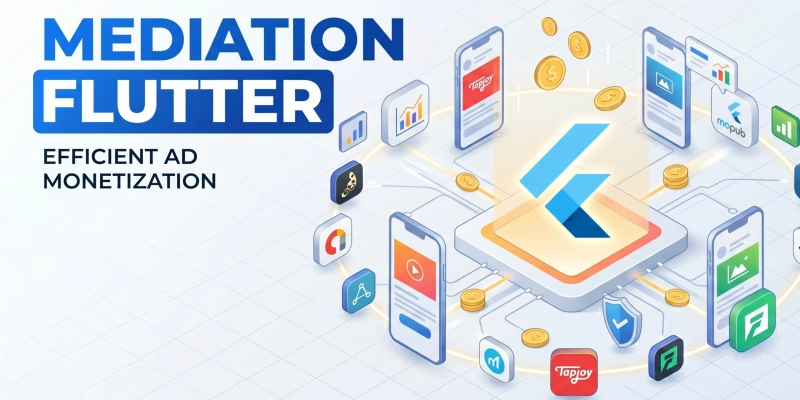
Technical isometric diagram for Flutter mobile ad mediation, illustrating efficient ad monetization infrastructure for cross-platform app developers.
AdTech & Monetization

Ad Mediation for Flutter

Maximizing revenue in the competitive mobile landscape requires more than just standard ad placements; it demands a strategic approach to monetization. For Flutter developers, ad mediation serves as the ultimate engine for growth. By implementing a robust mediation platform, you can force top-tier ad networks to compete for your inventory in real-time, significantly driving up your average eCPM. This guide explores the technical and strategic advantages of moving beyond single-network setups. You will learn the nuances of integrating industry-leading networks and the transformative power of programmatic bidding. Unlike traditional waterfalls, programmatic bidding ensures that every impression is sold to the highest bidder at the exact moment of the request, eliminating manual overhead and maximizing fill rates. Whether you are launching a new utility app or scaling a global gaming title, mastering these mediation techniques is the key to unlocking sustainable, scalable earnings and ensuring your Flutter project achieves its full financial potential.

July 8, 2025 5 min read

Maximize your ad revenue with CAS.ai

Smart mediation platform for mobile publishers and game developers.


Telegram
WhatsApp
Slack
Phone