
Mobile game publishing workflow banner showing user acquisition, creatives, monetization, analytics, and ROAS around a mobile game dashboard in a futuristic UI.

Mobile Game Publishing: The Growth Workflow We Use at CAS.AI

December 19, 2025 5 min read

Mobile game publishing is no longer a “nice-to-have” option for future growth. In practice, mobile game publishing has become a necessary step for scaling mobile games in a predictable way, entering Tier-1 geos, and building a stable business model.

Based on our experience, iOS projects can generate up to 35–40% of revenue from in-app purchases, while Android games usually reach 15–25%. At the same time, advertising remains the main revenue source for most mobile games. Mobile game publishing at CAS.AI is designed so that these revenue streams do not compete with each other, but reinforce one another.

What Mobile Game Publishing Means at CAS.AI

At CAS.AI, mobile game publishing is not only about user acquisition. It is a complete growth system, where every decision is driven by data.

We take responsibility for:

  • monetization and mediation with 14–20 active ad networks,
  • user acquisition with a transition from CPI to ROAS,
  • analytics at the geo, placement, and campaign levels,
  • ASO with regular A/B testing,
  • creative production and continuous testing.

The role of a mobile game publisher is not just to bring traffic, but to ensure that every acquired user pays back and can be scaled profitably.

If you want to see how we apply this in practice, explore our publishing overview here.

Minimum Requirements for Mobile Game Publishing

We do not require perfect metrics at the start, but there are baseline benchmarks without which scaling is not possible.

Retention and Engagement

For most casual and midcore games, we expect:

  • Day 1 retention (R1): 20–22% or higher,
  • Day 3 retention (R3): 10–12%,
  • Day 7 retention (R7): 5–7%, depending on the genre,
  • average session length of 5–8 minutes,
  • 2.5–4 sessions per active user per day.

If metrics are below these levels, we focus on product improvements first, not scaling.

Monetization at the Early Stage

For successful mobile game publishing, monetization must already be implemented or easy to scale:

  • 6–10 interstitial impressions per user per day,
  • 8–12 rewarded video impressions per user per day,
  • no aggressive placements that harm retention,
  • baseline ad ARPDAU of $0.02–0.05 on Android and $0.05–0.08 on iOS.

These numbers are not a ceiling, but they show monetization potential.

Analytics as the Entry Point to Mobile Game Publishing

Every mobile game publishing project at CAS.AI starts with analytics. We build unit economics for each geo and channel, including:

  • CPI by country,
  • D0, D1, and D3 ROAS,
  • ARPDAU and LTV,
  • eCPM by format and geo,
  • session depth and return funnels.

Initial UA tests usually start with $100–300 per channel, which is enough to collect meaningful data for decisions.

For a real example of how we analyze and scale performance, see Publishing Case #4.

Monetization Within Mobile Game Publishing

Monetization at CAS.AI is based on a hybrid model:

  • bidding + waterfall,
  • different setups for Tier-1, Tier-2, and Tier-3 countries,
  • separate strategies for rewarded video and interstitials.

In practice, this leads to:

  • 2–3x eCPM growth within the first 30–60 days,
  • 1.5–2x increase in ad impressions per DAU without retention loss,
  • 5–20x monthly revenue growth during scaling.

If you want another case that highlights a different growth path, check Publishing Case #2.

User Acquisition and Scaling Mobile Games

CAS.AI does not scale traffic blindly. For scaling mobile games, the process looks like this:

  • CPI campaigns to collect data,
  • retention and ROAS analysis by channel,
  • transition to ROAS campaigns after reaching D1 ROAS of 50–70%,
  • scaling only profitable geos.

In stable cases, this results in:

  • 100k–300k installs per month,
  • creative CTR of 5–8%,
  • click-to-install conversion rate of 25–40%.

Creatives as a Growth Driver in Mobile Game Publishing

Creatives have a direct impact on scaling. At CAS.AI:

  • new hypotheses are tested every 3–5 days,
  • 10–30 creatives are tested simultaneously,
  • video, static, and playable formats are used.

Strong creatives can reduce CPI by 20–40% and improve traffic quality, which immediately impacts ROAS.

For a broader view on how UA systems scale in mobile, you can also reference Google’s guidance on app growth and measurement here.

ASO and Mobile Game Publisher Strategy

ASO in mobile game publishing is not a one-time task. We regularly test:

  • app icons,
  • the first two screenshots,
  • localization for specific countries.

Improving store page conversion from 30% to 42–45% is equivalent to increasing the UA budget without additional spend.

For platform-level best practices, see Google Play’s developer documentation here.

Partnership Model with CAS.AI

CAS.AI works as a mobile game publisher under a partnership model:

  • existing revenue stays with the developer,
  • incremental growth generated through publishing is shared under an agreed model,
  • all analytics are fully transparent for the partner.

We focus on long-term growth, not short-term metric spikes.

Why Mobile Game Publishing Works

Based on our cases, mobile game publishing allows teams to:

  • increase project revenue by 10–50x,
  • enter Tier-1 geos with positive ROAS,
  • build a sustainable economy independent of organic traffic,
  • scale games systematically, not randomly.

Conclusion

Mobile game publishing is not a “magic button”, but a well-structured process. When a game has solid baseline metrics, the right mobile game publisher can turn it into a scalable business.

CAS.AI builds publishing on data, testing, and real-world experience from dozens of live cases. That is why scaling mobile games becomes not a risk, but a reliable growth tool.

Helpful resources:
Learn more about our approach on the publishing page,
and explore real results in Case #4
and Case #2.

Oleg Shlyamovich
Oleg Shlyamovich CEO & Co-Founder, CAS.AI

9+ years in mobile monetization. 500+ apps, 5B+ downloads.

Last updated: View all articles →

Explore More

Technical isometric diagram for React Native mobile ad mediation, illustrating smart ad integration infrastructure to optimize cross-platform app revenue.
AdTech & Monetization

Ad Mediation in React Native

Ad mediation is the essential "go-between" for React Native developers looking to maximize app revenue. Rather than relying on a single ad network, mediation creates a real-time auction where multiple networks compete for your ad slots. This ecosystem ensures that every impression—whether it’s a banner, interstitial, or high-value rewarded video—is sold to the highest bidder. The transition from traditional "waterfall" models to programmatic bidding has revolutionized monetization, often increasing earnings by 10% to 30%. By integrating a single mediation SDK, developers can access premium demand from giants like AdMob, AppLovin, and CAS.ai without the engineering overhead of managing dozens of individual plugins. Beyond higher eCPMs, mediation offers unified analytics, improved fill rates in secondary markets, and built-in A/B testing. For any React Native developer aiming for professional-scale growth, a robust mediation strategy is no longer optional. It is the foundation of a profitable mobile business.

May 8, 2025 8 min read
obile app ad mediation flow chart illustrating how to optimize and boost app monetization
AdTech & Monetization

Mobile Game Monetization: The Complete Guide

For any mobile game publisher, success isn't just about the build; it’s about the infrastructure behind it. Whether you are an indie developer or an established indie game publisher, treating monetization as an afterthought is a costly mistake. Mobile game publishing has evolved, and manual setups are now a revenue leak that a casual game publisher simply cannot afford. To become the best casual game publisher in your niche, you must leverage automation. This is especially true for a hyper casual game publisher, where thin retention curves mean every impression counts. By choosing a robust game publishing platform like CAS.AI, you streamline your workflow from day one. Don't wait until launch to fix your strategy. Master indie game publishing by integrating a mediation layer before you publish your game on Google Play, ensuring you squeeze maximum value from your global audience while focusing on the gameplay players love.

May 13, 2025 16 min read
Technical isometric diagram for Godot Engine mobile ad mediation, illustrating the network infrastructure to optimize and boost mobile game income.
AdTech & Monetization

Ad Mediation for Godot

Ad mediation is the essential middleman between your mobile game and multiple ad networks, ensuring you never leave money on the table. Instead of relying on a single provider like AdMob, mediation triggers a real-time auction for every ad slot, allowing the highest bidder to win the impression. For Godot developers, this technology is a game-changer. By implementing a mediation layer, you can navigate the engine's unique SDK landscape while accessing high-paying formats like rewarded videos and interstitials. Platforms like CAS.ai streamline this process by connecting your project to over 20 networks and 150 DSPs through a single integration. This setup eliminates the "empty slot" problem, stabilizes revenue during seasonal shifts, and provides unified analytics. Whether you are building hyper-casual titles or complex midcore games, ad mediation can boost your total revenue by 30% to 60%, making it a non-negotiable tool for any serious mobile developer.

June 8, 2025 6 min read
Diagram illustrating a hybrid monetization strategy blending In-App Purchases (IAP) and In-App Advertising (IAA) for mobile apps in 2026.
AdTech & Monetization

Hybrid Monetization 2026: Adapting Your User Acquisition for a Blended IAA + IAP Model

Your UA team is busy chasing D7 ROAS. Product rolls out new IAP bundles. Ad ops keeps adjusting interstitial floors. Each team is optimizing on its own, and the player ends up stuck in the middle. They get hit with ads before they even see a purchase offer. Or they run into a paywall when all they wanted was a rewarded video. Hybrid monetization tossed out the old playbook. You cannot just pick ads or IAP now. The studios that win in 2026 run both at the same time for every player. Now every user has two lifetime value curves, not one. Mediation decides who sees ads, how often, and under what rules. This piece covers where studios slip up when they try to add hybrid monetization to a UA plan that only thinks about one thing. It shows how one mid-core studio rebuilt its stack using entitlement checks and frequency caps for different player groups. There is also a five-step sequence for setting up mediation without ruining the player experience.

August 12, 2026 15 min read
Technical isometric diagram for Flutter mobile ad mediation, illustrating efficient ad monetization infrastructure for cross-platform app developers.
AdTech & Monetization

Ad Mediation for Flutter

Maximizing revenue in the competitive mobile landscape requires more than just standard ad placements; it demands a strategic approach to monetization. For Flutter developers, ad mediation serves as the ultimate engine for growth. By implementing a robust mediation platform, you can force top-tier ad networks to compete for your inventory in real-time, significantly driving up your average eCPM. This guide explores the technical and strategic advantages of moving beyond single-network setups. You will learn the nuances of integrating industry-leading networks and the transformative power of programmatic bidding. Unlike traditional waterfalls, programmatic bidding ensures that every impression is sold to the highest bidder at the exact moment of the request, eliminating manual overhead and maximizing fill rates. Whether you are launching a new utility app or scaling a global gaming title, mastering these mediation techniques is the key to unlocking sustainable, scalable earnings and ensuring your Flutter project achieves its full financial potential.

July 8, 2025 5 min read
App Store Optimization (ASO) strategy guide for mobile apps
AdTech & Monetization Case Study

ASO in 2026: How to Make Sure Users Can Actually Find Your App Page

ASO isn’t a launch-day checkbox. It’s a feedback loop. If you skip the update cycle, your rankings slip and competitors pass you. This checklist cuts through the noise and shows what actually drives organic installs in 2026: build separate keyword structures for iOS and Android (copy-pasting is lazy and costs you installs), rebuild your semantic core every 2-4 weeks, and run visual tests that isolate a single variable so your data is actionable. You’ll get the real rules: why the first three screenshots on iOS make or break your conversion, how literal translation kills your numbers in new markets, and the only four A/B tests that matter when you start: icon style, hero screenshot message, color themes, and video vs. static. The 2026 AI stack is here: keyword tracking, competitor moves, creative testing, and review monitoring so you’re not stuck in spreadsheets. Five mistakes still tank rankings, even if your keywords look perfect.

December 12, 2025 11 min read
Abstract 3D digital technology platform block representing ILRD Impression Level Revenue Data for mobile game monetization.
AdTech & Monetization

ILRD Is Not a Setting. It’s the Foundation of Your Monetization Stack.

ILRD isn’t just a setting. It’s the base of your monetization stack. If you’re still looking at yesterday’s aggregate revenue and calling it “performance,” you’re flying blind. In modern user acquisition (UA), seeing $27,000 in daily revenue doesn’t tell you whether your campaigns are profitable, whether your ad frequency test is working, or whether your cheapest advertising channel is quietly hurting lifetime value (LTV). Impression-Level Revenue Data (ILRD), which measures revenue earned per individual ad impression, changes that. It connects every ad impression to a real user, specific device, and the original traffic source, turning return on ad spend (ROAS) optimization, analyzing groups of users over time (cohort analysis), and combining ads with in-app purchases (hybrid monetization) into measurable systems instead of relying on educated guesses. But IRLD isn’t just about turning it on. Waterfall floor math, bidding mechanics, alternative stores like RuStore, and Meta's platform restrictions can introduce discrepancies that quietly corrupt your signal and your UA decisions. In the full article, we break down what’s normal, what’s fixable, and what’s catastrophic. We also show you how to verify your IRLD before every build. If you’re using target Return on Ad Spend (tROAS) in 2026, this isn’t optional reading.

March 6, 2026 11 min read
Two mobile phones displaying revenue growth charts and data analytics with promotional text Grow Together, Earn Together for CAS.AI mobile game ad mediation program.
AdTech & Monetization

CAS.AI Launches Referral Program

Grow Together: Introducing the CAS.AI Referral Program Scale your revenue beyond your own games with the new CAS.AI Referral Program. We’re turning community trust into a powerful third growth engine for mobile developers. How it works: • Earn Passive Income: Receive 1% of your referred partner’s ad revenue every month for a full year. • Performance Boost: Refer five or more active partners in a single month to jump your rate to 1.5%. • Guaranteed Start: Your first month’s bonus is guaranteed, with no revenue thresholds applied. • Simple Setup: Partners just enter your account name when signing up at cas.ai/company. Whether you are a studio founder, a mediation partner, or a publishing expert, you can now turn your professional network into recurring yield. [Read the Full Article] Ready to start earning? Log in to your dashboard to find your account name and start referring today.

April 16, 2026 6 min read
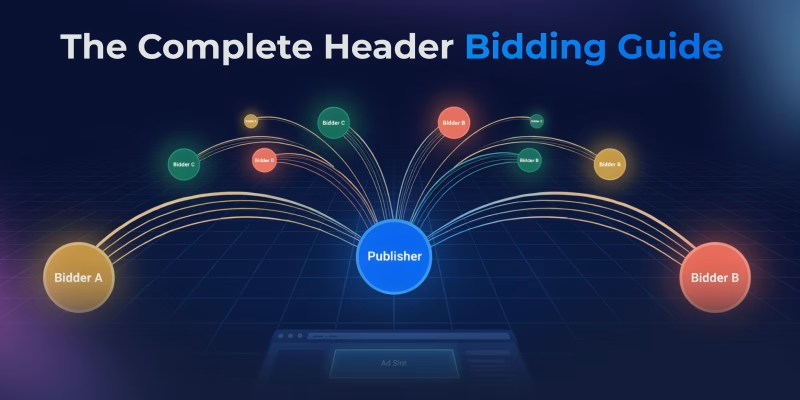
Network node diagram illustrating mobile header bidding mechanics with a central publisher app connecting to multiple programmatic demand sources.
AdTech & Monetization Guide

The Complete Header Bidding Guide

Traditional waterfall mediation is failing modern publishers. By ranking ad networks in a fixed, predetermined order based on historical data, the waterfall model creates a structural revenue leak where higher-paying bidders are often ignored simply because of their rank. Header bidding solves this by flipping the auction model entirely, allowing all demand partners to bid simultaneously before the ad server is even called. Whether you are a hyper-casual game developer or a cross-platform creator using Flutter or Unity, understanding the technical nuances between client-side and server-side auctions is critical. While client-side offers transparency, server-side bidding is often preferred for mobile apps to reduce latency. By integrating header bidding into your ad mediation platform, you move away from managed queues toward a live, competitive market, ensuring you capture the true market value of every single impression.

May 1, 2025 12 min read

Maximize your ad revenue with CAS.AI

Smart mediation platform for mobile publishers and game developers.


6–16 chars · A–Z, digit & special (#!?$%&*()<>.,) · no spaces

Already registered? Your current password may predate these requirements — reset it instead of signing up again. Reset password

 
Telegram
WhatsApp
Slack
Phone