Halloween in Mobile Gaming: A Full-Funnel Playbook for UA, Re-engagement, and Revenue
October kicks off the busy season for mobile games, but most teams just slap a pumpkin on the screen, toss up a spooky banner, and cross their fingers that the date alone will do the heavy lifting.
But the numbers tell a different story. Players might show up in October, but whether they install, return, or spend comes down to what you actually offer them and how you get the word out.
This guide walks through every step: pulling in new players, bringing back the ones who left, figuring out which LiveOps tricks are worth the effort, running your shop, making ads work for you, and knowing what to track once Halloween is over. I’ll point out where each stat comes from, and flag anything that’s old or comes from a vendor.
If you’re already in the thick of October, use this to wrap up the season on a high note and get a head start on next year.
Why October matters (and why it’s not enough)
Start with the market. Sensor Tower puts global player spending at $6.8 billion in October 2025, up 4.5% from September. Halloween-themed live ops are one driver, alongside the general pull of Q4.
Engagement points the same way. Adjust’s Halloween trend data from October 2023 showed US arcade sessions running 18% to 36% above the yearly average all month long. Simulation game installs in the US peaked at +77% on October 15. Those are single-year, genre-specific readings. They describe those categories, not your game.
Spending data is thinner. Kidoz reports that US spending on horror-themed mobile games rose 13% in October while installs recovered 5%. That covers horror titles only and is about a year old, so it isn’t the number for your match-3.
And everyone is already doing this. AppSamurai notes that 90% of the top-100 grossing iOS games run seasonal events as part of their LiveOps strategy. Halloween is table stakes, not a differentiator.
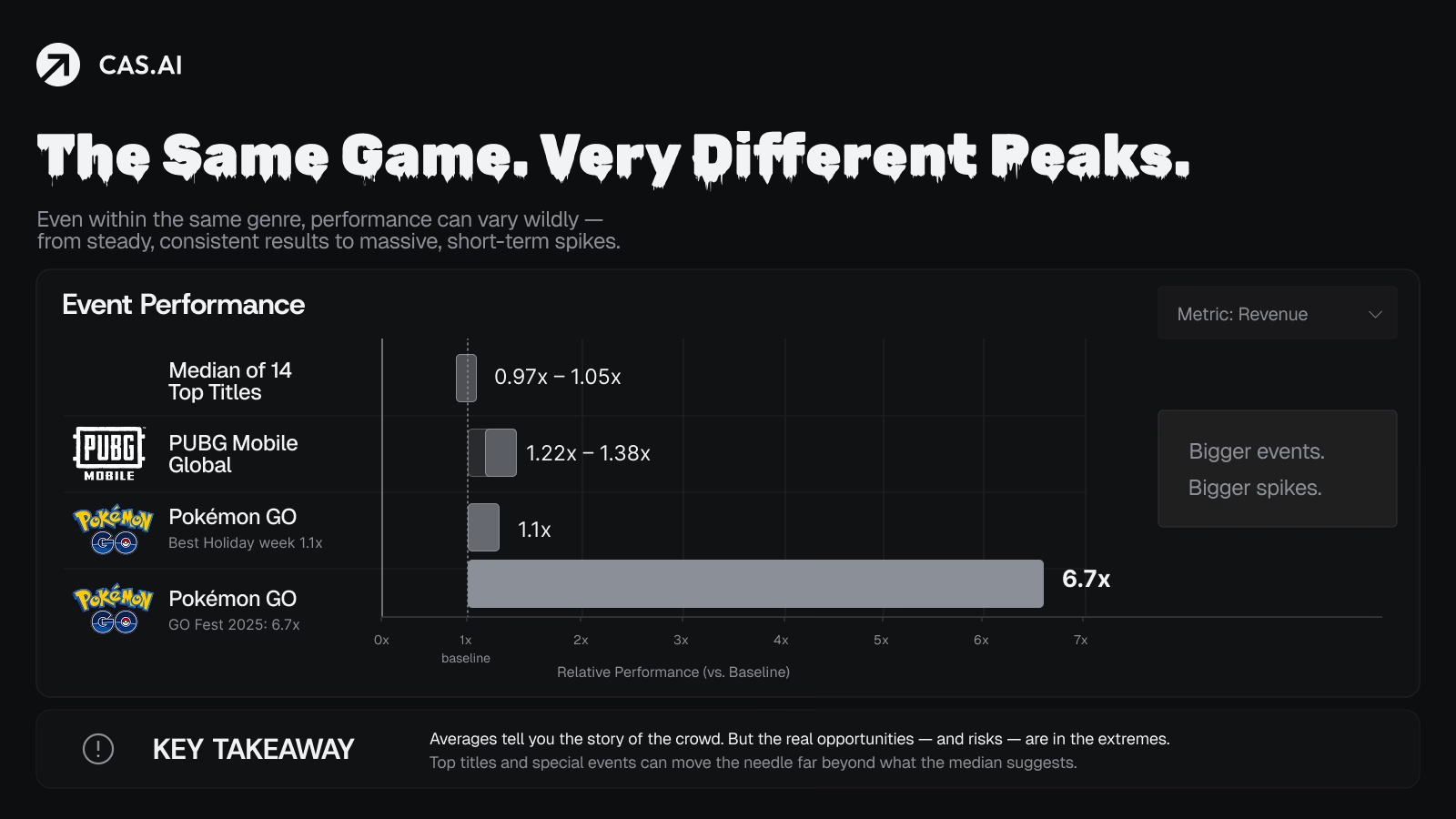
Now, the number that should change how you plan. Naavik analyzed 14 top mobile titles, including Candy Crush Saga, Clash of Clans, Coin Master, Monopoly GO, and Royal Match. Their median Halloween-week revenue has sat between 0.97x and 1.05x a normal week in every market checked since 2016. Halloween barely moves the needle on average.
The exception is PUBG Mobile Global, at a median of 1.22x to 1.38x since 2022. Zombie modes and gruesome limited-time skins fit both the game and the holiday. The pattern is simple: the more a game leans into Halloween thematically or mechanically, the bigger the uptick. Console follows the same logic. Fortnitemares has run since 2018 and Call of Duty’s The Haunting since 2020.
That same dataset adds a second pressure. Live-ops events per game climbed from 73 to 89 per month during 2025. Your Halloween event now competes with your own. So yes, run a Halloween event. Players expect it, and skipping out means you might lose them to a game that doesn’t. Just remember, the date itself brings eyeballs, not dollars. The rest of this guide is about turning that attention into something more.
Acquisition: build for the first session, not just the install
It’s easy to chase Halloween installs and just as easy to waste them. The real question is not how many people you attract, but what they see when they first open your app.
Work backward from the date. Playio recommends having creatives ready two to four weeks before the seasonal window and warming up audiences early. If you wait until the event is live, you’re bidding against everyone else at inflated prices.
Run every channel you have, with one story. The same app-trends report found that campaigns using three or more channels can reach purchase and engagement rates up to 250% higher than single-channel efforts. That’s a vendor number with no clear baseline, so treat it as directional. The practical takeaway is consistency: the same theme and message across social, paid, email, and in-app. Sequence them as teaser, launch, and last chance.
Localize, or don’t bother. Halloween means different things in different places. Geotarget your campaigns and match visuals to local traditions, such as Día de los Muertos in Mexico. Naavik data adds a harder constraint: Halloween barely registers in markets like Japan, Germany, or Korea, a spooky ad nobody cares about. Give your store listing a quick makeover. Swap in a Halloween icon, update your screenshots, and add a short preview video. These are some of the easiest ways to boost conversions. Toss in keywords like haunted or spooky games, since searches for Halloween stuff jump by almost half in the weeks leading up to October 31. Try out short vertical videos that show off limited-time rewards or rare items. Rewards are worth testing.
Make sure your ad matches what players see first. If someone clicks a Halloween ad, they should land right in the Halloween event, not your usual home screen. That’s what themed landing pages and deep links are for. If the creative and the first screen don’t line up, you’re just wasting your Halloween ad budget.
Think about that first session. Someone joining during Halloween should get a different welcome than your usual onboarding. Show off limited-time content, hand out a welcome reward, and let the Halloween theme set the mood right away.
The Naavik data shows what happens when that conversion isn’t designed. In its Christmas-week analysis, cohort downloads rose 1.41x while revenue rose only 1.05x. The gap came down to how fast new players hit a paid gate. Last War and Whiteout Survival put hard progression gates in the first days after install and converted to 1.3x to 1.5x baseline revenue. Candy Crush Saga took the biggest download lift (1.55x) but converted to just 1.06x, because a new player there is weeks away from a paid gate.
That example is from Christmas, but the same rule applies. Seasonal installs only turn into revenue if you give players a chance to buy while the event is still live.
Re-engagement: the bigger Halloween opportunity
Not everyone agrees on what matters most. Most advice says Halloween is all about getting new players. Kidoz flips that: in a world where downloads are flat but revenue keeps climbing, seasonal events are better for bringing back old players than chasing new ones.
Kidoz sells ad inventory, so weigh that framing accordingly. But the logic holds up against the economics. GameBiz Consulting makes the broader case that keeping existing players costs far less than acquiring new ones, and that retention campaigns generally return more per dollar. Halloween can do both jobs. Lapsed users are the cheaper win.
Give lapsed players a reason, not a nudge. Inviting someone back for a new event creates less friction than a generic “come back” message. A Halloween event is a fresh, time-limited hook that didn’t exist last week.
Personalize the message. Alerts based on where the player left off, their progression, and their interests outperform generic announcements. The Adjust report cites a figure of up to 191% more engagement for personalized notifications, though the underlying report isn’t named, so read it as directional. At minimum, segment into lapsed, active, and high-value players, and give each a different offer. Whales and casual players need different incentives.
Orchestrate the touchpoints. Use a push to announce the event, an in-app pop-up to hand over the reward, and an email for the full rundown. Halloween is a chance to have fun with the copy, and ghost-town and resurrection puns suit the season. Back the joke with a real reward or a limited discount, or the pun is all you’ve sent.
Use FOMO, with limits. Argentics describes the psychology well. Time-limited events create fear of missing out and tap into the pull of exclusive content, breaking routine gameplay loops and boosting participation. The same source warns about the downside. Events that come too often cause fatigue, and rewards that make existing progress feel worthless push players away. With dozens of events per game per month, restraint is part of the design.
You don’t need a holiday to reactivate. The Naavik dataset points to EA’s Team of the Year event in FIFA Ultimate Team, which EA credited with reactivating over 2 million lapsed players in a month with no real-world holiday involved. Halloween works for re-engagement when it gives players a real reason to return. The date alone isn’t one.
Keep an eye on what happens after. Counting how many players come back is simple. The real test is whether they stick around or spend once the event is over. If your spike disappears, you’ll need a different plan than if it holds steady.
LiveOps: what separates an event from a reskin
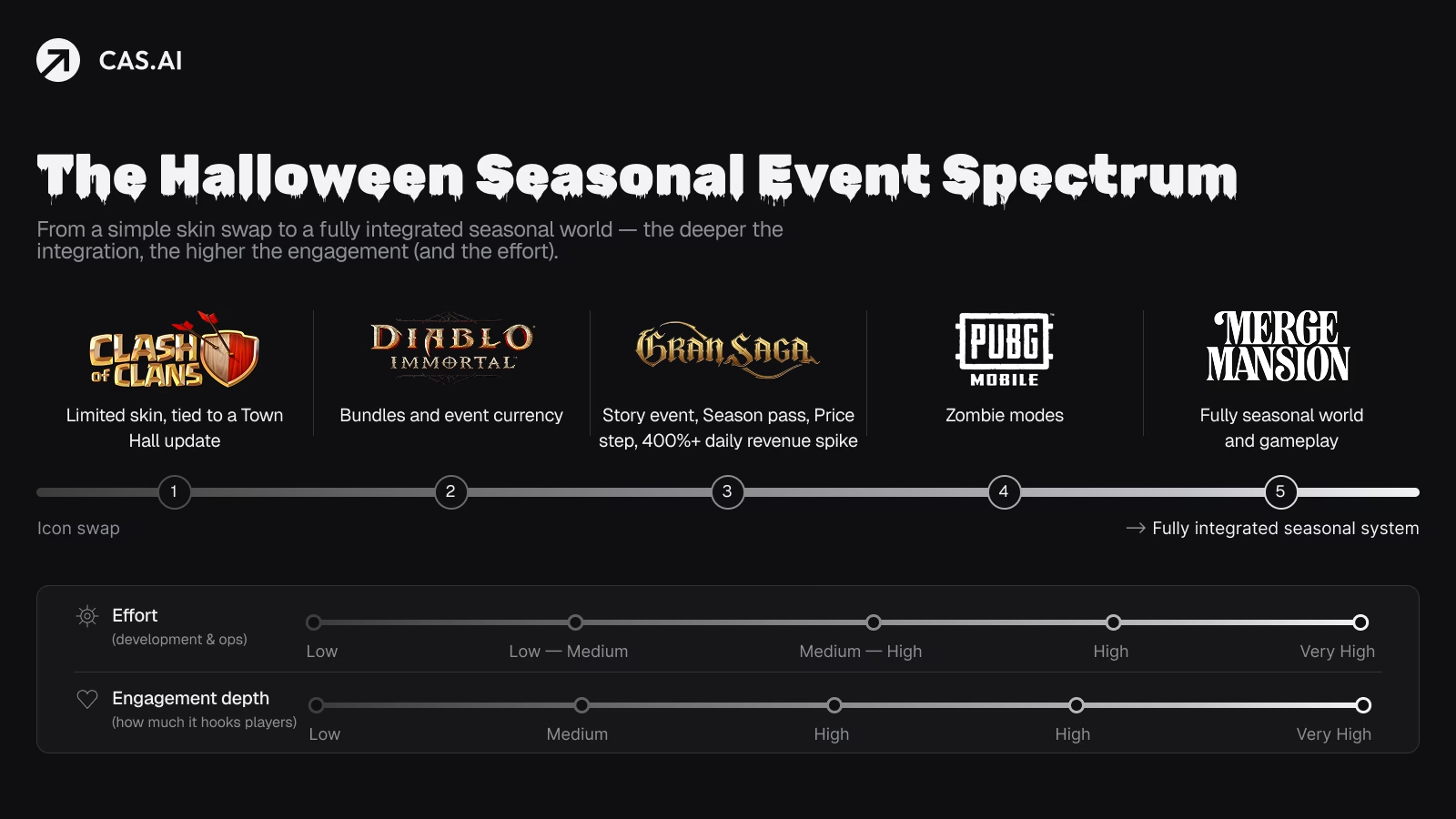
Halloween events come in all shapes and sizes. On one end, you’ve got quick fixes like new decorations and skins. On the other, you have full-blown seasonal systems with their own progression and economy. The easy stuff ships fast but doesn’t keep players busy for long. The deeper events take more effort but actually keep people engaged. The biggest mistake is hyping up an event and then just swapping out a few graphics.
GameRefinery’s Halloween 2022 case studies show the range. The data is from 2022, so cite it as such, but the mechanics still apply.
Gran Saga went big. Its October 20 update added a five-stage story event with a challenge stage, a limited-time mount unlocked through event achievements, a Halloween season pass, a login bonus, and a puzzle event. A themed costume sold for 2,000 diamonds during the event and 3,000 afterward. GameRefinery reported a daily revenue spike of over 400%. The end-of-event price step made the deadline real.
Clash of Clans went light and timed it well. The event was a limited-time base skin, returning units, two challenges, and a skin in the October Battle Pass. Supercell launched it alongside a major Town Hall update that drove a 500% jump in downloads. The lesson: attach your event to a bigger moment when you can.
Diablo Immortal is the honest case. Hallow’s Wake, its first seasonal event, ran from October 19 to November 2 with limited-time bundles, a charge gauge that refunded one random buyer, and event currency exchangeable for cosmetics. It produced a revenue spike, but a smaller one than earlier content updates, and it earned favorable press after previous monetization controversies. Not every event beats your last patch.
Icon swap vs. structural integration. Across these cases, the strongest Halloween events weren’t the ones with the most pumpkins. They were the ones where the theme changed what players did. Merge Mansion, like most leading titles, runs weeks of Halloween content built around its core loop. The PUBG Mobile zombie modes and Fortnitemares from the dataset above work the same way, because the mechanics and the holiday already belong together. A reskin asks players to care about a decoration. An integrated event gives them a new goal.
Here are three more things to keep in mind when planning your event:
- Cosmetics are the reliable core. Themed skins are a major revenue driver across mobile games. Consider a seasonal discount, then return them to full price when the event ends. A themed battle pass, or an event currency with its own store, extends the effect if your game has enough IAP depth.
- Your own calendar can beat the holiday. In the Naavik data, a game’s self-made events outperformed shared holidays on every title checked. Pokémon GO’s best week, GO Fest 2025, ran 6.7x a normal week, against 1.1x for its best holiday. Monopoly GO’s best week, built around a content drop, ran 2.6x. If you have a major update coming, consider shipping it next to Halloween rather than burying it under the theme.
- Be careful with discounts. Players will often load up during a sale and then stop spending once it’s over. If you run a discount, be ready for a drop afterward.
Monetization: in-app, web shop, and the players who never buy
On the in-app side, the pattern is consistent: scarcity-driven items such as pumpkin skins and haunted avatars, bundled with currency and priced to nudge mid-tier spenders, plus an event pass with a free and a paid track. The Gran Saga price step is a good model for making a deadline visible.
The web shop is where many teams leave money on the table. Xsolla, citing its own data, says seasonal web shop events can triple purchase frequency, double average order value, and add up to 30% more paying users during the event window. These are vendor numbers from a company that sells web shops, so attribute them accordingly. The tactics behind them are sound, and Xsolla says most can be live in days without a game update:
- Themed, time-limited bundles with countdown timers and limited-quantity tags. Bundling rare or seasonal items lifts both conversion and order value.
- Daily rewards and streaks that grow across the event, such as a trick-or-treat calendar with a bigger prize on October 31.
- Real-time notifications when a bundle goes live, is about to sell out, or a reward is waiting.
- A loyalty store where purchases earn points redeemable for web-shop-only items, with a redemption deadline to keep urgency up.
- A shop that feels like part of the game: the same visuals, with in-shop actions paying off in-game.
Treat Halloween as a dress rehearsal. The offers and mechanics you build now carry over to Black Friday and Cyber Monday. The Naavik data backs the priority: Black Friday revenue lift has held around 1.19x for a decade, and it runs higher where Halloween barely matters, at 1.50x in Japan and 1.27x in Germany (Korea sits at 1.12x). If resources are tight, test ideas at Halloween and save the big push for Black Friday.
Don’t forget the players who never buy. Everything above targets spenders, but most players never buy. Their value is attention, which is where ads come in.
Put the two datasets side by side. Sessions rise in October, yet in-app revenue barely moves in Halloween week. More sessions don’t automatically mean more spending. That’s a hypothesis, not a finding, since the datasets differ and the revenue cohort leans IAP-heavy. Check your own ARPDAU for event week.
If your game earns from ads or a mix of ads and IAP, focus here:
- Work ads into your event. Rewarded videos that pay out in event currency let non-spenders take part and stick around. It’s like having an offerwall inside your game. Kidoz says players with a good, opt-in ad experience are up to three times more likely to buy later, but since that’s coming from an ad network, you should test it yourself.
- Take care of your paying players. Anyone who just bought a Halloween bundle is a VIP. Go easy on interstitial ads for them during the event, and save the heavier ad load for non-spenders.
- Audit your mediation before October, not during it. More sessions mean more impressions per user per day. A setup with stale floors or a static waterfall loses money as demand shifts across the month. CAS.AI runs a hybrid RTB and waterfall auction on every impression, across 20+ ad networks and 150+ DSPs, through one SDK with 25+ mediation adapters. CAS.AI doesn’t own an ad network, so there’s no in-house demand to prioritize. Every format, from rewarded and interstitial to banner and native, goes through the same auction.
- Connect your user acquisition to ad revenue per player. If you’re running Halloween-themed UA, it only pays off if the ad revenue per user during the event covers what you spent to get them. Compare your cost per install to your ARPDAU for the event window, not your yearly average.
Measurement: separate the spike from the lift
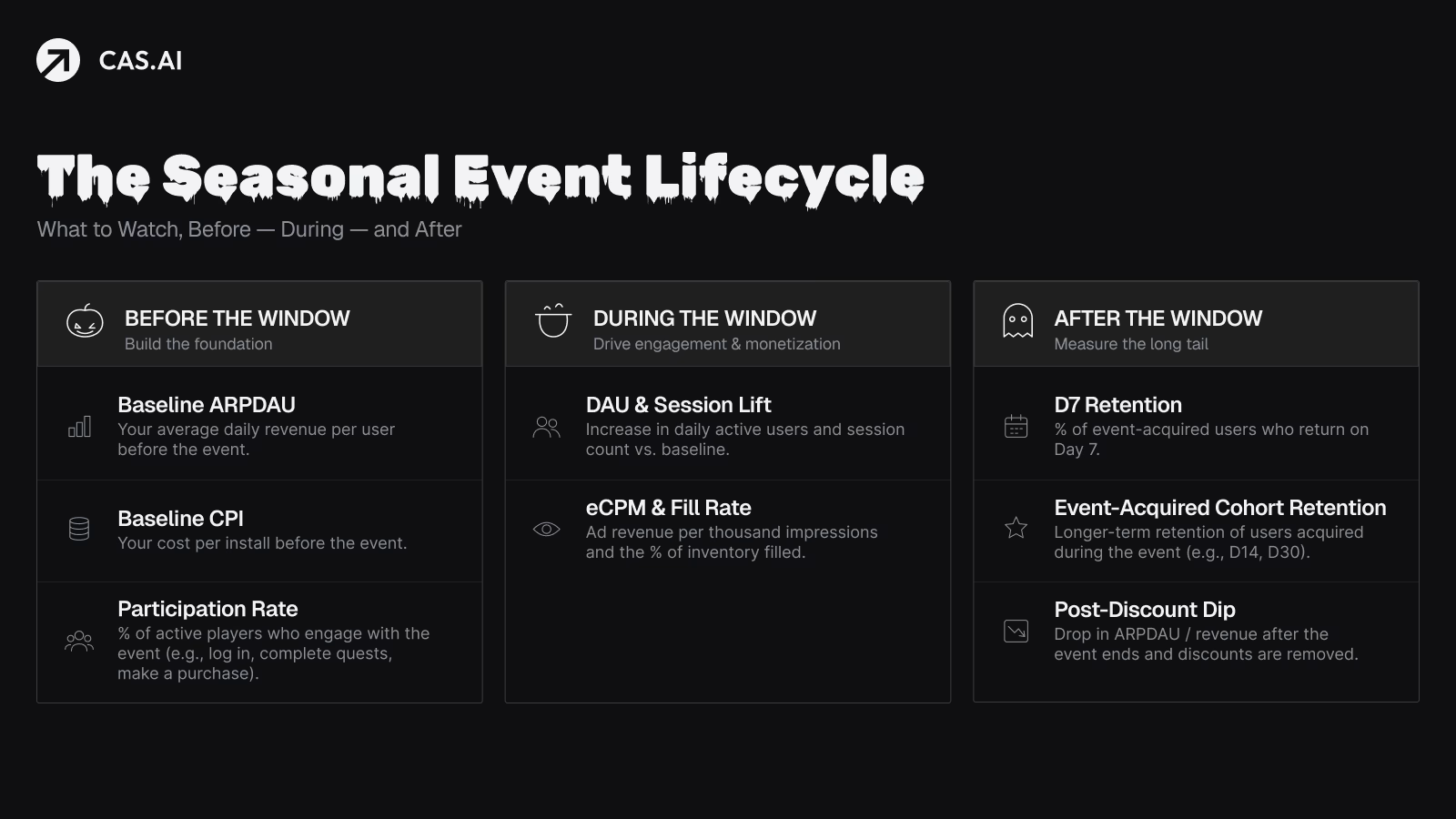
If you don’t have a way to measure, you can’t make next year’s event better. Start by tracking the event window as its own group, then compare what happens before, during, and after; look at engagement, retention, and in-app purchases.
The core set:
- Event participation rate: the share of active users who join the event or click through to the event hub.
- DAU and session lift during the event versus baseline.
- D7 retention after the event ends. This separates a short-term spike from lasting retention.
- Post-event retention of users acquired during the event, tracked independently. Whether they keep playing is what determines the real value of seasonal UA.
- Reactivation uplift and retention delta for returned users.
- Conversion rate and ARPU/ARPDAU: did the event turn browsers into buyers?
- Installs and CPI for seasonal creatives against your baseline.
- eCPM and fill rate by day, if you run ads, to see whether event-week traffic monetized as well as ordinary traffic.
Keep an eye on the week after the event. If you offered discounts, expect revenue to drop once the sale ends. What really matters is whether that dip is small and recovers quickly.
Conclusion and checklist
Halloween isn’t magic on its own. The numbers show it brings attention, but not much else unless you work for it. You get revenue by giving players a real reason to show up, making sure the right people see it, and making the most of everyone who joins, even the ones who never spend a dime.
Before the window
- Lock an event scope you can finish well, from skins and offers up to a full LiveOps layer.
- Prepare UA creatives two to four weeks ahead, localized by market.
- Update store icon, screenshots, preview video, and keywords.
- Build the event hub or landing screen that ads and deep links point to.
- Prepare shop bundles, daily rewards, and notifications.
- Review your mediation setup and rewarded video placements.
During the window
- Run segmented push, in-app, and email: teaser, launch, last chance.
- Keep a clear reward timeline visible in-game.
- Watch participation, DAU lift, ARPDAU, and eCPM daily.
After the window
- Read D7 retention for the event cohort and for event-acquired users.
- Compare ARPDAU and CPI against baseline.
- Reuse the offers and mechanics that worked for Black Friday.
Give players a reason to care, get your message to the right people, and see what sticks once Halloween is over.