

Every mid-size publisher has sat through some version of the same pitch by now: rip out the App Store tax, stand up a webshop, keep an extra 20-30 points of margin on every transaction. The math on the slide always looks clean. The math in your actual P&L rarely does.
That gap is worth taking seriously, especially in 2026, when the regulatory ground under app store commissions has genuinely shifted. But “worth taking seriously” and “worth building” are different questions, and for a publisher with a few million MAU and a lean finance team, conflating them is an expensive mistake. This piece is about separating the two and what happens to the other 95% of your player base while everyone is busy talking about the 5% that a webshop can actually reach.
The tax is real, and it just got more complicated.
Let’s start with what has actually changed. The whole webshop debate only makes sense if you look at today’s commission rules, not the ones from a few years back.
Apple’s standard App Store commission is still 30% on in-app purchases and first-year subscriptions, dropping to 15% for year-two subscriptions and for developers under the Small Business Program threshold. That part hasn’t moved. What has moved is everything around external payment links. Following the Epic v. Apple contempt ruling, Apple was barred from charging any commission on purchases completed through external links in US apps for a period; that meant 0%.
Apple didn’t accept that as final: in August 2026, it filed a proposal with the court to charge up to 15% on US link-out purchases, with reduced rates for Small Business Program participants, and that proposal is now before the district court awaiting a ruling. In the EU, the picture is different again: publishers who adopt Apple’s alternative business terms pay a Core Technology Commission of 12-20% on external purchases, compared with a 17% in-app commission if they stick with IAP.
Here’s the bottom line: that brief “0 percent tax” window in 2025 was always going to be short-lived. By the time you finish building a webshop, the commission rate you started with might already be history. Google’s Play Store is following a similar path, with its own collection of lower but still real fees for alternative billing.
This does not mean webshops are dead in the water. But the old pitch about circumventing the 30 percent tax is already outdated. If your finance model is still banking on a permanent 0 percent external rate, it is time for a reality check before you show it to the execs.
The economics, done honestly.
Here’s the version of the math that usually gets presented: move a transaction from IAP to a webshop, replace a 30% platform cut with a 5-10% payment processing fee, and you’ve just handed yourself 20-30 points of margin. Industry data on realized webshop deployments supports a range close to that; publishers routing purchases through direct-to-consumer channels are generally seeing margin improvements in the same band, driven primarily by the spread between platform commissions and processor fees.
That is the part everyone likes to show. Here is what usually gets left out. A webshop captures only revenue that would have occurred anyway. It doesn’t create new spenders; it changes which pocket the existing spender’s money lands in. If a player was already going to buy the $20 currency pack inside your app, redirecting that purchase to a webshop is close to free money, minus processing fees and the operational cost of running the channel. If a player was never going to spend at all, a webshop changes nothing about their lifetime value. It’s a margin play on existing payer behavior, not a new revenue stream.
That difference is huge for mid-size publishers, since most of your money already comes from a small group of payers. Even the companies selling webshop tools will tell you this up front: webshops work best when you have plenty of paying users. If your paying base is thin, your first job is to turn more players into payers before you even think about building a webshop.
How small is “the payer segment,” really
This is the number that should be front and center in every webshop discussion. Yet it is almost always missing from the pitch.
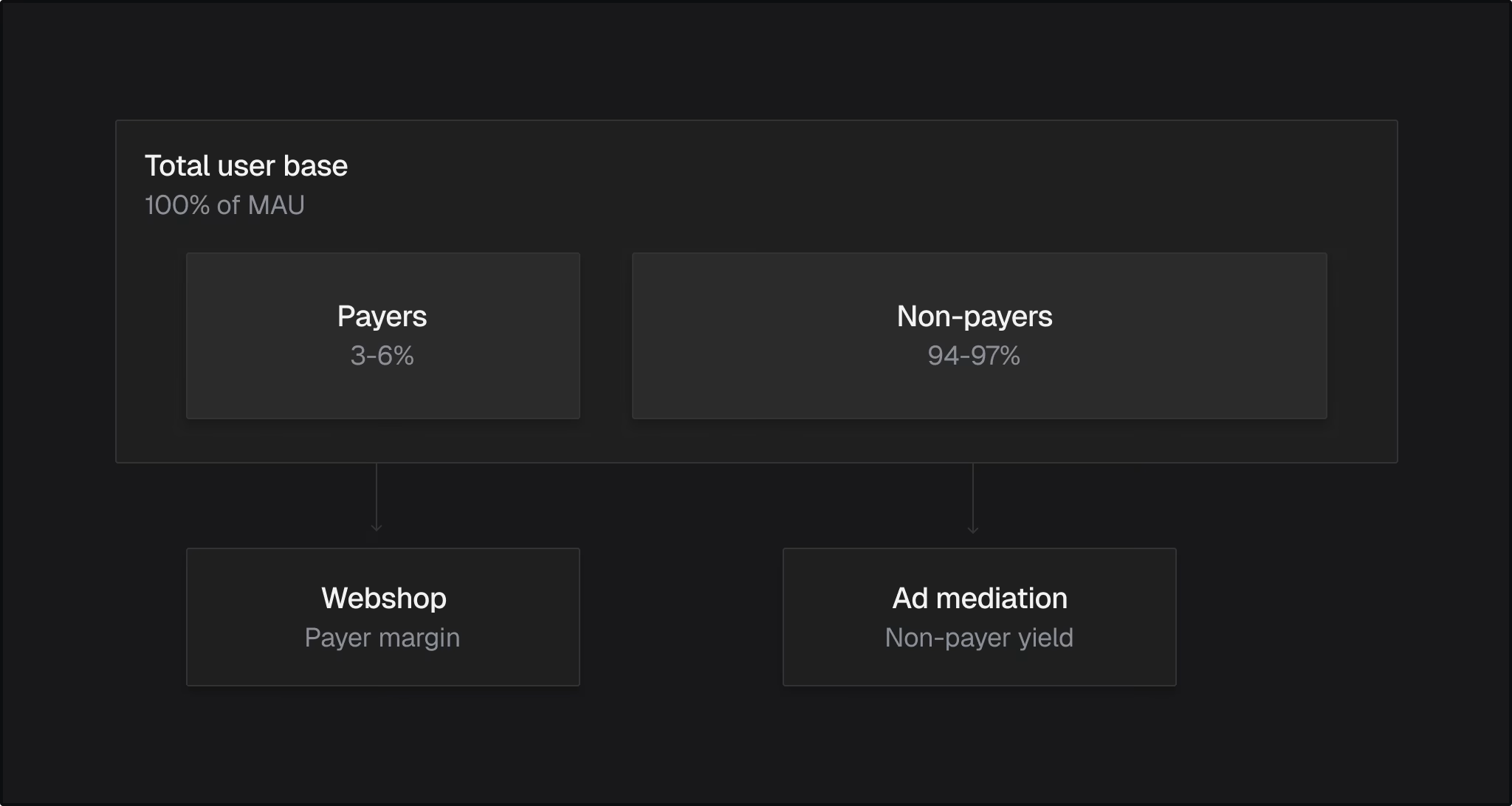
Across mobile gaming, first-purchase conversion- the share of players who ever make a single purchase- typically sits in the low single digits, with well-optimized funnels pushing from roughly 3% toward 5- 6% through better timing, value framing, and payment flow design. That’s the ceiling most publishers are working toward, not the floor. Even genres with materially higher payer share- casino and casual titles pushing past 60% of revenue from IAP rather than ads- are describing revenue mix, not the percentage of individual users who convert to paying. The player-level number stays small almost everywhere.
Add a webshop to that funnel, and you are just squeezing a bit more out of an already tiny group. Even the best webshops can get 40 to 60 percent of visitors to finish a purchase, but those are people who were already ready to spend. That does nothing for the 94 to 97 percent of your players who never even get that far.
So the honest framing for a mid-size publisher’s finance lead is this: a webshop is a high-leverage tool applied to a low-single-digit slice of your user base. It’s not wrong to build it. It’s wrong to expect it to move your overall revenue picture the way a channel touching 100% of your DAU would.
What does a webshop actually cost you operationally
The margin math usually ignores the real costs of running a webshop. This is where mid-size publishers get burned, since they lack the robust support and finance teams that larger companies rely on.
When you run a webshop, you take on headaches that Apple and Google used to handle. Support tickets go up. Refunds get trickier, since you are now the merchant, not the platform. Your team has to deal with payment failures, chargebacks, and fraud. Tax compliance, especially VAT, lands on your plate too. This is not a reason to skip webshops, but it is a reason to treat them as a channel with real costs, not just a magic margin boost.
Finance model for a mid-size publisher
- Revenue captured: existing payer spend that migrates from IAP to webshop, at your current payer conversion rate and ARPPU
- Margin gained per transaction: roughly 20-30 points, net of processing fees, before subtracting operating cost
- New operating cost: support headcount or tooling, refund/chargeback handling, compliance overhead, and the engineering cost of building and upkeeping the checkout flow itself
Traffic cost: the ongoing cost of getting players to actually open the webshop, since awareness and acquisition are consistently cited by publishers as the hardest part of scaling a D2C channel, ahead of the technical build itself
Plug those four numbers into your own payer count and ARPPU, and you will quickly see whether a webshop makes sense. If you have a big, valuable payer base and a game that lasts, it usually works out. If your payers are just a few thousand scattered accounts, the fixed costs can eat up most of your gains. You end up with a channel that helps a handful of transactions but does not move the needle for your business.
A practical example
Let’s make this real with numbers instead of more theory. Here is a simple version of the math every finance lead should run.
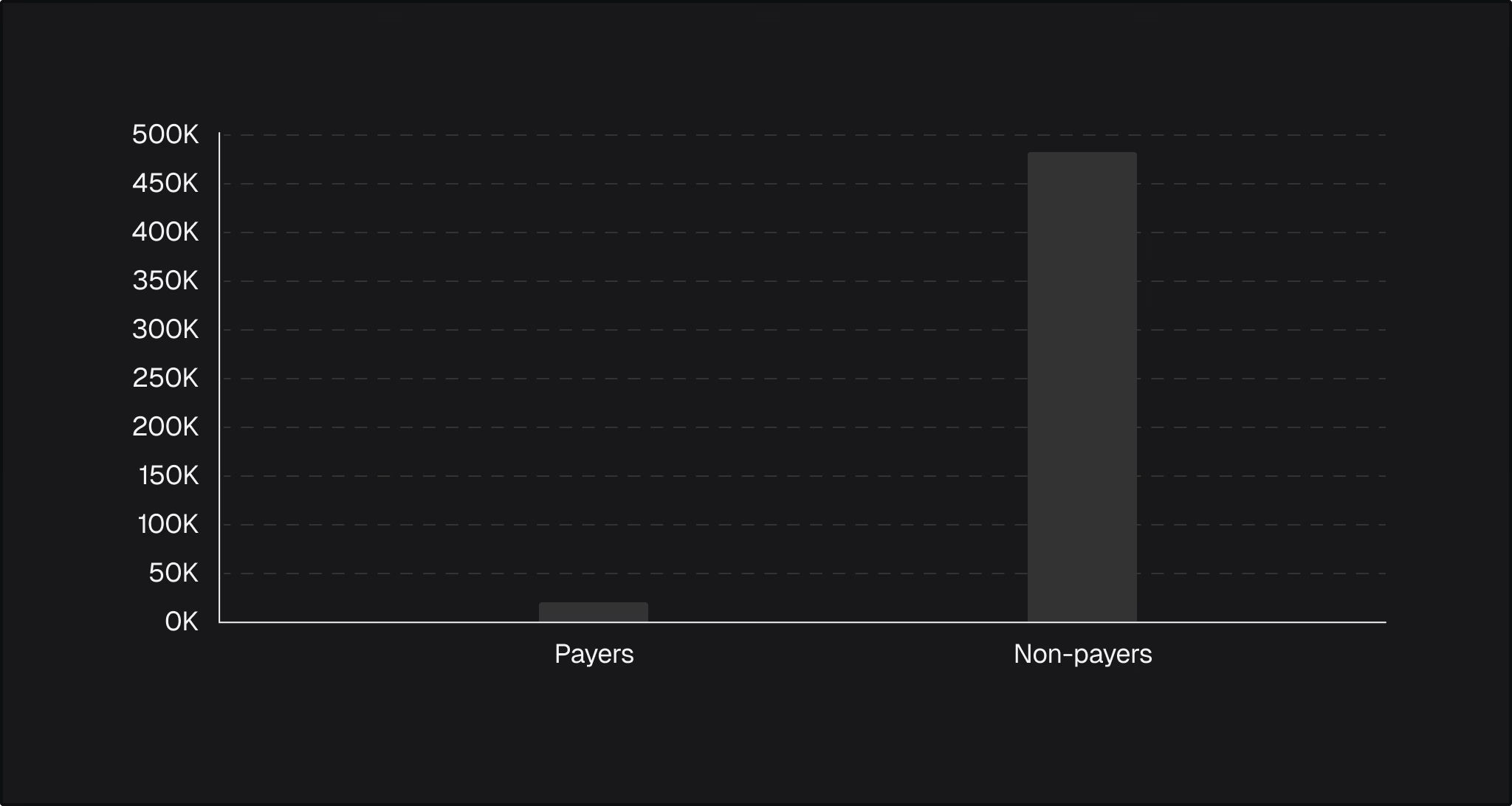
Take a mid-size publisher with 500,000 MAU, a 3% payer conversion rate, and an ARPPU of $40 a month, roughly 15,000 paying users generating $600,000 in monthly IAP revenue. Under standard App Store terms, Apple’s 30% commission takes $180,000 of that off the top, leaving the publisher with $420,000.
Now run that same money through a webshop. Say the new external-link fee is 15 percent, plus about 3 percent for payment processing. That is 18 percent total, not 30, and it means about $72,000 more margin each month before costs. Take out the cost of support, refunds, chargebacks, and compliance, and a lean team might clear $40,000 to $55,000 after expenses. That is worth building in this case, but remember: it only touches 15,000 users, or 3 percent of your base.
The remaining 485,000 MAU generated zero IAP revenue this month, and the webshop project does nothing to change that. If that same publisher is running default mediation settings and leaving even $0.30-$0.50 of eCPM on the table per thousand impressions across a base that size, the unrealized revenue from tightening ad yield can easily exceed what the webshop unlocked without touching a single payment flow, refund policy, or compliance requirement. The webshop and the mediation fix aren’t competing for budget; they’re solving for different populations, and sizing the opportunity correctly on both sides is what keeps a mid-size team from overinvesting in the smaller one just because it’s the one everyone’s talking about.
What about everyone else?
This is the real point, and it is what gets lost every time people frame the debate as app store tax versus webshop.
At its best, a webshop helps you keep more margin from players who were already spending. It does nothing for the 90 percent or more of your users who were never going to pay, no matter what the commission was. Those players are not just background noise. For most mid-size publishers, they make up the bulk of your engagement, your session time, and, if you ignore them, the largest group bringing in zero revenue.
That segment isn’t a webshop problem. It’s an advertising yield problem, and it’s the one mid-size publishers systematically under-invest in relative to how much revenue is sitting there. Rewarded video, interstitials, and offerwalls monetize exactly the population a webshop can’t reach: non-payers or payers with low-spend sessions, without requiring anyone to pull out a credit card. And this segment has its own version of the “commission” problem: mediation setups that leave yield on the table, waterfall structures that underprice demand, and fill rates that don’t reflect what advertisers would actually pay if the auction were running efficiently.
The smart move for a mid-size publisher is not to pick between a webshop and ads. It is building a hybrid model where each channel does what the other cannot.
- Webshop: captures margin from the payer segment that already converts, reducing the platform’s cut of revenue you were getting anyway
- In-app advertising, run through an optimized independent mediation layer: captures revenue from the non-paying majority, where a webshop has literally nothing to offer
If you treat these as rivals on a budget slide, you risk pouring too much into the smaller, tougher-to-scale channel and not enough into the one that actually reaches every user.
Where CAS.AI fits in that picture
This is where independent mediation actually matters, not simply as an afterthought tacked onto the end of an article.
The post-IDFA advertising environment has made user-level tracking an unreliable foundation for yield optimization; publishers can’t count on granular identifiers to tell them what an impression is worth, and dual-role ad networks that also run their own demand have a structural incentive to route auctions in ways that don’t necessarily reflect the best price available to the publisher. CAS.AI’s ML-driven yield prediction is built for exactly this environment: it optimizes fill and eCPM using aggregate and contextual signals rather than relying on user-level tracking, feeding a cleaner, more accurate revenue signal into whatever attribution and mediation stack a publisher is consolidating.
For the non-paying majority of a mid-size publisher’s audience, that’s the entire ballgame. Those players will never touch a webshop, never enter a payment flow, and never generate a commission dispute for Apple or Google to take a cut of. The only lever available for that segment is to maximize the value of each ad impression, and to do so through an independent layer that doesn’t quietly favor its own demand over the publisher’s yield. Webshops only work for payers. Making the rest of the audience worth something is a mediation and yield problem, and it’s the one CAS.AI is built to solve.
What the “consolidation” trend gets right, and where it stops
It’s worth naming why this hybrid framing is showing up more in 2026 specifically, rather than treating it as an everlasting best practice. The post-IDFA measurement environment pushed publishers to consolidate their attribution and mediation stacks around modeled, aggregate signals rather than user-level tracking, resulting in fewer tools, cleaner data, and less duplicated spend on redundant platforms. That consolidation instinct is correct, and it’s the same instinct that should apply to monetization strategy, not just measurement tooling.
The mistake is applying consolidation logic only to the tools, not to the audience segmentation beneath them. A publisher can have a perfectly consolidated, well-instrumented stack and still misallocate strategic attention if it treats “monetization” as a single problem with a single answer, rather than two structurally different problems, payer margin and non-payer yield, that happen to show up on the same P&L line. The stack consolidation makes execution cleaner. It doesn’t do the segmentation thinking for you.
A decision framework, not a verdict
None of this is an argument against webshops. It’s an argument against treating “should we build a webshop” as a yes/no question that applies equally to every publisher. A few questions worth running before committing engineering time:
- What share of your revenue already comes from a concentrated group of payers? If a small number of accounts drive a disproportionate share of IAP revenue, a webshop is likely to recoup its costs quickly; you’re optimizing margin on spend that’s already predictable and recurring.
- What does your first-purchase conversion rate actually look like today? If it’s meaningfully below industry benchmarks, the higher-leverage investment is almost certainly fixing that funnel, pricing, timing, and value perception, before building a second checkout experience for the same narrow group of buyers.
- Do you have the support and compliance capacity to own refunds, chargebacks, and tax remittance? If the honest answer is “not without hiring,” build that cost into the model before greenlighting the project, not after the first quarter of support tickets arrives.
- What are you doing about the non-paying majority right now? If the answer is “running default mediation settings from whichever network signed us first,” that’s very likely the larger, easier-to-capture opportunity, and it doesn’t require a single player to change their payment behavior.
- Is your commission-rate assumption still accurate? Given that the external-link fee landscape is actively being litigated and could shift again by the time a webshop project ships, model the case against a realistic post-ruling rate rather than the temporary 0% window some publishers are currently pricing in.
- Are you building for one storefront or several? A US-only external-link implementation is a materially different, cheaper project than one that must also satisfy the EU’s Core Technology Commission terms, Japan’s Mobile Software Competition Act requirements, and Google Play’s alternative billing rules simultaneously. Scope the build to the storefronts where your payer concentration actually justifies the compliance overhead, rather than defaulting to a global rollout because the US case looked good on its own.
Answering these five honestly, with your own numbers rather than the ones in a vendor’s pitch deck, is what turns “should we build a webshop” from a debate into a calculation.
The bottom line for finance leads and C-level stakeholders
A webshop is a legitimate, often profitable tool for publishers whose payer base and ARPPU justify the operating costs of running one, and for transactions those payers were already going to make anyway. It is not a growth strategy, and it is not a substitute for fixing how you monetize the players who were never going to open a payment screen in the first place.
The publishers getting the full picture right in 2026 aren’t choosing between the app store tax and a webshop. They’re running both channels against the audience each one actually serves: margin optimization on the payer segment through direct-to-consumer, and yield optimization on everyone else through an independent, ML-driven mediation layer that doesn’t depend on the identifiers that post-IDFA advertising took away. Get that segmentation right, and the “app store tax” stops being the headline problem; it becomes one line item in a monetization stack that’s finally accounting for all of your users, not just the ones who were already grasping for a credit card.