The Ultimate Guide to Mobile Game Monetization: Models, Strategies, and Ethical Practices
Running monetization on a network-by-network basis is a losing game. You waste hours in dashboards, patching SDKs, chasing eCPMs, and watching fill rates drop. That’s time and revenue you never get back.
Ad mediation exists to fix that. Before diving in, let’s compare what you’re doing now with what could be improved.
Whether you’re indie or scaling up, here’s what actually matters: what ad mediation does, how it works, why it outperforms manual setups, and how to pick a platform that squeezes more value from every impression.
Mobile Game Publishing: Monetization Starts Before Launch
Too many indie developers treat monetization as an afterthought. They spend months building, ship to Google Play, and only then start asking how to make money. That’s the wrong order.
Whether you’re an indie game publisher putting out your first title or a studio scaling a portfolio of casual games, your monetization infrastructure needs to be ready on day one. The ad networks, the mediation layer, and the floor price logic should not be improvised after launch.
Casual and Hyper-Casual Publishers Have the Most to Lose
For a casual game publisher, ad revenue isn’t a secondary income stream; it’s the business model. Rewarded video, interstitials, and banners drive virtually all revenue when there’s no meaningful in-app purchase funnel. That means fill rates, eCPMs, and network coverage aren’t metrics to check occasionally. They’re what you live and die by.
Hyper-casual game publishers feel this even more acutely. With thin retention curves and massive volume, every missed impression is a real cost. A manual monetization setup at that scale isn’t just inefficient, it’s a revenue leak you can’t afford.
Indie Game Publishing Is a Resource Problem
Indie game publishing means doing everything with less. Less budget, less engineering time, fewer people to manage dashboards and chase eCPMs across eight networks. That’s exactly why mediation exists.
An indie developer who integrates a mediation SDK on day one gets the same automated optimization, competitive bidding, and centralized reporting that a well-funded studio gets without the headcount. If you want a deeper breakdown of how the underlying system works, the mobile game monetization guide above covers every layer, from waterfall logic to in-app bidding to floor price strategy.
Publish Your Game on Google Play With Monetization Already Running
When you’re ready to publish your game on Google Play, mediation should already be part of your build. Waiting until after launch to integrate ad networks means you’re flying blind during your highest-traffic window, the first days after release, when organic discovery is at its peak, and every impression counts.
Mobile game publishing today is competitive enough that the difference between a good launch and a great one often comes down to infrastructure. The developers who treat this monetization guide as required reading before they submit to the store are the ones who don’t leave their launch revenue on the table.
What Is Ad Mediation? (And Why It Matters)
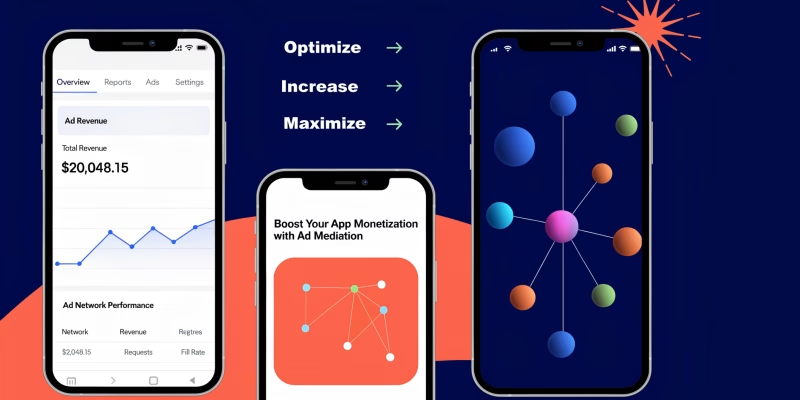
Ad mediation puts every network under your control, all from one SDK. No more scattered integrations or wasted effort.
Stop wasting time integrating endless SDKs. Mediation sits between your app and every network, handling the mess for you. It’s your command center.
When your app needs an ad, mediation connects to every network instantly, grabs the highest bid, and serves it quickly. No waiting, no missed value.
The goal is simple: maximize eCPM and fill rate on every impression, without micromanaging anything.
Drop in the mediation SDK once, and you’re done. Your app supports every network, no more SDK stacking, update chaos, or bloat slowing you down.
The Problem With Manual Monetization
To really understand the value of ad mediation, it helps to picture what manual in-app monetization looks like without it.
Eight networks means eight SDKs, eight dashboards, eight sets of rules. You’re stuck checking stale data, tweaking priorities that are already out of date, and scrambling every time an SDK update drops.
Manual setups aren’t just slow – they’re broken. You lose impressions, make calls on stale data, and waste engineering time on maintenance instead of building what matters.
Mediation kills the busywork. One system, automated, always optimizing for you.
How Ad Mediation Works: Step by Step
Here’s the flow: the user opens your app, an ad slot is ready, and the mediation SDK pings the platform.
- The pThe platform fires the request to every network at once. No more waiting in line – everyone bids, every time. It collects all bids or floor prices, compares them, and picks the winner. Doesn’t matter if it’s bidding, waterfall, or hybrid, the logic is the same.
- Highest bid wins. Mediation tells that network to serve the ad.
- The ad appears to the user. They never see the machinery, but you get the best return on every impression.
Waterfall vs. In-App Bidding: Two Approaches to Ad Mediation
Understanding. If you want to pick the right monetization platform, you need to understand how waterfall and in-app bidding actually work – and why it matters. idding: The Traditional Model
The waterfall model was the industry standard for years. Here’s how it works:
- Ad networks are ranked in a set order, usually based on past performance.
- With each ad request, the top-ranked network gets the first chance to fill it.
- If that network can’t fill the request (or doesn’t meet the floor price), the request “falls” down to the next network in line.
- This continues until the ad slot is filled or the waterfall is exhausted.
Waterfalls look simple, but they leave money on the table. If a lower-ranked network would pay more, you never see it. Multiply that by millions of impressions, and you’re bleeding revenue.
Keeping waterfalls working means constant manual updates. Stop, and your revenue drops – fast.
In-App Bidding: The Real-Time Revolution.
Every ad network. In-app bidding throws every impression into a real-time auction. Every network bids at once. No fixed rankings, no stale CPMs – just real competition, every time.re notable:
- Every impression reaches its true market value. No network can underbid because they know they’re ranked first.
- Competition raises prices. When networks bid at the same time, they try harder to win with their best offer.
- Bids reflect the moment. For example, a user in Germany on a Wednesday afternoon is worth more or less than a user in Brazil on a Saturday evening. In-app bidding prices adjust instantly.
The Hybrid Approach: Best of Both Worlds
Most top monetization platforms don’t make you pick sides. They run both waterfalls and in-app bidding simultaneously.
Hybrid models combine the strengths of both approaches. In-app bidders compete for top spots, ensuring real-time, competitive pricing, while the waterfall fills gaps if bidders don’t cover every impression. This means you benefit from both high eCPMs and consistent fill rates – more competition, fewer missed opportunities, and maximized revenue without compromise.
The Real Benefits of Ad Mediation for Publishers
Here’s what mediation actually delivers:
1. Higher Revenue Per Impression
More bidders mean more competition and higher prices. Switching from manual waterfalls to in-app bidding can triple your revenue. That’s not a rounding error – it’s a game changer.
2. Higher Fill Rates
Fill rate is the ratio of ads served to ads requested. For example, if your app asks for 1,000 ads and serves 850, your fill rate is 85%. The other 150 are missed revenue opportunities.
Manual setups always struggle with fill rates. Every network has blind spots – limited coverage, inventory gaps, or category restrictions. If your main network can’t fill a slot in Southeast Asia, that’s lost revenue.
Mediation fixes this. If one network can’t fill, another steps in. Your fill rate climbs because you always have a backup. Integration Overhead
Every extra SDK is a liability: a bigger app, slower load times, more crashes, more maintenance. Stack five SDKs, and you multiply the hassle.
With mediation, you integrate once. The platform handles every network update. Your team stays focused on building the product.
For small teams, this is a game-changer. Every hour saved on SDK headaches goes straight into building features players actually care about.
4. Automation Replaces Manual Labor
Manual monetization eats your day. You’re stuck reviewing eCPMs, tweaking priorities, testing floors, and chasing fill rates. The grind never ends.
Mediation automates the grind. Algorithms handle bid optimization, shifting, and impression routing to squeeze out maximum value. You set the rules, the platform does the rest.
You’ll still check your dashboard, but the system keeps optimizing even when you’re not watching.
5. Centralized Analytics and Reporting
You can’t make smart monetization calls without clear data. Manual setups scatter your numbers across networks, forcing you to stitch together reports just to see what’s happening. Mediation pulls all your data into one place: eCPM, fill rate, ARPDAU, revenue by network, geo, and format. You spot problems and opportunities instantly – no more dashboard scavenger hunts.
Key Features to Look for in a Mediation Platform
Not all mediation platforms are equal. Here’s what actually moves the needle.
Real-Time Bidding Support
In-app bidding is the baseline. If your platform doesn’t support it with a hybrid fallback, you’re already behind.
Ad Format Coverage
Your mediation platform must support every ad format you use or plan to use. Check these first:
- Rewarded video: The highest-value format in mobile gaming. Users opt in to watch an ad in exchange for in-game currency or content.
- Interstitials: Full-screen ads served at natural transition points (level completions, loading screens).
- Banners and MRECs: Static or animated display ads, typically less disruptive, but lower. If your mediation can’t handle every format you use, you’re leaving money on the table. Simple as that. The table.
A/B Testing
Optimization never stops. The best platforms let you A/B test floor prices, network mixes, placements, and bidding strategies – so you know what actually works, not just what you hope works.y works.
Without A/B testing, you’re making optimization choices based on intuition. No A/B testing? You’re guessing. With it, every change is backed by real data ports, which means you can generate more competition for your inventory. Seek platforms with deep integrations across the major demand sources, particularly those with strong coverage in your core markets.
Quality beats quantity every time. Fifty strong integrations are worth more than 200 weak ones.
Documentation, Support, and Onboarding
The best platform is the one you can actually use and maintain. Before you commit, check these:
- Quality and completeness of integration documentation
- Availability of technical support (especially important during initial setup)
- Reporting API availability for custom analytics workflows
- Account management support for scaling publishers
Comparison: Top Ad Mediation Platforms
Ad Mediation Platform Comparison
Here’s a quick look at three leading players in the mediation space. Each platform has particular strengths. AppLovin MAX excels at high-volume gaming monetization with sophisticated algorithm-driven optimization. Google AdMob is a natural entry point for developers already in the Google ecosystem, with broad advertiser demand and a simple setup. IronSource (now part of Unity) offers deep gaming-specific tooling and one of the most mature A/B testing suites in the industry.
Pick based on your app’s category, scale, and target markets. Most publishers end up testing several platforms anyway – mediation makes switching painless.
Diversify Your Network Portfolio
Relying on one or two networks is a risk, no matter how strong they look now. Performance shifts, budgets change, and what works in Q4 can flop in Q1. Don’t get caught flat-footed. Serve 6 to 12 networks in different demand categories. If one drops, the others cover you. Your revenue stays steady.
Localize Your Network Mix
Networks don’t perform equally everywhere. A network strong in North America might flop in Southeast Asia or Latin America. Treating your global audience as one market leaves money on the table. Take action by analyzing your user base and strategically partnering with networks proven to be successful in each region to boost your earnings.
Analyze your top geos and make sure you have networks with strong local demand in each. Use your mediation analytics to find gaps and close them.
Treat Floor Prices as Variables, Not Constants
Floor prices are one of the highest-leverage tools in mediation. Set them too low, and you undervalue your inventory. Set them too high and your fill rate tanks.
The right floor for a rewarded video in Tier 1 is nothing like the right floor for a banner in Tier 3. Use A/B tests to dial in floors – don’t just set and forget. Establish a regular review cadence: weekly for active optimization and monthly for structural reviews.
- Identify underperforming networks and modify their placement.
- Evaluate new network integrations.
- Check fill rate trends by geography and format.
- Test new floor price configurations.
Monitor Ad Quality
Don’t sacriDon’t sacrifice user experience for a quick eCPM bump. Mediation can surface bad ads – use quality controls. Bad ad experiences drive players away, and no short-term gain is worth that loss. The Role of Ad Mediation: Privacy, Attribution, and What’s Next
Mobile advertising is changing fast. Mediation sits at the center of that shift.
Privacy-First Advertising
Apple’s App Tracking Transparency (ATT) framework and Google’s Privacy Sandbox initiative have fundamentally changed how user-level targeting and attribution work. SKAdNetwork-Apple’s privacy-preserving attribution framework limits the granularity of conversion data that ad networks can access. Google’s Privacy Sandbox brings similar constraints to Android.
For publishers, hyper-targeted user data is out. Privacy-safe, aggregate signals are in. Mediation platforms are adapting fast with better SKAdNetwork support, contextual targeting, and smarter attribution.
If your mediation platform has strong privacy tools, you’ll handle this shift. If you’re stuck on IDFA workflows, you’re falling behind.
Contextual and Cohort-Based Targeting
With user tracking restricted, context is king. App content, time of day, device, and general location now drive targeting.
Smart mediation platforms now embed contextual intelligence into their algorithms, enabling advertisers to target the right audience without user IDs. That’s how you keep value high without crossing privacy lines.
AI-Powered Optimization
Mediation is getting smarter. Machine learning predicts demand, positions inventory for high-value impressions, and adjusts floors in real time – all hands-off.
The gap between publishers on modern platforms and those stuck on legacy systems is only getting wider.
Glossary: Know the basics. That’s how you evaluate platforms, read your data, and talk to partners without getting lost.
eCPM (Effective Cost Per Mille): The revenue a publisher earns per 1,000 ad impressions. The primary metric for evaluating ad network performance. Calculated as: (Total Revenue / Total Impressions) × 1,000.
Fill Rate: The percentage of ad requests that actually get filled. A 95% fill rate means 5% of your ad slots went unfilled and earned nothing. Higher fill rates are better, but not if you sacrifice eCPM – quality matters as much as quantity.
ARPDAU (Average Revenue Per Daily Active User): Total ad revenue divided by daily active users. This is the key metric for measuring monetization efficiency across your whole user base – not just impressions served.
In-App Bidding: A real-time auction mechanism where multiple ad networks bid simultaneously for an impression. The highest bidder wins. Replaces (or supplements) traditional waterfall logic.
Waterfall: A sequential ad request model where networks are ranked by priority and called one at a time until the impression is filled. More predictable than bidding but typically less efficient.
Floor Price: The minimum eCPM a publisher will accept for a floor price. Floor Price: The minimum eCPM you’ll accept for an impression. Bids under this get rejected, and the impression either falls to the next network or goes unfilled. Low latency is critical for user experience. In-app bidding infrastructure is built to keep latency under 200ms for the bidding process.
SDK (Software Development Kit): A package of code and tools that developers integrate into their apps to enable third-party functionality. In the ad mediation context, integrating a mediation SDK is the single technical step required to connect your app to a mediation platform’s full network ecosystem.
Impression: One ad shown to a user. This is the raw count that drives your actual revenue – not just eCPM.
Final Thoughts: Is Ad Mediation Right for You?
If you’re monetizing a mobile app with ads and not using mediation, you’re leaving money on the table. Simple as that. Mediation is just as valuable for solo developers who don’t have time to manage networks by hand. Automation, centralized analytics, and competitive bidding are structural advantages for every publisher – no matter your size.
The right platform gives you:
- One integration that unlocks access to a full network ecosystem
- Real-time bidding that guarantees every impression reaches its true market value
- Automated optimization that works even when you’re focused on building your product
- Centralized reporting that turns segmented data into clear, usable insights
Whether you’re starting from scratch or fixing a broken setup, mediation is the backbone that makes everything else work. The market is competitive, fast, and only getting more complex. The winners are the ones who let the right tools handle the mess and focus on building experiences players actually care about. Art with mediation. Let the algorithms compete. Watch your revenue follow.
Ready to stop juggling mediation partners? With CAS.AI, you don’t have to. One SDK gives you access to 10 major ad networks – AdMob, AppLovin, ironSource, Unity, Mintegral, Pangle, and more – without separate accounts, revenue thresholds, or conflicting integration docs.
Payments are consolidated, too. Instead of tracking 10 payout schedules and minimums, you get a single payment on a predictable date – CAS.AI handles the invoicing. No more chasing networks that pay out on 90-day cycles or hold funds until you hit a $1,000 minimum.
On the monetization side, CAS.AI runs a continuously optimized hybrid waterfall. You’re not wasting hours tuning eCPM floors or flying blind with pure bidding. You get higher eCPMs and your time back.
Integration takes hours, not weeks. The CAS.AI SDK always bundles the latest network versions, so you never have to monitor upstream SDK updates again.
You’ll still get all the data you need – you’ll just spend a lot less time collecting it.