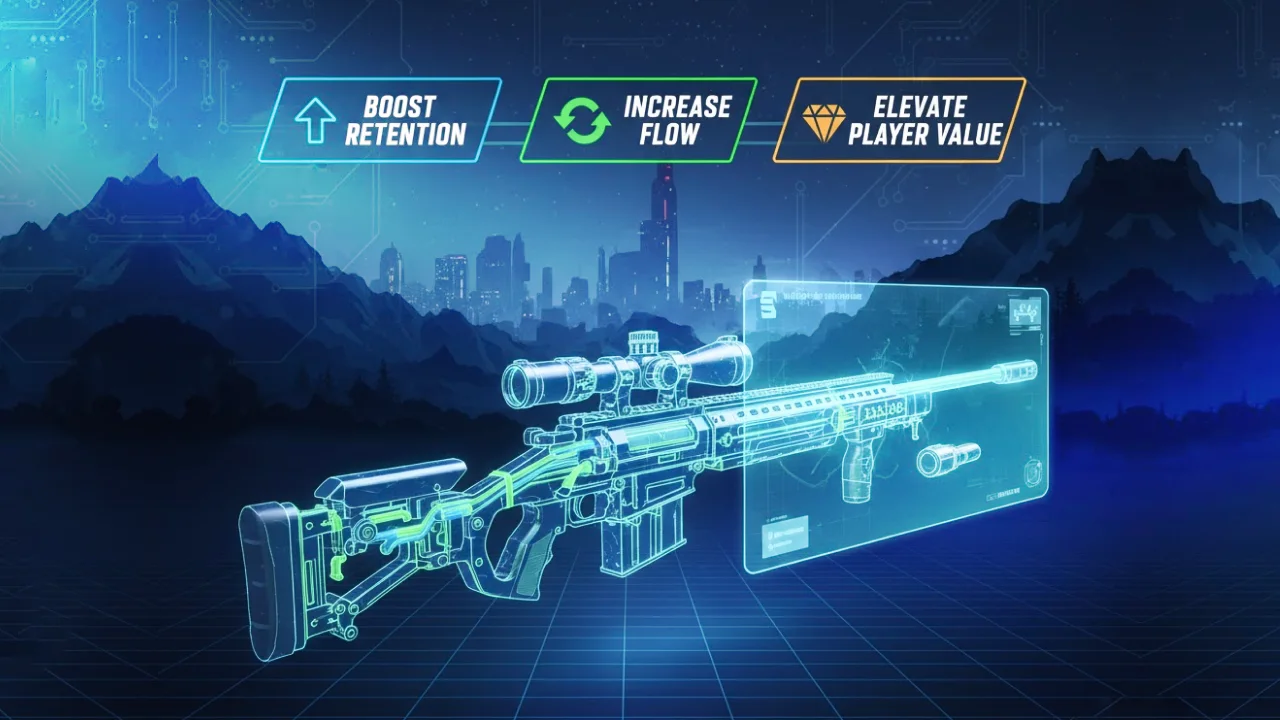
Epic Sniper Upgrade — Boost Retention, Increase Flow, Elevate Player Value

Epic Sniper Upgrade: Boost Retention, Flow, and Player Value

November 7, 2025 5 min read

Mobile sniper shooter retention is the north star of this update. We’ll combine FTUE improvements, smarter ad flow, and systemic D1 D7 retention optimization to match the sniper fantasy players expect and grow revenue. For context and tools, see CAS.AI, our ad mediation, and developer docs.

Why We’re Doing This

Our goal is to quickly boost retention (D1/D7), increase ad and in-app revenue, and align player expectations. We’ll start with quick wins, run A/B tests, and then refine AI, balance, and meta. As a result, mobile sniper shooter retention improves without a full rebuild.

Key KPIs

  • FTUE completion rate ≥ 85%, D1 ≥ 35%, D7 ≥ 12%
  • Average session time +10–15%
  • ARPDAU / eCPM / imp/DAU +5–10% through better placements
  • Crash/ANR < 1%, FPS ≥ 50 on target devices
  • Install-to-level-1 conversion ≥ 95%

1. Onboarding and Accessibility (FTUE)

A smooth first minute drives mobile sniper shooter retention. When players clearly learn controls and weapon logic during FTUE, they come back the next day. Currently, the lack of a guided tutorial causes early drop-offs and hurts D1.

Therefore, we’ll ship an interactive weapon tutorial (choose → aim → shoot), plus clearer visual cues and animated hand indicators. In addition, we’ll track FTUE by device specs and FPS to catch friction early.

Expected result: FTUE +10 pp, D1 +3–5 pp. Together, these FTUE improvements form the base layer of our D1 D7 retention optimization.

Initiatives

  • More visible cursor/hand indicator with animation and outline.
  • Technical funnel from app launch to level 1; track drops by RAM/FPS.
  • Loading hints and aesthetic load screens that also support ASO.

A/B Tests

  • New shooting tutorial: manual aim vs. auto-aim.
  • Flow that stops at the home screen after onboarding.

2. NPC Behavior and Combat Feel

Right now, NPCs move and die with little expression, while groups often act in sync. Consequently, encounters feel similar.

  • Movement/death animations and punchy VFX (hits, sparks, damage cues).
  • Expanded AI: cover, flanking, and conditional behaviors (low HP, grenade reaction).
  • Clear archetypes: fast-weak, slow-strong, kamikaze.
  • Mini-bosses with unique abilities (grenades, healing, sustained fire).

Expected result: session time +10%, D7 +2–3 pp. Better combat feel reinforces mobile sniper shooter retention.

3. Weapon Balance and Readability

Balance should underline the fantasy. Pistols must not dominate at long range, and equipped weapons must be obvious at a glance.

  • Range logic: pistols miss at distance; weapons differ by damage/range/control.
  • Headshots = instant kill if no helmet.
  • Clear stats and descriptions (damage, accuracy, reload).
  • UI update: small sniper icon instead of the ↔ switch.
  • Fewer low-value skins; more meaningful visuals (bullet trails, blood splashes).

Expected result: upgrade conversion +15–20%, deeper progression +1–2 levels per DAU per day. In turn, this supports D1 D7 retention optimization.

4. Levels, Variety, and Difficulty Curve

Linear paths and low difficulty reduce engagement. To counter this, we’ll add choice, pace, and challenge sooner.

  • Multiple solutions per level (explosive barrel versus clearing enemies).
  • Difficulty curve: every N-th level marked Hard/Boss.
  • Earlier boss (≈ level 5) with dynamic movement, grenades, and a unique trait.
  • Diverse objectives: briefcase or phone target, hostage rescue, escape denial.
  • New modes: hostage, stealth, sniper challenges with slow-mo finishers.
  • Sniper-only starter pack to align expectations and improve mobile sniper shooter retention.

Expected result: D1/D3 +2–4 pp and stronger progression engagement.

5. Meta, Store, and Battle Pass

No meta usually means shallow growth. Accordingly, we’ll introduce light but sticky loops.

  • Meta loop with goals, collections, and weekly rewards.
  • Store packs for different motivations: economy, progress, collection.
  • Battle Pass rebalance: clearer tasks, meaningful rewards, useful free track.
  • UI refresh: achievements up top; ad-reward icon = bigger reward, smaller ad.
  • Gadsme integration and placement tests.

Expected result: ARPDAU +5–10% and higher store conversion. Monetization that respects flow further sustains mobile sniper shooter retention.

6. Technical Quality and Camera Feel

Camera lag after shots breaks rhythm; some players never enter gameplay after install.

  • Remove camera return delay while keeping recoil feedback.
  • Profile RAM/FPS on key devices; optimize textures and shaders.
  • Reduce crashes and ANRs to < 1%.

Expected result: start-flow failures −50% and zero camera-lag complaints. Stability always helps retention.

7. Ads and Monetization Experience

Interstitials must appear at natural pauses; rewarded ads should start instantly.

  • Test interstitial timing: before-win versus after-win.
  • Ensure rewarded ads are pre-cached for instant playback.
  • Redesign ad-reward icon for clear value.

Expected result: imp/DAU +10% and fewer complaints. Well-timed ads support mobile sniper shooter retention instead of hurting it.

Priorities by Impact vs Effort

High impact, fast: onboarding, funnel, camera fix, ad placement, rewarded cache, UI icons/achievements, weapon range balance, headshot logic, hard-level markers, load screens.

Mid impact: AI cover logic, mini-bosses, store packages, Battle Pass rebalance, weapon descriptions, sniper intro levels, UI reskin.

Long term: hostage/stealth modes, player stances, new goals, ally abilities, expanded meta.

8-Week Roadmap

  • Weeks 1–2: FTUE tutorial, visual pointer, funnel setup, camera fix, ad placement A/B, rewarded cache, loading hints.
  • Weeks 3–4: Weapon balance (range/DPS/headshot), UI refresh, first Hard/Boss levels, review “barrel/mechanic” maps.
  • Weeks 5–6: AI improvements, mini-bosses, store packs, Battle Pass rebalance, Gadsme integration.
  • Weeks 7–8: Sniper starter levels, new objectives (hostage, briefcase, phone), major UI reskin, backlog for meta.

Ad timing experiments and their impact on D1/D7 and ARPDAU.

Conclusion

In short, we remove friction early and make combat expressive. This raises mobile sniper shooter retention without heavy rebuilds. Meanwhile, meaningful balance, better AI, and varied objectives power our D1 D7 retention optimization.

At the same time, refreshed monetization and store design lift revenue. Combined with ongoing FTUE improvements, these steps create a smoother experience, higher D1/D7, and stronger ARPDAU — a durable base for long-term growth.


Helpful resources

Need help implementing this plan? Visit CAS.AI, explore CAS Ad Mediation, and check our developer docs.


Zoriana Omelchuk
Zoriana Omelchuk Head of Marketing, CAS.AI

12 years in mobile marketing, UA, and ASO.

View all articles →

Explore More

Technical isometric diagram for Unity mobile ad mediation, illustrating the network infrastructure to maximize mobile game ad revenue.
AdTech & Monetization

What Is Ad Mediation for Unity Developers

For Unity developers, ad mediation is the essential technology layer that sits between your mobile game and dozens of global ad networks. Instead of relying on a single provider, mediation connects you to a vast marketplace, triggering real-time auctions for every impression. By polling multiple networks simultaneously, the system ensures the highest-paying ad is always served, significantly increasing your eCPM and fill rates. Modern platforms utilize programmatic bidding (or header bidding) alongside traditional waterfalls to create a competitive environment where 20 to 70+ networks bid for your inventory. For Unity creators, this eliminates single-network dependency and centralizes reporting into one dashboard. Whether you choose native solutions like Unity LevelPlay or high-performance independent options like CAS.AI, implementing a robust mediation strategy is the most effective way to automate growth and ensure you aren't leaving money on the table.

March 8, 2025 5 min read
Technical isometric diagram for React Native mobile ad mediation, illustrating smart ad integration infrastructure to optimize cross-platform app revenue.
AdTech & Monetization

Ad Mediation in React Native

Ad mediation is the essential "go-between" for React Native developers looking to maximize app revenue. Rather than relying on a single ad network, mediation creates a real-time auction where multiple networks compete for your ad slots. This ecosystem ensures that every impression—whether it’s a banner, interstitial, or high-value rewarded video—is sold to the highest bidder. The transition from traditional "waterfall" models to programmatic bidding has revolutionized monetization, often increasing earnings by 10% to 30%. By integrating a single mediation SDK, developers can access premium demand from giants like AdMob, AppLovin, and CAS.ai without the engineering overhead of managing dozens of individual plugins. Beyond higher eCPMs, mediation offers unified analytics, improved fill rates in secondary markets, and built-in A/B testing. For any React Native developer aiming for professional-scale growth, a robust mediation strategy is no longer optional. It is the foundation of a profitable mobile business.

May 8, 2025 8 min read
Abstract 3D digital technology platform block representing ILRD Impression Level Revenue Data for mobile game monetization.
AdTech & Monetization

ILRD Is Not a Setting. It’s the Foundation of Your Monetization Stack.

ILRD isn’t just a setting. It’s the base of your monetization stack. If you’re still looking at yesterday’s aggregate revenue and calling it “performance,” you’re flying blind. In modern user acquisition (UA), seeing $27,000 in daily revenue doesn’t tell you whether your campaigns are profitable, whether your ad frequency test is working, or whether your cheapest advertising channel is quietly hurting lifetime value (LTV). Impression-Level Revenue Data (ILRD), which measures revenue earned per individual ad impression, changes that. It connects every ad impression to a real user, specific device, and the original traffic source, turning return on ad spend (ROAS) optimization, analyzing groups of users over time (cohort analysis), and combining ads with in-app purchases (hybrid monetization) into measurable systems instead of relying on educated guesses. But IRLD isn’t just about turning it on. Waterfall floor math, bidding mechanics, alternative stores like RuStore, and Meta's platform restrictions can introduce discrepancies that quietly corrupt your signal and your UA decisions. In the full article, we break down what’s normal, what’s fixable, and what’s catastrophic. We also show you how to verify your IRLD before every build. If you’re using target Return on Ad Spend (tROAS) in 2026, this isn’t optional reading.

March 6, 2026 11 min read
Graphic illustrating a conceptual framework for Beyond Gaming Marketing and Ad Monetization, featuring 3D icons that represent the interplay between user acquisition and revenue generation.
AdTech & Monetization

Beyond Gaming: How Non-Gaming Apps Are Rewriting the Mobile Monetization Playbook

Non-gaming apps are set to out-earn games in 2025: $85.6 billion versus $81.8 billion. But if you’re leaving most users unmonetized, the headline is irrelevant. Most non-gaming apps blow it in three main ways: They obsess over subscriptions, which only convert 2-5% of users; run lazy, single-format ad stacks; and cling to the myth that better monetization ruins the user experience. It doesn’t. Combine ads and subscriptions. Watch lifetime value jump over 50%. Users who hit rewarded video are 4.5 times more likely to pay. Clearly, the formats work. Hybrid models work. The blueprint is already out there. Gaming has already paid the price to figure this out. Skip the mistakes: start adopting hybrid monetization strategies now to close the gap.

June 15, 2026 15 min read
Mobile game publishing workflow banner showing user acquisition, creatives, monetization, analytics, and ROAS around a mobile game dashboard in a futuristic UI.
Publishing

Mobile Game Publishing: The Growth Workflow We Use at CAS.AI

Mobile game publishing at CAS.AI is built for scaling mobile games with a data-driven system: CPI→ROAS UA, hybrid monetization (bidding + waterfall), ASO A/B tests, and creative iteration. Learn the baseline metrics we require and the workflow we use to scale profitably into Tier-1 geos.

December 19, 2025 5 min read
Technical isometric diagram for Unreal Engine mobile ad mediation, illustrating infrastructure to maximize game ad revenue across multiple networks.
AdTech & Monetization

Ad Mediation for Unreal Engine

Building a high-performance mobile game in Unreal Engine is only half the battle; the real challenge lies in effective monetization. Ad mediation is the essential bridge between your game and dozens of global ad networks. Rather than relying on a single provider, mediation creates a live auction environment where networks compete in real-time to fill your ad slots, ensuring you receive the highest possible eCPM for every impression. For Unreal Engine developers, whose games often attract high-value, engaged audiences, mediation isn't just an option—it’s a revenue multiplier. By integrating a solution like CAS.ai, developers can access over 150 DSPs through a single SDK. This independent, programmatic approach removes network bias, leading to reported ARPU increases of 1.5x to 2x. With features like a "no-loss" A/B test guarantee and reduced crash rates, ad mediation allows you to focus on gameplay while maximizing your bottom line automatically.

March 8, 2025 5 min read
Technical isometric diagram for Flutter mobile ad mediation, illustrating efficient ad monetization infrastructure for cross-platform app developers.
AdTech & Monetization

Ad Mediation for Flutter

Maximizing revenue in the competitive mobile landscape requires more than just standard ad placements; it demands a strategic approach to monetization. For Flutter developers, ad mediation serves as the ultimate engine for growth. By implementing a robust mediation platform, you can force top-tier ad networks to compete for your inventory in real-time, significantly driving up your average eCPM. This guide explores the technical and strategic advantages of moving beyond single-network setups. You will learn the nuances of integrating industry-leading networks and the transformative power of programmatic bidding. Unlike traditional waterfalls, programmatic bidding ensures that every impression is sold to the highest bidder at the exact moment of the request, eliminating manual overhead and maximizing fill rates. Whether you are launching a new utility app or scaling a global gaming title, mastering these mediation techniques is the key to unlocking sustainable, scalable earnings and ensuring your Flutter project achieves its full financial potential.

July 8, 2025 5 min read
ASO 2026 strategies for mobile app discovery, organic growth, and app monetization.
AdTech & Monetization

Mobile App Monetization Under Siege: Maturing Algorithms Kill Organic Growth as User Acquisition Takes the Crown

ASO and paid user acquisition have merged into a single growth system as store algorithms focus on product quality, Apple expands ad placements, and organic-only strategies lose ground inside the competitive app economy of 2025. Mobile marketing entered 2025 at a crossroads. The rules that governed app growth for years - organic optimization here, paid acquisition there - no longer hold. Apple Search Ads rolled out new placements, user behavior shifted in unexpected ways, and competition intensified across every category. The result? ASO stopped being a standalone discipline practiced in isolation and became inseparable from the entire product and marketing funnel.

February 6, 2026 13 min read

Maximize your ad revenue with CAS.ai

Smart mediation platform for mobile publishers and game developers.


Telegram
WhatsApp
Slack
Phone