
How to Advertise Your App
How to advertise your app comes down to combining paid user acquisition (Search Ads, Meta, TikTok, ad networks), strong creatives, and ASO, then measuring with CPI and ROAS. This playbook covers each channel and the 2026 budget.
Scale installs with CAS publishing
How to Advertise Apps Through Paid Channels
Six channels move installs at scale in 2026: Apple Search Ads, Google App Campaigns, Meta, TikTok, ad networks through mediation, and influencer/UGC. Each pulls a different type of user at a different cost and with a different creative format. Knowing how to advertise apps well isn’t about picking one; it’s about sequencing them correctly and knowing when each one earns its budget.
Apple Search Ads
High-intent traffic: users already searching for an app like yours. Best for apps with clear category keywords (finance, productivity, mid-core games). The creative format is minimal: your existing store listing does the work, so ASO quality directly determines Search Ads’ performance. Because intent is already established before the click, CPI runs tighter here than on any interruption-based channel; you’re paying for a user who was already looking, not one you’re persuading mid-scroll.
Google App Campaigns (UAC)
The standard entry point for Google app advertisement. UAC pulls assets automatically across Search, Display, YouTube, and Discover and optimizes toward your target action, install, in-app event, or ROAS. Good fit for broad-reach campaigns once you have at least three solid creative variants; the algorithm needs volume and creative diversity to learn efficiently, and campaigns launched with a single ad tend to plateau early. Expect a learning-phase dip in efficiency for the first 1–2 weeks before ROAS-target optimization stabilizes.
Meta (Facebook/Instagram)
Best-in-category interest and lookalike targeting, with the deepest creative testing infrastructure of any platform. Works for both game and non-game apps, but performance depends almost entirely on creative quality; a strong video hook matters more than targeting precision here. Meta’s Advantage and campaign types have pushed manual audience targeting toward automated, broad delivery; creative diversity is now the main lever advertisers actually control.
TikTok
Native, fast-cut, sound-on creative. Strong for casual and hyper-casual games and Gen Z-skewing apps. CPMs are volatile; costs shift week to week with trend cycles, so budget flexibility matters more than on other platforms. Ads that look like organic TikTok content consistently outperform polished studio spots here; the platform’s format expectations are distinct enough that repurposing a Meta creative rarely performs as well as building natively for TikTok first.
Ad networks (through mediation)
Access to dozens of demand sources and DSPs bidding in real time through a single app for ads integration. This is where mobile advertising scales past what any single network can deliver alone: mediation runs networks in competition for each impression, which is the main lever for pushing eCPM and fill rate up without adding manual work per network. It’s also the fastest way to test which apps for advertising your specific genre actually convert on, since spend shifts automatically toward whatever performs, without you manually reallocating budget network by network.
Influencer & UGC (mobile game influencer marketing)
Mobile game influencer marketing works especially well for mid-core and strategy titles, where a 60-second gameplay clip from a trusted creator outperforms a produced ad. Cost is negotiated per creator, not auction-based, with a budget for a flat fee plus a bonus tied to install volume if the creator’s audience matches your ICP. The format also serves as a creative source: high-performing influencer clips are frequently repurposed as paid UGC ads on Meta and TikTok, extending the value of a single piece of content across channels.
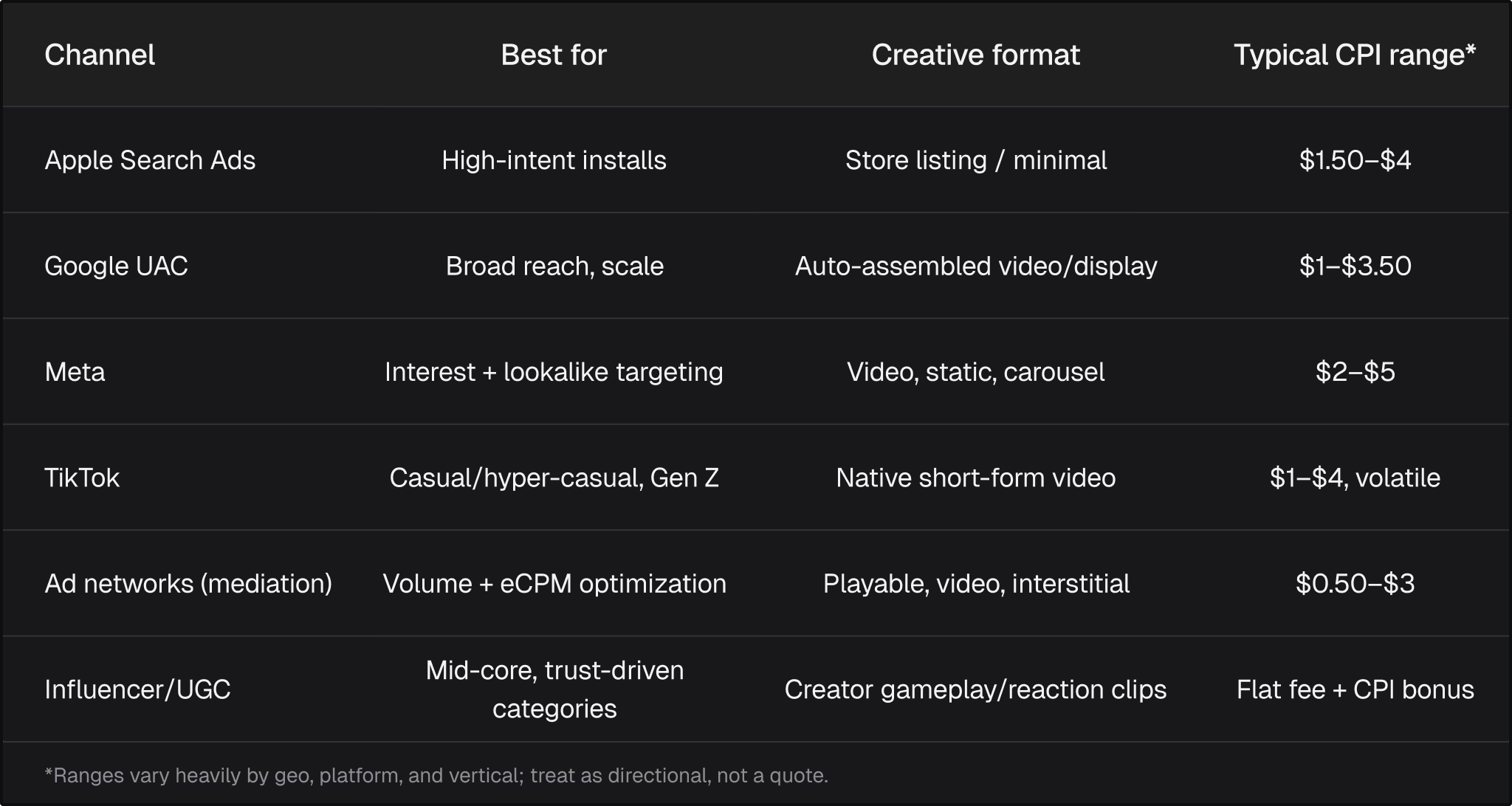
From running publishing accounts across genres, the pattern holds consistently: no single channel outperforms across every stage. Search Ads and mediation work best once a product already retains; Meta and TikTok are where you find out if a product retains at all. Sequencing matters more than most advertisers assume; testing retention-sensitive channels before you’ve validated a product’s core loop wastes budget on a question creative testing should have answered first.
Let CAS handle UA & creative production
Mobile Game Marketing: What Changes for Games
Mobile game marketing runs the same six-channel map as any app, but the weighting shifts. Games lean harder on TikTok and influencer/UGC for casual and hyper-casual titles, where a gameplay clip sells the core loop faster than any copy could. Mid-core and strategy games lean the other way, toward Meta’s deeper targeting and Search Ads’ high-intent traffic, since those players are further along in a genre they already search for by name. Retention data should decide the split before spend does: a game with strong D1 retention but weak D7 justifies aggressive top-of-funnel spend on TikTok and influencer content; a game with the reverse profile is better served pulling budget into Search Ads and mediation, where existing intent does more of the work than a cold creative hook.
Costs & CPI
CPI (cost per install) is what you pay to acquire one user through paid channels; a full breakdown is available at [/glossary/cpi/]. It’s the number every UA conversation starts with, and the one most likely to mislead you if you look at it alone.
CPI ranges vary sharply by geo and platform:
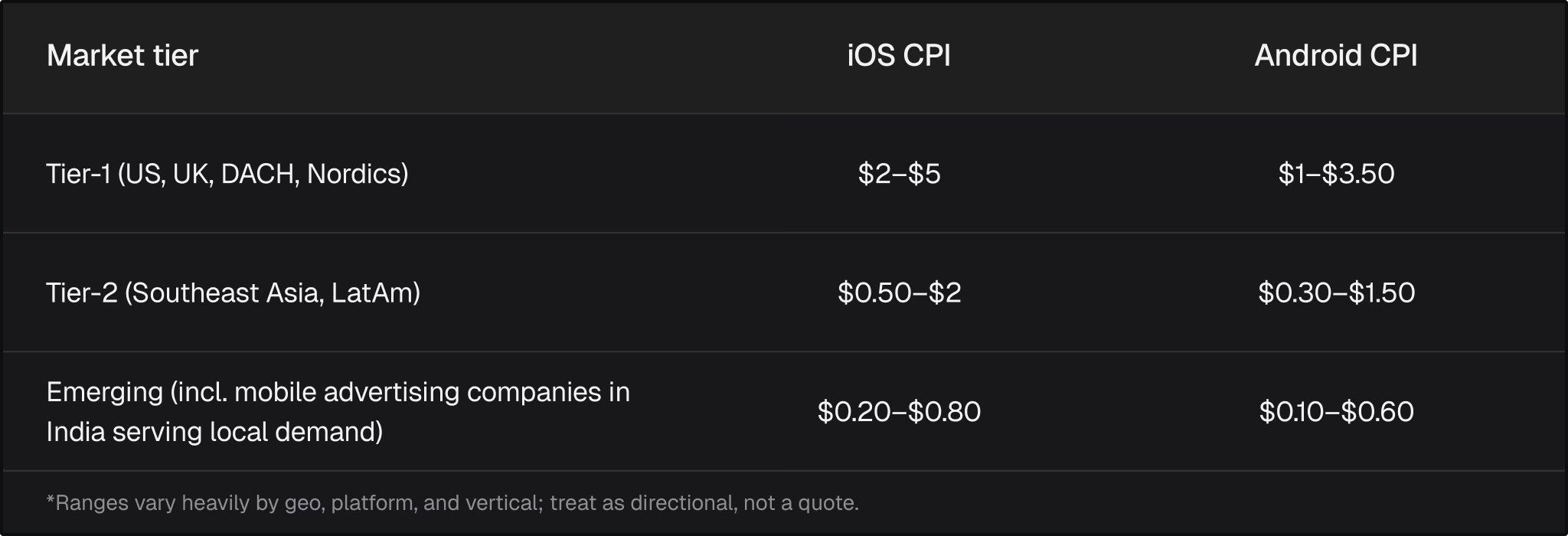
iOS CPI usually runs higher than Android across every tier, with a smaller, more affluent user base competing for the same inventory, and Apple’s Search Ads auction adding another layer of competition on top of Meta and TikTok. Android’s larger, more fragmented user base tends to bring the average down. However, it also brings more variance in user quality, which is exactly why CPI alone is a weak signal; a cheap Android install in an emerging market can still be a highly profitable user if ARPU holds. An expensive Tier-1 iOS install can still lose money if retention isn’t strong enough.
Budgeting works in two stages. Start with a test budget, enough to get statistical signal per creative and audience, typically 50–100 installs per variant before you conclude; going smaller means noise, not signal. Then scale by ROAS, not by CPI alone: a $4 CPI campaign that returns 150% ROAS in 30 days beats a $1 CPI campaign that never pays back. Cutting spend based on CPI in isolation is the most common budget mistake in mobile UA; it optimizes for the wrong variable, and it’s the fastest way to starve a channel that was actually working.
A practical budgeting cadence: allocate 15–20% of monthly UA spend to testing new creative and channels, and scale the remaining 80–85% into whatever already clears your payback target. Revisit that split monthly; a channel that was your best performer in Q1 can decay by Q3 as auction competition and creative fatigue catch up.
Creatives & A/B Testing
Creative decides the campaign more than targeting does. Three formats carry most 2026 budgets: video (still the highest-converting format for both games and apps), playable ads (best for mid-core and puzzle games, let the user try the core loop before installing), and UGC-style clips (native to TikTok and Meta feed placements, and increasingly outperforming polished studio ads on cost per result, if not always on raw click-through rate).
Testing runs the same way across formats:
- Hypothesis: What specific creative element are you testing (hook, first 3 seconds, CTA text, thumbnail)? A test without a stated hypothesis is spending, not learning.
- Variants: 3–5 versions, one variable changed at a time. Changing hook, music, and CTA simultaneously tells you which combination won, not which element mattered.
- Metrics: IPM (installs per thousand impressions) for early signal, CPI for cost efficiency, ROAS for the number that actually matters. IPM moves fastest and is useful for early kill decisions; ROAS takes longer to mature but is the only one that tells you whether a creative made money.
- Iterate, kill the bottom 50% each week, and keep testing the winner against new challengers. Creative fatigue sets in faster than most teams expect; even a strong performer typically needs a refresh within 3–4 weeks as frequency climbs and CTR decays.
This is standard mobile game advertising discipline, and it applies just as directly to gaming app marketing for non-game titles; the loop doesn’t change, only the creative format does. A finance app testing onboarding-flow creative runs the same hypothesis-variant-metric-iterate cycle as a match-3 game testing gameplay hooks.
A good creative checklist: hook in the first 2 seconds, one clear value proposition, gameplay or product shown honestly (mismatched creative, showing gameplay that doesn’t exist in the actual app, drives high day-1 uninstalls and inflates CPI on the metric that matters most, retained users), and a CTA that matches the store listing so the transition from ad to store page doesn’t create friction.
Some mediation platforms bundle native mobile app A/B testing tools for onboarding and pricing flows, which are useful for post-install optimization. However, that’s a separate discipline from creative testing and outside what this guide covers. Worth knowing it exists, and worth treating as a distinct workstream with its own hypotheses rather than folding it into creative test cycles.
Let CAS handle UA & creative production
Organic: ASO
ASO (App Store Optimization) is the one acquisition channel with no CPI; it’s free traffic, funded entirely by getting your store listing right. The levers that move it: a keyword-optimized title and subtitle, an icon that reads clearly at thumbnail size (most store browsing happens on a phone screen, so an icon that only works at full size is a real cost), and screenshots that show the actual product rather than marketing copy dressed up as screenshots.
ASO compounds where paid UA doesn’t. A keyword ranking improvement keeps paying out every day it holds, with no ongoing spend- the opposite of a paid campaign, which stops the moment budget stops. That compounding effect is also why ASO deserves ongoing attention rather than a one-time setup: rankings drift as competitors update their own listings and as store algorithms shift weighting, so a listing optimized six months ago is quietly losing ground even without any change on your end.
The two are not competing priorities. Paid UA drives volume and proves what converts; ASO captures the organic demand that paid campaigns generate as a side effect: users who saw your ad, didn’t convert immediately, then searched for your app by name later. Store conversion rate optimization (screenshots, preview video, ratings prompts) directly improves paid campaign economics too, since Apple Search Ads and Google UAC both send traffic to the same store listing ASO is optimizing.
ASO is also the more durable answer to the discoverability problem for a successful mobile game long after a paid campaign ends: a game that stops advertising but keeps strong keyword rankings and keeps acquiring users; a game that relied entirely on paid UA goes to zero the day spend stops.
Full ASO guide
Monetize While You Advertise
Paid UA and monetization aren’t sequential; they run in parallel from day one. While you’re spending to acquire users, every impression those users see is a chance to earn back part of that spend through in-app ads, which changes the actual payback math on every UA dollar you spend.
Adding ads to your app starts with mediation. Instead of integrating one ad network directly, mediation runs multiple networks in competition for each ad slot, which pushes eCPM up without extra engineering work per network. This is also the more direct answer to how to make an app with ads that actually performs: mediation, not a single hardcoded SDK, because a single network never sees the full competitive picture that a real-time auction across multiple demand sources does.
If you’re asking how to make money with app economics that hold up alongside paid UA, the answer is ad placement strategy as much as network choice: interstitials between natural break points (level completion, not mid-action), rewarded video offered as an opt-in value exchange rather than forced, and banner or native placements that don’t cannibalize the core experience. Placement quality affects both revenue per user and retention; an intrusive ad implementation can generate short-term eCPM at the cost of the long-term LTV that makes the whole UA investment worthwhile.
If the goal is to make an app and earn money from launch, pairing paid UA with in-app ad monetization is the standard playbook; you’re not choosing between acquiring users and monetizing them; you’re running both from the same install. The apps and games that treat monetization as an afterthought, added once UA scale plateaus, consistently leave revenue on the table that a mediation setup from day one would have captured.
See mediation
Measuring Success: ROAS / eROAS
CPI tells you what a user costs. ROAS (return on ad spend) tells you whether that user was worth it: revenue generated divided by spend, over a given window (typically D7, D30, D90). eROAS goes one step further by including ad revenue from in-app impressions, not just IAP; full definition at Glossary. For any app running in-app ads alongside IAP, eROAS is the more honest number; ROAS alone undercounts what a user actually returned, sometimes significantly for hybrid-monetization titles where ad revenue makes up 40–60% of total user value.
Track weekly, not monthly, mobile UA moves fast enough that a month-old read is already stale, and by the time a monthly report flags a problem, you’ve often spent four more weeks compounding it. Scale a cohort when D7 eROAS trends above your payback target for two weeks running; cut it when CPI climbs and eROAS doesn’t follow. Watch for the gap between D7 and D30 signals too; some campaigns look strong early on IPM and CPI, then fade on D30 ROAS once the initial novelty wears off; early metrics are a screen, not a verdict.
A simple weekly review checklist: CPI trend by channel, D7 eROAS by cohort, creative fatigue signals (CTR and IPM decay), and budget pacing against target. Campaigns that fail two consecutive weekly reviews on eROAS are candidates for pause, not further optimization; chasing a losing cohort past that point rarely recovers it and pulls budget from channels that are working.
This is, ultimately, how to make a profitable mobile game: not the lowest CPI, but a payback curve that clears cost within your cash cycle, and a measurement cadence tight enough to catch the difference between the two before it costs real budget.
FAQ
How much does it cost to advertise an app?
Depends heavily on geo and platform; Tier-1 iOS CPI runs $2–$5; emerging markets can be under $0.50. See the CPI table above for full ranges.
What’s the cheapest way to promote an app?
ASO plus organic plus tightly targeted paid spend. ASO carries no CPI; paid should follow once you know what converts, so you’re not paying to discover what organic testing could have shown you for free.
How do I advertise a free app and still earn money?
Add in-app ads through mediation; you monetize impressions from users you’re already paying to acquire, so acquisition cost and monetization work toward the same payback target instead of two separate goals. See [/mediation/].
What’s the best channel for a new game?
Test ad networks and Search Ads first, then scale whichever clears your ROAS target; don’t commit budget to one channel before you have signal on retention and creative performance.
Paid vs. organic: which should I prioritize?
Both run together. Paid gets you scale and speed; ASO gets you efficiency that compounds without ongoing spend, and each channel improves the other’s economics over time.