
Creative at the Speed of AI: What Studios Are Actually Automating in Q3 2026
Half a year ago, AI creative was just a quick UGC-style hook whipped up overnight and tossed into a test with a few human-made versions, mostly to see what would happen. That already feels old. By Q3 2026, AI-generated creative is no longer an experiment. For more and more UA teams, it is the main way things get made. The question is no longer whether it works, but how much of the process can be handed off.
But this shift brings a new headache, and it has nothing to do with creativity. It is about bandwidth.
The bottleneck moved from production to evaluation.
For years, creative testing was slow because every version needed a person to brief, shoot, edit, and export. That took days. Now, AI has compressed that timeline to hours, or even minutes. A UA manager can ask for twenty different hooks, a dozen ways to frame an offer, and a pile of CTAs before lunch is even on the table.
The result is not more creative freedom. It is a traffic jam.
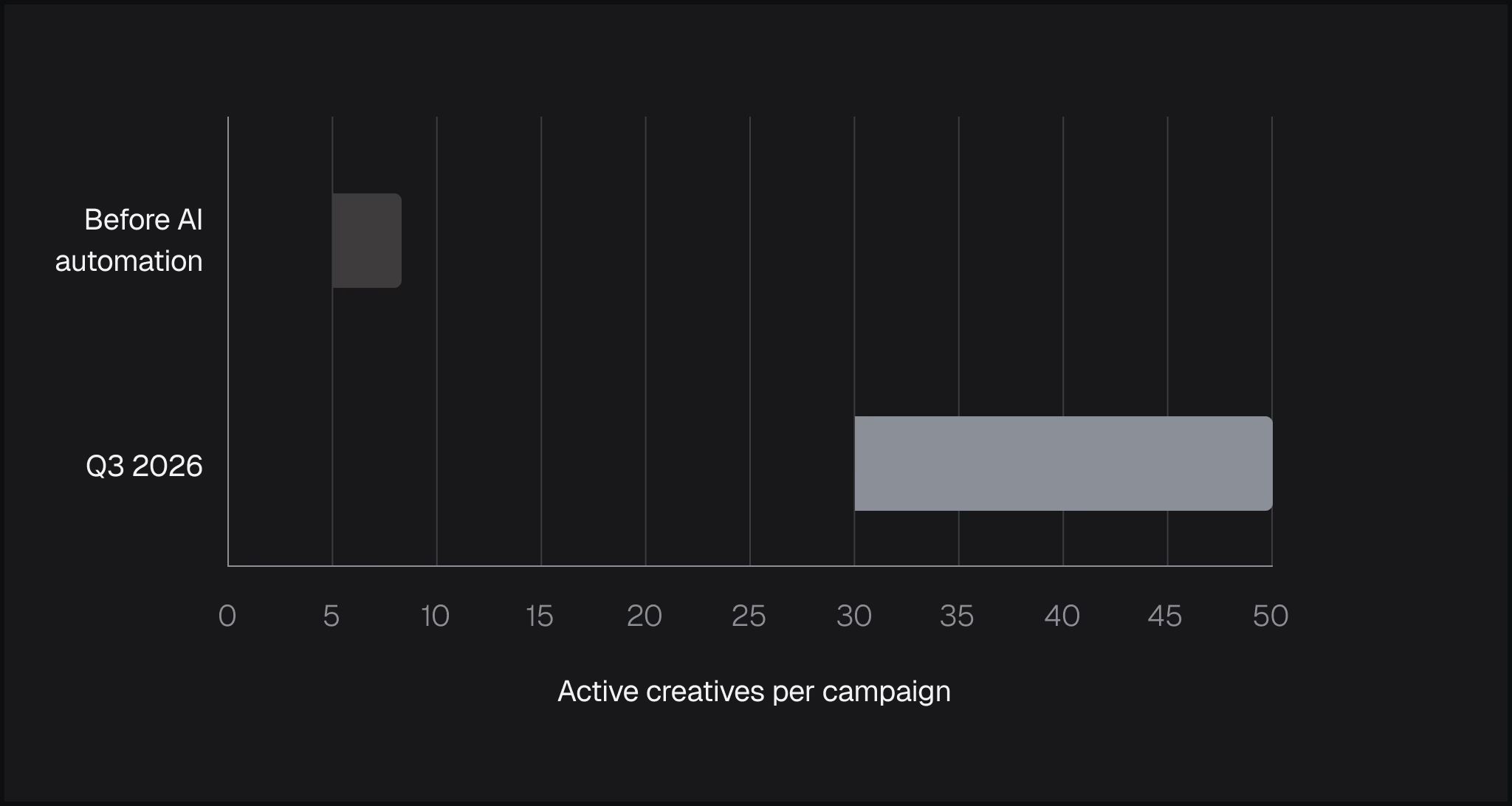
Teams are producing more variants than any human reviewer can watch, tag, and rank in a normal workday. Ad accounts that used to run 5-8 active creatives per campaign are now cycling through 30-50, and the number keeps climbing as generation gets cheaper. The old workflow, a creative strategist eyeballing thumbnails and picking favorites, doesn’t scale to that volume. It was never built to.
So the real automation story in Q3 2026 isn’t “AI makes ads.” It’s “AI makes decisions about ads that used to require a person.” Studios that are ahead right now aren’t the ones generating the most creative. They’re the ones that have automated the parts of the pipeline that decide what happens to a variant after it’s generated: does it get more budget, does it get paused, does it get remixed, does it get retired?
What’s actually in production, not just in demos
A few categories have moved past pilot status and are running as standing infrastructure inside UA teams:
Hook generation and rotation. The first 2-3 seconds of a video ad get the most interaction by far, because that’s where fatigue shows up first. Studios are running hook libraries that regenerate automatically once a hook’s CTR drops below a set threshold relative to its own baseline, not a fixed calendar, but a performance trigger. The generation step is trivial now; the trigger logic is where the actual engineering happens.
Offer and pricing-frame variants. The main creative stays the same, but the value proposition changes. Maybe it is ‘Free trial,’ or ’50 percent off your first pack,’ or ‘Limited time.’ AI makes it cheap to test a bunch of these against the same visual, something that used to mean a dozen separate edits.
CTA text and button copy. This sounds small, but changing CTA copy is one of the easiest and most effective things to automate. You do not have to touch the video itself; swap out the overlay text.
AI UGC ads. Synthetic “creator” testimonials and gameplay reactions, generated at a volume no influencer program could match. The quality gap that made these look obviously synthetic a year ago has mostly closed for short-form hook content; studios report AI UGC now holding its own against human-shot UGC on CTR in blind tests, though retention past the hook still varies more.
Playable ad generation. This is still the trickiest area, but AI-assisted playables are no longer just for the biggest spenders. Now, even mid-sized studios can ask for a playable for a specific campaign without waiting two weeks for developers. Full custom interactivity still needs people, but swapping out templates does not.
What is not on this list is full ad concepts made from start to finish with no human input. That is still mostly something you see in demos, not in real production. The teams getting real results are using AI to generate many versions within a creative direction set by people, not to replace the direction itself.
AI UGC, in more detail
AI UGC is worth a closer look because it changed the fastest this year. A year ago, synthetic creator content was a novelty. It looked fake and was mostly used for shock value in awareness campaigns where being real did not matter much. That has changed in two big ways.
First, the visual and voice quality closed the gap that made synthetic UGC obviously fake: flat lighting, uncanny mouth movement, a voice that didn’t match the face. Second, and more important for UA specifically, teams learned that the format doesn’t need to be indistinguishable from real UGC to work. Users scrolling a feed aren’t running a Turing test; they’re deciding in under a second whether a hook is worth another second of attention. AI UGC clears that bar reliably now, even when a longer, more attentive viewing would reveal it’s synthetic.
This change means studios can now maintain a rotating group of synthetic creator personas, using the same fake identities across a campaign to ensure brand consistency. There is no need for scheduling, contracts, or waiting around like with real creators. This does not replace real creator partnerships, which still bring authenticity and community that AI cannot fully copy. Instead, it is a parallel track for high-volume, fast hook testing that real creator programs were never good at.
Playable ads: the slower-moving category
Playables are still the area where ‘automated’ really means ‘assisted.’ Swapping out art or copy in a template is now quick and easy with AI tools. But if you want a truly new way to interact, something that really showcases gameplay and predicts who will actually play after installation, you still need a developer and a game designer involved.
A new middle ground is opening up: AI can now help create variations within an existing playable. Once a studio has a good playable, it is realistic to automate five or six versions with different difficulty, pacing, or visual themes. That is very different from saying AI can build your playable from scratch. It is important to be clear about this, because if you promise too much, the work ends up back with the developers anyway.
The real breakthrough is in spotting creative fatigue.
If you asked a UA manager in 2024 how they spotted a tired creative, the real answer was usually that CPMs crept up and someone finally noticed. That is slow and reactive, and it means money gets wasted for days before anyone does anything.
The teams that are serious about automating creative in Q3 2026 have matched it with automated fatigue detection. These systems monitor CTR drops, frequency, and CPM changes for each creative and flag problems before a person would even notice them in the dashboard. This pairing is more important than just being more creative. If you generate more versions without a faster way to spot fatigue, you are just burning through more ads in the same slow loop.
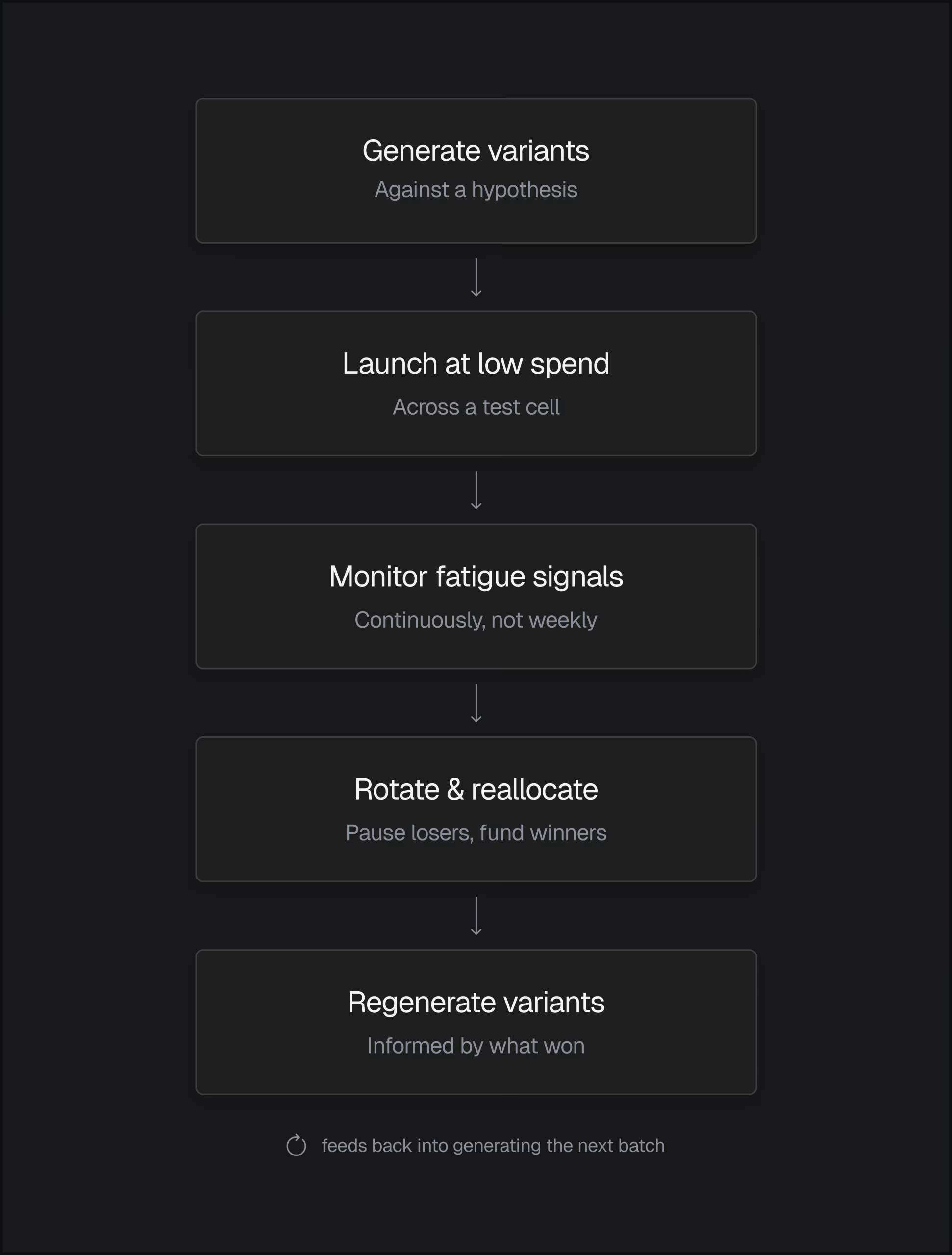
What is emerging now is a closed system, not just a bunch of one-off tasks:
- Generate a batch of variants against a hypothesis (new hook, new offer frame, new CTA)
- Launch at low spend across a test cell.
- Monitor fatigue signals continuously, not on a weekly review cadence.
- Rotate automatically, pause or deprioritize creatives that cross the fatigue threshold, and reallocate budget to winners.
- Regenerate new variants informed by what won, closing the loop.
Studios that treat this as a real system, not just a manual process with an AI tool tacked on at the start, are the ones seeing creative refresh cycles shrink from weeks to days. When you look at it this way, the real bottleneck was never how fast you could make new creative. It was how fast you could decide what to do next.
What fatigue detection actually monitors
“Fatigue detection” gets used loosely, so it’s worth breaking down what the more mature setups are actually tracking, because it’s rarely a single metric:
- CTR decay relative to a creative’s own rolling baseline, not a fixed benchmark shared across the account, since a naturally lower-CTR creative that’s stable isn’t fatigued, and a high-CTR creative that’s declining fast is.
- Frequency and reach saturation: how many times the same users are seeing the creative, which predicts fatigue before CTR visibly drops.
- CPM drift within the same audience and placement: a rising CPM against a stable audience is often the earliest signal, appearing before CTR or install volume moves.
- Comment and engagement sentiment on platforms where it’s available, as a softer leading indicator that a creative is starting to feel repetitive to its audience.
None of these signals alone is enough. The systems that work combine two or three into a single score and use that to decide when to rotate. A small jump in CPM by itself does not mean fatigue. But if CPM goes up and CTR drops for the same audience, that usually means it is time to swap things out.
Where the creative team’s job actually goes
Every creative lead is quietly wondering: if AI makes the variants and an automated system decides what to rotate, what is left for a human creative strategist to do?
The real answer is that the job moves up a level instead of shrinking. The tasks that disappear are the ones nobody liked anyway, like resizing an asset for the eleventh ad format, building a CTA variant by hand, or staring at a dashboard for a CPM blip. What is left, and what is actually getting more valuable, is setting the hypothesis for the automated system to test. That means deciding which emotional angle to try next, which offer framing fits this audience, and when a fatigue signal means you need a small tweak or a whole new creative direction. Automated systems are good at running tests once you give them a clear idea of what to test. They are not good at coming up with the idea from scratch, and that is where a creative strategist still matters.
Teams that have made this shift well all say the same thing. They spend less time picking winners from a list and more time designing the test itself.
Why “which creative wins” is the wrong question
This is where many teams still miss the mark, even with a fully automated system. They are optimizing for the wrong thing.
Install volume is the easiest signal to automate around because it’s fast, it’s clean, and every ad platform reports it natively. A creative that pulls installs at a low CPI looks like a winner within hours. But install volume tells you almost nothing about what happens after the install, whether those users retain, convert, or generate meaningful ad revenue or IAP spend in the following weeks. A hook that attracts high-volume, low-intent installs can look like your best performer in the dashboard and be your worst performer in the P&L.
This is the gap that separates studios genuinely ahead in creative automation from studios that have just automated volume. The former have built (or plugged into) a feedback loop that ties creative performance back to downstream monetization, not just top-of-funnel metrics. The latter are optimizing a fatigue-detection system beautifully against a number that doesn’t actually predict revenue.
Filling that gap demands data that most ad networks don’t hand back to publishers by default: impression-level revenue tied to the creative and cohort that generated it. This is where mediation-layer transparency becomes a creative-testing tool, not just a finance one.
CAS.AI gives publishers a way to see what happens after someone clicks on an ad. It is not just about which version gets the most installs. The real question is which creative actually brings in ad revenue after users start using the app and the data makes its way to the measurement platform. For a user acquisition team juggling dozens of AI-made ad versions every week, this is the difference between chasing a feel-good number and focusing on the revenue that actually matters.
Building the system, not chasing the tool
For teams wondering where to start, the real steps are not about buying an AI creative tool. It is about making a series of infrastructure decisions:
Start with the feedback loop, not the generation tool. If you cannot tell within a day whether a creative’s traffic is sticking around and making money not just installing then making more creatives faster means you are guessing faster. Fix how you measure before you ramp up production.
Set fatigue thresholds based on each creative’s own baseline, not some fixed industry number. If a hook starts at a 4% CTR and drops to 2.5%, it is tired. If a hook always runs at 2 percent, it might be just fine. Automated systems that use absolute numbers often kill off creatives that were never going to be blockbusters but were still solid performers.
Treat hooks and CTAs as the things you test most often. They are cheap to make and have the biggest impact on early funnel numbers, so they are the best place for tight automation. Full creative concepts and playables need a slower, more hands-on approach. The cost of getting those wrong is higher, and saving time on generation matters less than the risk of a bad idea or, not on variant selection. The teams getting the most out of this shift aren’t removing strategists from the process; they’re moving them up a level, from picking winners manually to setting the hypotheses and guardrails the automated system tests against. That’s a better use of a creative strategist’s time than watching a dashboard for CTR decay.
Check what ‘winning’ really means in your dashboards before you ramp up volume. If your team is looking at installs or CPI, making more AI-generated creative will only make you optimize for the wrong thing faster. Make sure you are tracking downstream revenue first.
Common questions on AI creative automation
How is AI creative automation different from just using AI to generate ad copy or video?
Generation is just one step in a bigger loop. Real automation in Q3 2026 pairs AI-made variants with automated fatigue detection and rotation. The system decides what to test next and what to retire, not just how to make assets faster.
What’s the realistic creative refresh cycle for a team running this well?
Teams that have generation, fatigue detection, and rotation all working together are seeing creative refreshes happen in days, not weeks, on their biggest campaigns. This is especially true for hooks and CTAs, since they are cheap to make and have the biggest impact early on.
Does AI UGC actually perform as well as real creator content?
On short-form hook metrics like CTR, AI UGC is catching up quickly and is holding its own in more and more tests. Retention and engagement after the hook still vary a lot, which is why studios are using it as a parallel testing track rather than a full replacement for real creator partnerships.
Why isn’t install volume a good enough signal to optimize creative against?
Because install volume is just the easiest thing to measure, not the thing that matters for your bottom line. A creative that wins on installs can still lose on retention and revenue down the line. To fix that, you need to connect creative performance to what happens after the install, like cohort retention and real monetization, not just top-of-funnel numbers.
The next 6 months
The generation side is only going to get cheaper and faster. That trend is not slowing down. By early 2027, the idea of manually briefing every ad variant will seem as old-fashioned as building waterfalls by hand. The real difference between studios will not be who has the best generation models. That access is leveling out fast, and most of it is just a few API calls away for everyone.
It’ll come from whoever has built the tightest, fastest, most accurate loop between creative output and business outcome. Generation is becoming a commodity. The evaluation layer fatigue detection, cohort-level monetization data, and the discipline to rotate based on signal rather than gut feel are where the actual competitive advantage will sit for the next several quarters.
Studios treating creative as a system, with production, monitoring, and revenue attribution in a single loop, will be able to scale creative volume without scaling waste. Everyone else will just be making more ads faster, but still missing the mark.