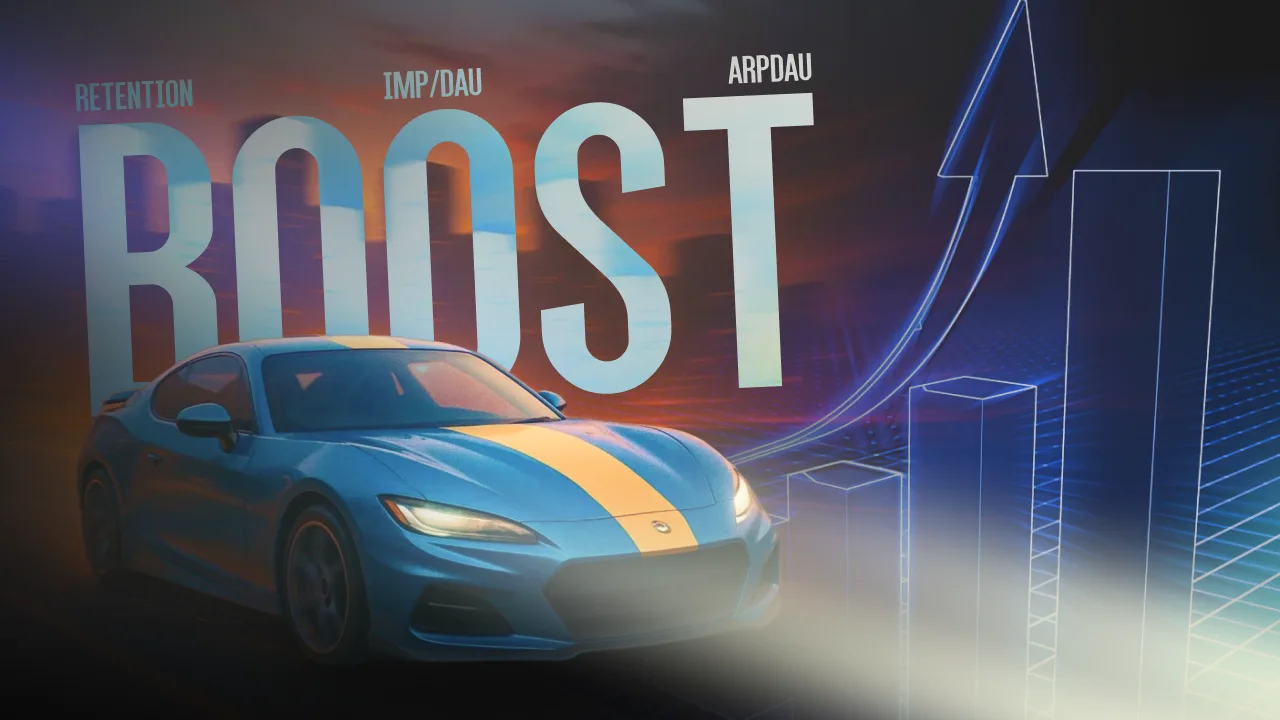
racing growth blueprint: blue car with BOOST text and upward chart showing higher D1/D7 retention, imp/DAU, and ARPDAU

Racing Growth Blueprint: 7 Proven Ways to Boost D1/D7 & ARPDAU

October 7, 2025 5 min read


Practical notes from the CAS.AI team.

Post-launch, many racing games plateau for the same reasons: the run feels predictable, vehicles don’t signal real progress, and the economy doesn’t invite players back tomorrow. This is a practical blueprint for racing game growth after launch—it blends universal principles with field ranges we’ve observed so you can lift D1/D7, imp/DAU, and ARPDAU without rebuilding the whole game.

For additional context on mobile retention and monetization, see
GameAnalytics’ blog.

Industry ranges we’ve seen

  • Career modes can suppress retention by roughly −17–25% even when “easier”.
  • Time-limited events (TLEs) often add +5–6% to races and ad revenue but fade without deeper progression.
  • Multiplayer can sit near ~0.1% of races in casual-leaning titles, while iOS subscriptions may reach ~20% of IAP yet rarely anchor the core loop.

1) Make every run eventful

If the run is flat, the meta won’t rescue it. Your first wins come from injecting small, readable surprises inside the race. Short-lived transformers (e.g., a 10–20s “bike mode” with a narrower hitbox), track punctuation (ramps, lane-split corridors, moving bottlenecks), and reactive hazards (falling objects, patrol helicopters, timed obstacles) create decision density without bloating scope. The result is longer, more memorable attempts and a natural lift to races per session and imp/DAU—gains that outlive any weekend event.

2) Turn vehicles into true progression, not skins

Progress should be felt on the asphalt. Introduce vehicle classes (C/B/A) with deeper upgrade ceilings and occasional class-gated routes. Prioritize meaningful stats—acceleration bands, braking distance, and vehicle width (narrow bodies thread traffic better). Slightly lowering the baseline of the starter vehicle makes early upgrades tangible. When the default unit isn’t a secret best-in-class, players convert sooner, ownership distribution normalizes, and long-term goals become clear.

3) Give each mode its own economy

One currency rarely fits all motivations. Map rewards to behaviors so players circulate across modes for different reasons. Free Ride can fuel soft currency and common parts (low pressure, high volume). Competitive or online modes can add a rare currency for prestige cosmetics or unique parts. Career/Chapters can grant exclusive blueprints and accelerated XP unavailable elsewhere. This separation preserves value, prevents inflation, and diversifies ARPDAU sources over 30–60 days.

4) Shorter runs, cleaner ad cadence

You don’t need more ads—you need smarter timing. Trim average run length to create natural post-fail interstitials. Place rewarded video at tension peaks (revive after crash, hazard skip, blueprint boost) and improve speed readability (velocity cues, danger telegraphing, lane guidance) so players stay in flow. Protect the first minute from intrusive formats. Teams that paired shorter runs with early vehicle re-pricing saw +5–7% ad revenue through more attempts and cleaner breaks.

5) Daily tasks that are actually worth it

Long or stingy dailies train players to ignore them. Redesign for under five minutes and ensure rewards beat a normal run. Rotate task types—distance, near-misses, clean overtakes—to teach the core and highlight mastery. Keep career-style content optional: a path to exclusives, not a gate to racing. When daily rewards rise just above baseline, habit formation resumes and cohorts carry momentum into D7.

6) Events that build retention, not just spikes

Treat TLEs as on-ramps to the long game, not fireworks. Use a progress ladder with pity protection (guaranteed blueprint thresholds), align routes and modifiers with specific class strengths (e.g., narrow-body advantages), and add event-specific rare-currency sinks to prevent value inflation. This turns short surges into steadier ARPDAU and lifts that persist into D7–D14 instead of collapsing on Monday.

7) Test like a portfolio: quick wins and a vertical slice

Avoid the false choice between tiny tweaks and giant features. Run two tracks in parallel. In 1–2-week sprints, tune run length, early vehicle pricing, upgrade costs, ad cadence, and UI clarity—these are compounding wins. In 3–6 weeks, ship an “eventful race” vertical slice: two to three dynamic elements, one transformer, and one rare-currency sink. Cohort-test before global rollout to de-risk scale. Teams that sustain both tracks lock consistent gains within 60–90 days.

What to measure (and how to read it)

Metric Why it matters Target change / Guardrail
D1/D3/D7 retention Habit formation & long-term potential Seek D7 ↑ with stable D1; big D1↑ but flat D7 = event/UA mismatch
Avg. session length Moment-to-moment quality Should rise with “eventful” content; watch fatigue indicators
Races per session Core loop stickiness Upward trend with shorter runs & better cadence
imp/DAU & eCPM Ad supply × price Keep acceptance high; avoid forced mid-flow spikes
ARPDAU (by mode & class) Monetization health Diversify sources; track event vs. non-event
Time to first upgrade / vehicle Early progression Reduce friction; ensure starter nerf isn’t punitive
Ownership distribution Depth of progression Prevent over-reliance on default unit

Red flags

  • imp/DAU ↑ with races per session ↔︎ → monetizing the same play more aggressively, not growing engagement.
  • High D1, weak D7 → the hook is superficial; strengthen core goals and sinks.
  • Large gaps across classes → upgrade economy mispriced or content gating too steep.

30/60/90-day action plan

Days 1–30 (Foundations)

  • Trim run length and move interstitials to post-fail.
  • Improve speed/danger UI; protect the first minute.
  • A/B price the first 8–10 vehicles; soften early upgrade costs.

Days 31–60 (Progression & Economy)

  • Ship classes with visible stat impact (including width).
  • Refactor dailies to <5 minutes with above-run rewards.
  • Add the first transformer and one to two dynamic hazards.

Days 61–90 (LiveOps & Scale)

  • Launch a retention-focused event with a pity track and class synergy.
  • Add a rare-currency sink; extend RV at tension peaks.
  • Roll out the eventful-race slice to larger cohorts; lock wins.

Closing thoughts

Racing games win when the race feels alive, vehicles feel like progress, and the economy invites players back tomorrow. You don’t need a rewrite—just deliberate changes to the core moment, progression, and rewards. That’s how more races per session become higher imp/DAU, stronger ARPDAU, and healthier long-term retention. If you’d like a light review of your plan, the CAS.AI team can quietly suggest next steps.

 

Zoriana Omelchuk
Zoriana Omelchuk Head of Marketing, CAS.AI

12 years in mobile marketing, UA, and ASO.

Last updated: View all articles →

Explore More

eCPM mobile app monetization
AdTech & Monetization

What Is eCPM? Formula, Benchmarks & How to Increase It │CAS.AI

If you're a publisher, eCPM (effective cost per mille) is the revenue you earn for every 1,000 ad impressions. It's calculated with a simple formula: divide total ad revenue by total impressions, then multiply by 1,000. Unlike CPM, a fixed price that advertisers agree to upfront, eCPM reflects what you actually earned after accounting for fill rate, bids, and everything else. But the number alone means little without context. A $1.50 eCPM for a banner in Latin America is not the same as a $1.50 eCPM for rewarded video in the US. Format, geography, platform, and seasonality all move the needle. For publishers, the most reliable way to push eCPM higher? Competition. The more networks bidding on each impression in real time, the better your realized revenue. Publishers who switch to independent mediation typically see revenue per user jump 1.5–2x. That's not theory; that's what the data shows.

January 18, 2026 17 min read
Two mobile phones displaying revenue growth charts and data analytics with promotional text Grow Together, Earn Together for CAS.AI mobile game ad mediation program.
AdTech & Monetization

CAS.AI Launches Referral Program

Grow Together: Introducing the CAS.AI Referral Program Scale your revenue beyond your own games with the new CAS.AI Referral Program. We’re turning community trust into a powerful third growth engine for mobile developers. How it works: • Earn Passive Income: Receive 1% of your referred partner’s ad revenue every month for a full year. • Performance Boost: Refer five or more active partners in a single month to jump your rate to 1.5%. • Guaranteed Start: Your first month’s bonus is guaranteed, with no revenue thresholds applied. • Simple Setup: Partners just enter your account name when signing up at cas.ai/company. Whether you are a studio founder, a mediation partner, or a publishing expert, you can now turn your professional network into recurring yield. [Read the Full Article] Ready to start earning? Log in to your dashboard to find your account name and start referring today.

April 16, 2026 6 min read
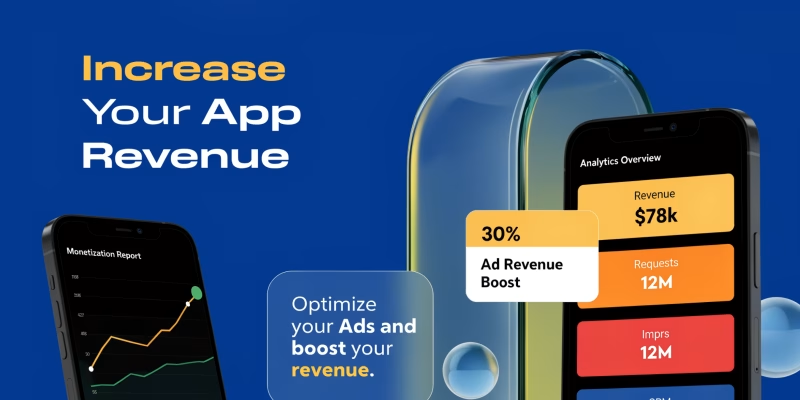
Promotional banner showcasing mobile ad optimization features on a smartphone screen to achieve a 30 percent ad revenue boost for application publishers.
AdTech & Monetization Guide

Ad Mediation: The Guide to Mobile App Monetization

Managing monetization network by network is a grind - multiple SDKs, scattered dashboards, constant eCPM tweaks, and missed revenue. Ad mediation, which manages ads across networks, solves this. With mediation, you get a single SDK and dashboard. Each ad request is sent to multiple networks, bids are compared in real time, and the highest-paying ad wins - no manual prioritization or stale data, just maximum value per impression. The result? Higher eCPMs, better fill rates, and far less operational overhead. Modern platforms combine real-time bidding and waterfall fallback, so every impression is monetized efficiently. Centralized analytics and automated optimization mean you’re scaling performance, not just reacting. Manual setups leave revenue on the table. Mediation isn’t just a tool - it’s the backbone of smart app monetization.

January 4, 2025 14 min read
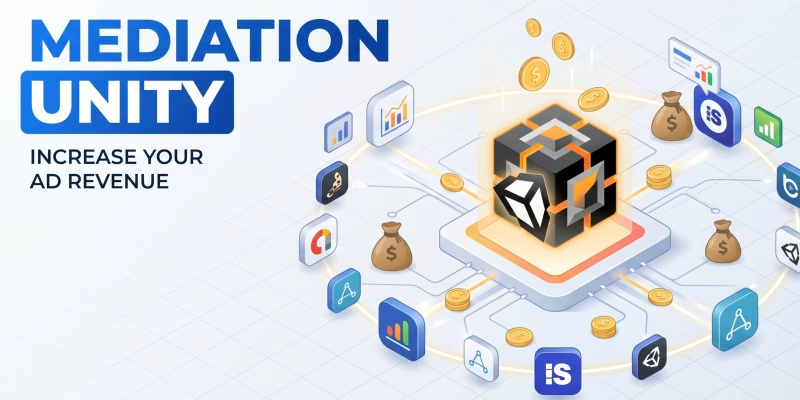
Technical isometric diagram for Unity mobile ad mediation, illustrating the network infrastructure to maximize mobile game ad revenue.
AdTech & Monetization

What Is Ad Mediation for Unity Developers

For Unity developers, ad mediation is the essential technology layer that sits between your mobile game and dozens of global ad networks. Instead of relying on a single provider, mediation connects you to a vast marketplace, triggering real-time auctions for every impression. By polling multiple networks simultaneously, the system ensures the highest-paying ad is always served, significantly increasing your eCPM and fill rates. Modern platforms utilize programmatic bidding (or header bidding) alongside traditional waterfalls to create a competitive environment where 20 to 70+ networks bid for your inventory. For Unity creators, this eliminates single-network dependency and centralizes reporting into one dashboard. Whether you choose native solutions like Unity LevelPlay or high-performance independent options like CAS.AI, implementing a robust mediation strategy is the most effective way to automate growth and ensure you aren't leaving money on the table.

March 8, 2025 5 min read
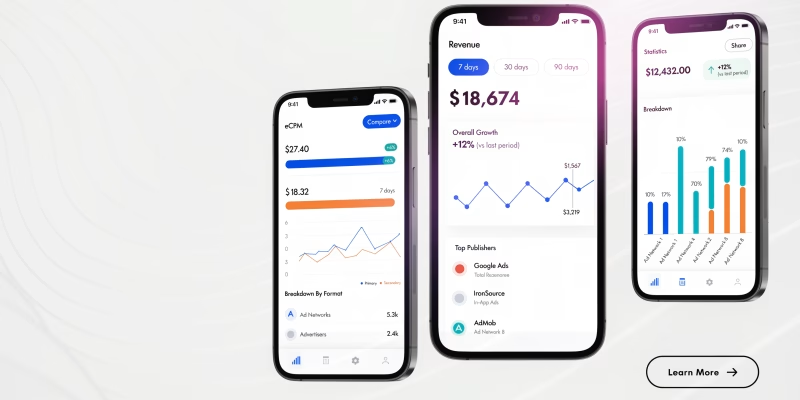
Three smartphone mockups showcasing a mobile ad mediation dashboard with analytics tracking, revenue metrics, and user growth charts for publishers.
AdTech & Monetization

Ad Mediation: What is it & How does it affect Mobile App Monetization

Stop bleeding ad revenue (and ditch the manual mess) Managing multiple ad networks shouldn’t feel like a full-time job. If you’re still juggling fragmented dashboards or manually updating endless SDKs, you’re likely leaving money on the table. Ad mediation is the solution. By consolidating your networks into a single platform, you can automate the competition for your ad slots. Whether you use Waterfall, Real-Time Bidding, or a Hybrid model, mediation ensures that the highest-paying network wins every impression in milliseconds. Our latest guide breaks down: Maximum eCPMs: How bidding drives higher value for your inventory. Seamless Integration: One SDK for Unity, Flutter, React Native, and more. Smart Analytics: Using real-time data to optimize fill rates and ARPDAU. Don’t treat monetization as an afterthought. Build a system that works intelligently on your behalf so you can focus on building great apps.

February 5, 2021 7 min read
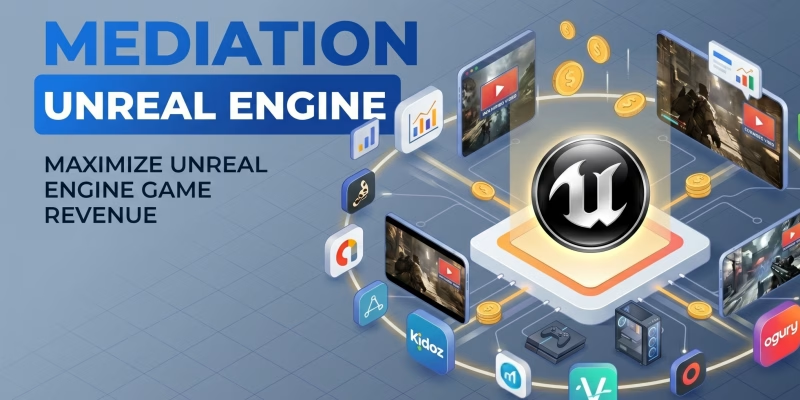
Technical isometric diagram for Unreal Engine mobile ad mediation, illustrating infrastructure to maximize game ad revenue across multiple networks.
AdTech & Monetization

Ad Mediation for Unreal Engine

Building a high-performance mobile game in Unreal Engine is only half the battle; the real challenge lies in effective monetization. Ad mediation is the essential bridge between your game and dozens of global ad networks. Rather than relying on a single provider, mediation creates a live auction environment where networks compete in real-time to fill your ad slots, ensuring you receive the highest possible eCPM for every impression. For Unreal Engine developers, whose games often attract high-value, engaged audiences, mediation isn't just an option—it’s a revenue multiplier. By integrating a solution like CAS.ai, developers can access over 150 DSPs through a single SDK. This independent, programmatic approach removes network bias, leading to reported ARPU increases. With features like a "no-loss" A/B test guarantee and reduced crash rates, ad mediation allows you to focus on gameplay while maximizing your bottom line automatically.

March 8, 2025 5 min read
Abstract 3D digital technology platform block representing ILRD Impression Level Revenue Data for mobile game monetization.
AdTech & Monetization

ILRD Is Not a Setting. It’s the Foundation of Your Monetization Stack.

ILRD isn’t just a setting. It’s the base of your monetization stack. If you’re still looking at yesterday’s aggregate revenue and calling it “performance,” you’re flying blind. In modern user acquisition (UA), seeing $27,000 in daily revenue doesn’t tell you whether your campaigns are profitable, whether your ad frequency test is working, or whether your cheapest advertising channel is quietly hurting lifetime value (LTV). Impression-Level Revenue Data (ILRD), which measures revenue earned per individual ad impression, changes that. It connects every ad impression to a real user, specific device, and the original traffic source, turning return on ad spend (ROAS) optimization, analyzing groups of users over time (cohort analysis), and combining ads with in-app purchases (hybrid monetization) into measurable systems instead of relying on educated guesses. But IRLD isn’t just about turning it on. Waterfall floor math, bidding mechanics, alternative stores like RuStore, and Meta's platform restrictions can introduce discrepancies that quietly corrupt your signal and your UA decisions. In the full article, we break down what’s normal, what’s fixable, and what’s catastrophic. We also show you how to verify your IRLD before every build. If you’re using target Return on Ad Spend (tROAS) in 2026, this isn’t optional reading.

March 6, 2026 11 min read
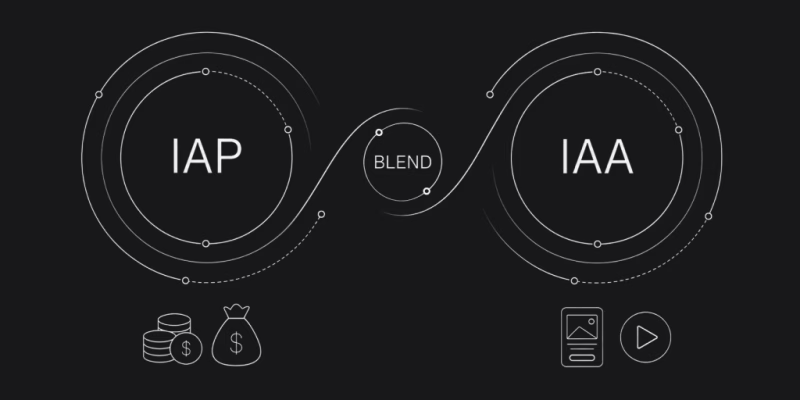
Diagram illustrating a hybrid monetization strategy blending In-App Purchases (IAP) and In-App Advertising (IAA) for mobile apps in 2026.
AdTech & Monetization

Hybrid Monetization 2026: Adapting Your User Acquisition for a Blended IAA + IAP Model

Your UA team is busy chasing D7 ROAS. Product rolls out new IAP bundles. Ad ops keeps adjusting interstitial floors. Each team is optimizing on its own, and the player ends up stuck in the middle. They get hit with ads before they even see a purchase offer. Or they run into a paywall when all they wanted was a rewarded video. Hybrid monetization tossed out the old playbook. You cannot just pick ads or IAP now. The studios that win in 2026 run both at the same time for every player. Now every user has two lifetime value curves, not one. Mediation decides who sees ads, how often, and under what rules. This piece covers where studios slip up when they try to add hybrid monetization to a UA plan that only thinks about one thing. It shows how one mid-core studio rebuilt its stack using entitlement checks and frequency caps for different player groups. There is also a five-step sequence for setting up mediation without ruining the player experience.

August 12, 2026 15 min read
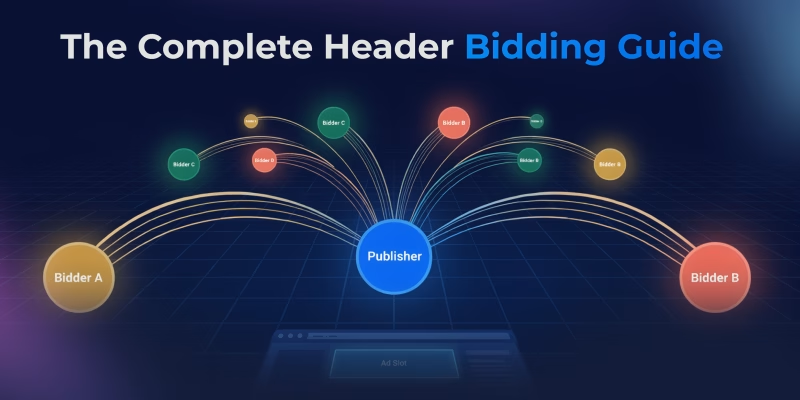
Network node diagram illustrating mobile header bidding mechanics with a central publisher app connecting to multiple programmatic demand sources.
AdTech & Monetization Guide

The Complete Header Bidding Guide

Traditional waterfall mediation is failing modern publishers. By ranking ad networks in a fixed, predetermined order based on historical data, the waterfall model creates a structural revenue leak where higher-paying bidders are often ignored simply because of their rank. Header bidding solves this by flipping the auction model entirely, allowing all demand partners to bid simultaneously before the ad server is even called. Whether you are a hyper-casual game developer or a cross-platform creator using Flutter or Unity, understanding the technical nuances between client-side and server-side auctions is critical. While client-side offers transparency, server-side bidding is often preferred for mobile apps to reduce latency. By integrating header bidding into your ad mediation platform, you move away from managed queues toward a live, competitive market, ensuring you capture the true market value of every single impression.

May 1, 2025 12 min read

Maximize your ad revenue with CAS.AI

Smart mediation platform for mobile publishers and game developers.


6–16 chars · A–Z, digit & special (#!?$%&*()<>.,) · no spaces

Already registered? Your current password may predate these requirements — reset it instead of signing up again. Reset password

 
Telegram
WhatsApp
Slack
Phone